 Doug Bies | Product Marketing Manager
More About This Author >
Doug Bies | Product Marketing Manager
More About This Author >
Doug Bies | Product Marketing Manager
More About This Author >
Doug Bies | Product Marketing Manager
More About This Author >
Introduction: A Regulatory Shift Healthcare Can’t Ignore
Healthcare cybersecurity has reached a regulatory inflection point.
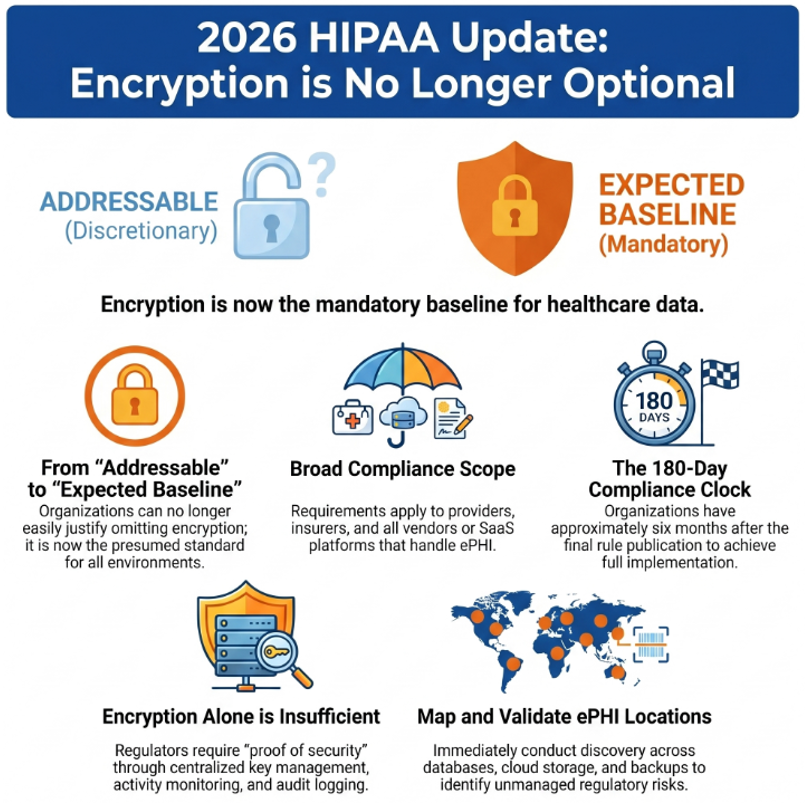
For years, organizations operated under a risk-based interpretation of HIPAA encryption requirements. Encryption was considered “addressable,” allowing regulated entities to determine whether implementation was reasonable and appropriate within their environment. That flexibility is now narrowing.
The proposed update to the HIPAA Security Rule signals a fundamental shift: encryption of electronic protected health information (ePHI) is becoming the expected standard across healthcare environments. Regulators have made clear that encryption is widely available, affordable, and technically feasible, and therefore increasingly difficult to justify omitting.
This shift comes amid escalating ransomware attacks, large-scale breaches, and the designation of healthcare as critical infrastructure. The message is clear: cybersecurity in healthcare is no longer just operational hygiene. It is national resilience.
This article is written for:
- CISOs navigating architecture and enterprise risk implications
- Executives and Boards responsible for oversight and liability
- Compliance practitioners tasked with translating regulatory language into enforceable controls
The implications extend far beyond a technical control update. This is a structural change in how healthcare organizations must design, manage, and prove security.
The Regulatory Turning Point
Historically, HIPAA categorized encryption as an “addressable” safeguard. Organizations could implement alternative measures if encryption was deemed unreasonable or inappropriate. The proposed rule reflects a different regulatory philosophy. Encryption is now presumed reasonable in most environments. If an organization chooses not to encrypt, it must provide strong justification.
In practical terms, encryption is moving from discretionary safeguard to expected baseline. That baseline applies across databases, file systems, cloud workloads, applications, endpoints, and backups.
Why Regulators Tightened Expectations
The regulatory update is driven by measurable risk trends:
- Breaches affecting large populations continue to rise
- Ransomware disproportionately targets healthcare institutions
- Medical data is monetized aggressively on criminal marketplaces
- Healthcare is officially designated critical infrastructure
Regulators no longer view encryption as an IT enhancement. They view it as a fundamental control necessary to protect national healthcare systems and patient trust.
Who Must Comply
The proposed rule applies broadly across the healthcare ecosystem:
- Providers
- Insurers
- Clearinghouses
- Business associates
- Vendors handling ePHI
The final category, Vendors handling ePHI, is often underestimated. Many technology vendors, SaaS platforms, analytics providers, and cloud operators fall into regulatory scope because they create, receive, store, or transmit ePHI. Organizations that do not traditionally identify as “healthcare entities” may now face direct compliance exposure.
The Real Deadline Pressure
Statutory timelines require compliance approximately 180 days after final rule publication. For enterprise healthcare environments with distributed systems, hybrid cloud infrastructure, and legacy platforms, six months is a compressed transformation window. Encryption initiatives involving database environments, unstructured file systems, application-layer encryption, backup archives, and key management redesign cannot be executed effectively under last-minute pressure. Preparation must begin now.
Why Encryption Alone Isn’t Enough
Regulators increasingly evaluate proof of security, not claims of security. Simply stating that encryption exists is insufficient. Evidence is required. And encryption implemented without operational governance creates material risk gaps. Encryption Without Visibility Leaves Gaps:
- Unmanaged keys leave data still vulnerable: Encryption strength depends entirely on key protection. If encryption keys are poorly stored, inadequately rotated, or broadly accessible, the data can be decrypted just as easily by an attacker as by an authorized user. Encryption without disciplined key lifecycle management becomes a false assurance.
- Unmonitored activity allows breaches to go undetected: Encryption protects data at rest, but it does not prevent misuse by authorized insiders or compromised credentials. Without activity monitoring, anomalous access patterns may continue undetected for weeks or months, increasing breach impact and regulatory penalties.
- Inconsistent policies make compliance unverifiable: If encryption policies differ across business units, environments, or data types, organizations cannot demonstrate uniform protection. Regulators increasingly expect centralized control and standardized enforcement. Fragmented implementation undermines audit defensibility.
The Architecture Regulators Expect
Modern compliance architecture must integrate multiple layers of control. Encryption is foundational, but it must operate within a broader governance framework. A Compliant Security Architecture Combines:
- Encryption: Protection of ePHI at rest and in transit across structured and unstructured environments.
- Key Lifecycle Control: Centralized key generation, storage, rotation, revocation, and separation of duties to ensure encryption remains resilient over time.
- Activity Monitoring: Real-time visibility into who accessed sensitive data, what actions were taken, and whether behavior deviates from expected norms.
- Audit Logging; Tamper-resistant, comprehensive logs that support investigations and regulatory review.
- Policy Enforcement; Centralized, consistent enforcement of encryption and access policies across hybrid and multi-cloud environments.
Platforms such as the CipherTrust Data Security Platform from Thales provide centralized encryption, key management, tokenization, and policy enforcement capabilities across enterprise systems. Monitoring capabilities from Thales extend visibility into database and file activity, generating the evidence increasingly expected by regulators.
Encryption must function as part of an orchestrated compliance ecosystem, not as a standalone control.
What CISOs / Executives See vs. What Compliance Practitioners See
The regulatory change impacts different stakeholders in distinct ways.
Leadership Perspective – CISOs and executives primarily see:
- Enterprise risk exposure
Encryption gaps translate directly into breach impact and regulatory liability. - Liability and breach cost
Incident costs include remediation, legal defense, regulatory penalties, class action exposure, and reputational harm. - Board accountability
Boards increasingly demand demonstrable cybersecurity maturity. Encryption posture becomes a governance metric. - Budget prioritization
Security investments must compete for funding. Leaders must justify encryption expansion as risk mitigation infrastructure.Regulatory scrutiny
Clearer requirements reduce interpretation defenses. Enforcement becomes more predictable and potentially more frequent.
Compliance Practitioner Perspective – Compliance teams focus on operational execution:
- Control mapping
Translating regulatory language into measurable technical safeguards. - Audit evidence
Producing documentation that proves encryption is active and consistently enforced. - Documentation burden
Updating policies, procedures, and risk assessments to align with new expectations. - Policy alignment
Ensuring encryption practices match written governance statements. - Gap remediation
Identifying deficiencies and coordinating technical corrections.
Even though this is the same rule, it has a completely different operational lens. Organizations that succeed align both perspectives, ensuring enterprise strategy and compliance execution move in parallel.
In Conclusion
The proposed HIPAA update marks a decisive shift in regulatory philosophy. Encryption is no longer a discretionary safeguard justified through risk analysis alone. It is becoming the foundational expectation for protecting electronic protected health information across the healthcare ecosystem.
Organizations that approach this shift strategically, by combining encryption with key governance, monitoring, logging, and centralized policy enforcement, will strengthen both compliance posture and operational resilience. Those that delay risk compressed implementation timelines, fragmented controls, and heightened enforcement exposure. Healthcare cybersecurity is entering a new standard of accountability. Preparation today determines defensibility tomorrow.
Practical Takeaways
For Practitioners
- Map every ePHI location now
Conduct comprehensive discovery across databases, file systems, cloud storage, endpoints, and backups. Unknown data locations represent unmanaged regulatory risk. - Validate encryption status
Confirm where encryption is active, where it is absent, and where it may be inconsistently deployed. - Document key management processes
Ensure key ownership, rotation schedules, separation of duties, and recovery procedures are formally documented and operationalized. - Verify logging coverage
Confirm that sensitive data access is monitored and that logs are retained, centralized, and protected against tampering.
For Decision Makers
- Fund encryption as infrastructure, not a project
Treat encryption expansion as a long-term architectural investment, not a temporary compliance response. - Require enterprise visibility dashboards
Executive-level reporting should provide measurable encryption coverage and monitoring status across the organization. - Establish executive oversight metrics
Incorporate encryption posture into board reporting and enterprise risk dashboards. - Align legal and security leadership early
Coordinate compliance interpretation, technical implementation, and breach response planning before enforcement expectations intensify.
Steps You Can Take Now
- Visit the following resources:
- Check out self-guided demos CipherTrust Data Security Platform.
- Contact a Thales Data Security Specialist to learn how Thales can help your organization comply with the proposed HIPAA regulations.