What is Manufacturing Cybersecurity?
Manufacturing cybersecurity is the practice of protecting the technology systems used by manufacturing organizations. This includes manufacturing environments — factory floors, production lines, and industrial equipment; the standard IT stack — legacy on-premises environments, cloud and SaaS platforms; and new innovations such as AI and IoT. In addition, because of the nature of its business, manufacturers need to be concerned about the security of their entire supply chain: all the third parties that share information in order to manufacture a product.
What Manufacturing Cybersecurity Protects?
- Operational Technology (OT): Programmable logic controllers (PLCs), industrial control systems (ICS), SCADA systems, sensors, and robotics that physically run production.
- Information Technology (IT): The business systems (ERP, inventory, supply chain software) on premises or in the cloud that manufacturers rely on.
- IoT/IIoT devices: Smart sensors, connected machinery, and other "Industrial Internet of Things" equipment that gathers real-time production data.
- Supply chain systems: Connections to suppliers, logistics partners, and third-party vendors.
Manufacturing Cybersecurity Statistics
The 2026 Thales Data Threat Report Manufacturing edition summarizes the most important findings gathered from a survey of 417 security and IT executives working for manufacturers of all types including durable manufacturing (e.g. automotive, electronics, and machinery) and non-durable (e.g. chemicals, paper), in 20 countries.
67 %
of manufacturers expressed concerns about rapid change in AI ecosystems
Only 31 %
of manufacturers have complete knowledge about where their data is stored
83 %
of manufacturers have five or more data protection tools
2026 EDITION
MANUFACTURING
Thales Data Threat Report
Data security in the agentic age: AI is the new insider threat to manufacturing organizations

How to Improve Manufacturing Cybersecurity with Thales
Accelerate Digital Transformation
Adopt AI, smart devices, multi-cloud environments, and big data faster with a cybersecurity framework built for innovation

Increase Resilience and Efficiency
Automate and streamline data, application and identity protection across cloud, hybrid, on-premises and OT systems
Reduce Risk and Complexity
Simplify compliance and minimize reputational risk with centralized data security governance
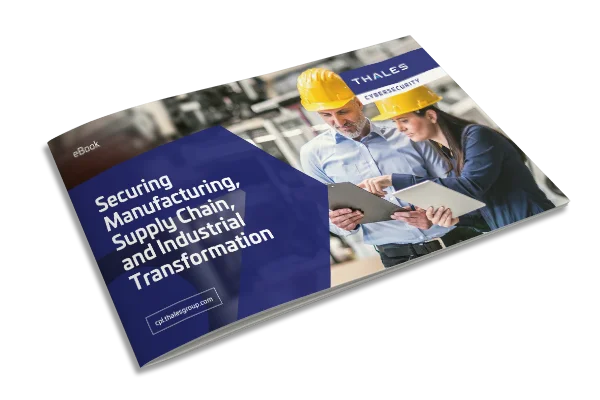
Securing Manufacturing, Supply Chain, and Industrial Transformation - eBook
The growth of cyber incidents is challenging the transformation that is essential to the future of manufacturing supply chains and industrial companies. Thales enables manufacturing, supply chain, and industrial security while enabling innovation, transformation, and increased resiliency.
How can manufacturers prevent data breaches?
Protect identities, credentials and manage access to sensitive assets
Simplify user access to cloud services, streamline cloud identity management, and eliminate password hassles for IT and users, while providing a single pane view of access events across your app estate to ensure that the right user has access to the right application at the right level of trust.
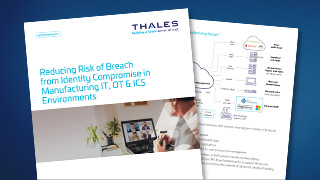
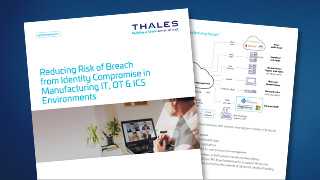
Reducing Risk of Breach from Identity Compromise in Manufacturing IT, OT & ICS Environments
The convergence of IT and OT domains have opened once-siloed OT systems to a new world of threats and risks. Increasingly, corporate networks are inter-connected with Industrial Control Systems, such as SCADA and PLC. Identity and Access Management (IAM) is the security discipline that enables the right entities to access the right resources, either hardware or IT applications, at the right times for the right reasons.
German Manufacturing Group selected SafeNet Trusted Access to move securely to the Cloud
A world leading Original Equipment Manufacturer, with thousands of employees over the world, wanted to move securely to the cloud. Learn how Thales provided a scalable authentication and access management solution to protect their cloud applications and secure remote access to their on premises systems.
Hardware Security Modules (HSMs) for manufacturing security
Thales Hardware Security Modules (HSMs) enable manufacturers to protect multiple aspects of the manufacturing process. From protecting code signing to ensure software used in manufacturing is authentic and approved, to authenticating digital signatures for processes and IoT devices, HSMs protect the manufacturing process across the supply chain.
Identify3D ensures customers’ IP and quality manufacturing with Thales

Identify3D Expands Security Offering with Thales Cloud-based HSM as a Service Solution
A leading software provider for digital manufacturing selects Thales Data Protection on Demand (DPoD) to ensure the security of their customers’ IP and the quality of their manufacturing.
Simplify compliance across Hybrid IT for Manufacturing and Industrial enterprises
Accelerate time to compliance by centralizing data discovery, classification, data protection, and unprecedented granular access controls with centralized key management – all on a single platform. Apply policy-based data and access security based on specific regulation requirements such as the Executive Order to Improve the Nation’s Cybersecurity, the European Union's Cybersecurity Act, GDPR, ISO 27001, SCADA, and more.
Global Automotive Manufacturer Improves Security and Compliance Across Cloud and Legacy Systems
Faced with an increasingly complex and risky cyber security environment, this global automobile manufacturer was able to improve security, reduce the risk of data breaches across the enterprise, and enhance its overall compliance profile with Thales.
Protect sensitive data in motion across Manufacturing and Industrial IT with high speed encryption
Protect data in motion with solutions that provide a single platform to encrypt everywhere, from network traffic between data centers and the headquarters to backup and disaster recovery sites, whether on premises or in the cloud.
A Leading Original Design Manufacturer (ODM) Partners With Thales To Secure Its Data-in-Motion
A leading global ODM generates and transmits volumes of critical business data with its various manufacturing and servicing facilities in Asia, North America, and Europe. Learn how Thales provided trusted security by deploying network encryptors to protect sensitive data across its entire network.
Recommended resources

Frequently asked questions
1. Operational Technology (OT) Meets IT
Modern factories increasingly connect industrial control systems (ICS), SCADA systems, and PLCs to corporate networks and the internet — often called IT/OT convergence. This connectivity enables efficiency gains (remote monitoring, predictive maintenance, real-time data analytics) but also exposes equipment that was never designed with security in mind to network-based attacks.
2. Physical Consequences, Not Just Data Loss
Unlike a breach at a bank or retailer, a cyberattack on a manufacturer can:
Halt production lines, causing costly downtime
Damage or destroy physical equipment (e.g., causing machinery to operate outside safe parameters)
Create safety hazards for workers
Compromise product quality or safety (tampered specifications in food, pharma, or automotive parts)
3.High-Value, Vulnerable Targets
Intellectual property: Manufacturers hold valuable designs, formulas, and trade secrets attractive to competitors and nation-states.
Legacy systems: Much industrial equipment runs on outdated operating systems that can’t easily be patched, since downtime is expensive and systems are often mission-critical.
Ransomware appeal: Attackers know manufacturers will pay quickly to avoid production stoppages, making the sector a frequent ransomware target.
4. Supply Chain Risk
Manufacturers sit within complex, interconnected supply chains. A breach at one supplier can cascade to partners and customers, and manufacturers are often targeted as a weaker entry point into a larger supply chain (as seen in various supply-chain attacks).
5. Regulatory and Safety Standards
Manufacturers are exposed to increasingly strict regulatory requirements around cybersecurity, along with liability concerns if a breach leads to safety incidents. For example, defense manufacturers are subject to regulations such as the CMMC in the United States. Other verticals, like automotive, pharmaceuticals, and all manufacturers deemed “critical infrastructure” have to comply with the NIS 2 in Europe.
6. National/Economic Security
For critical infrastructure sectors (energy, water treatment, defense manufacturing), a cyberattack can have consequences beyond a single company — affecting regional economies or public safety.
1. Ransomware
Malicious software that encrypts systems and demands payment, often exfiltrating data first for added leverage. This is by far the top threat for manufacturers — ransomware accounts for roughly 90% of total incurred losses in the sector, with incidents up sharply year-over-year. Unlike most industries, manufacturers can’t tolerate downtime the way an office-based business can, so attackers know a halted assembly line creates enormous pressure to pay quickly. Average downtime per attack runs into the days, translating directly into lost production and revenue.
2. Phishing
Deceptive emails or messages designed to trick employees into revealing credentials or installing malware. It remains one of the top initial-access methods into manufacturing networks, especially because employees on the shop floor often lack the same cybersecurity awareness or email-filtering protection as office-based staff at other industries.
3. Supply Chain Compromise
Attackers breach a trusted supplier, contractor, or vendor with legitimate access to a manufacturer’s network — including OT environments — and use that access as a backdoor. This is especially dangerous in manufacturing because of how deeply integrated multi-tier supplier networks are with production systems.
4. OT (Operational Technology) Exploitation
Attacks targeting the industrial control systems, PLCs (programmable logic controllers), and machinery that actually run production — as opposed to standard office IT. These systems are often old, difficult to patch, and were never designed with network connectivity or security in mind, making them uniquely fragile once exposed.
5. IT/OT Convergence Risk
The increasing integration of IT networks with OT systems (driven by cloud platforms and IoT) creates operational efficiency but massively expands the attack surface — allowing attackers who compromise a standard email account or laptop to move laterally into production-critical systems.
6. Insider Misuse
Employees or contractors with legitimate access who cause harm, either through negligence or malicious intent. Given how many people touch both IT and OT systems on a manufacturing floor, this is a meaningful and often underestimated vector.
7. Intellectual Property (Data) Theft
Manufacturers hold highly valuable product designs, formulas, and proprietary processes. Nation-state actors and competitors have strong incentive to steal this IP, making data theft a distinct threat from the extortion-driven motives behind ransomware.
8. MFA Misconfiguration
A surprisingly costly and specific weakness: improperly configured multi-factor authentication was identified as the single costliest security gap in the sector, responsible for a significant share of financial losses — showing that even well-intentioned security controls can create risk if implemented poorly.
9. Nation-State Activity
Geopolitically motivated attacks aimed at disrupting critical manufacturing infrastructure or stealing strategic IP — a growing concern given manufacturing’s classification as critical infrastructure.
10. Rapid, Ungoverned AI Adoption
A newer entrant: manufacturers adopting AI tools quickly, often without adequate governance or safeguards, which research shows makes those systems more likely to be breached and more costly when they are.
1. Legacy Systems and Technical Debt
Many industrial control systems (ICS) and PLCs are 15–20+ years old, running unsupported operating systems (Windows XP/7 is still common on factory floors). These systems often can’t be patched without vendor recertification, and some vendors no longer exist to provide updates.
2. IT/OT Convergence
As operational technology gets connected to IT networks and the internet (for remote access, analytics, IIoT sensors), the “air gap” that used to isolate factory equipment disappears — but security practices often haven’t caught up. IT and OT teams frequently use different tools, priorities, and even vocabulary, creating organizational friction.
3. Downtime Aversion
Unlike office IT, a factory can’t easily take a production line offline for a Tuesday-night patch cycle. This means known vulnerabilities often sit unpatched for extended periods, since the cost of downtime is weighed against the (often underestimated) cost of a breach.
4. Hybrid environments and integration risk
Most ,mufacturers now run legacy systems alongside modern cloud platforms simultaneously. This coexistence creates data inconsistencies, system incompatibilities, and fragmented workflows, with sensitive data moving between systems with different security capabilities, widening the window for error or exposure.
5. Lack of Visibility
Many manufacturers don’t have a full inventory of every device on their OT network (asset visibility). You can’t secure what you don’t know exists — and shadow IT/OT devices are common.
6. Supply Chain and Third-Party Risk
Manufacturers rely on numerous suppliers, contractors, and equipment vendors with remote access to systems. Each connection is a potential entry point, and smaller suppliers often have weaker security postures.
7. Skills Gap
There’s a shortage of professionals who understand both cybersecurity and industrial control systems/OT protocols (Modbus, DNP3, etc.) — general IT security expertise doesn’t fully transfer.
8. Safety vs. Security Tension
Security measures (like automatic system lockdowns) can conflict with safety systems designed to keep equipment running in predictable states. Poorly implemented security controls can accidentally trigger unsafe conditions.
9. Ransomware and Extortion
Manufacturing has been one of the most targeted sectors for ransomware in recent years, since attackers know production stoppages create strong pressure to pay quickly.
11. Budget and Prioritization
Cybersecurity often competes with capital investment in production capacity, making it harder to justify spend on something that “prevents a bad thing” rather than generates revenue.