

Proudly Partnering With...





Create new packages, bundles, and pricing offers without code changes. Test, launch, and quickly adjust what you sell as customer needs and market demands change.
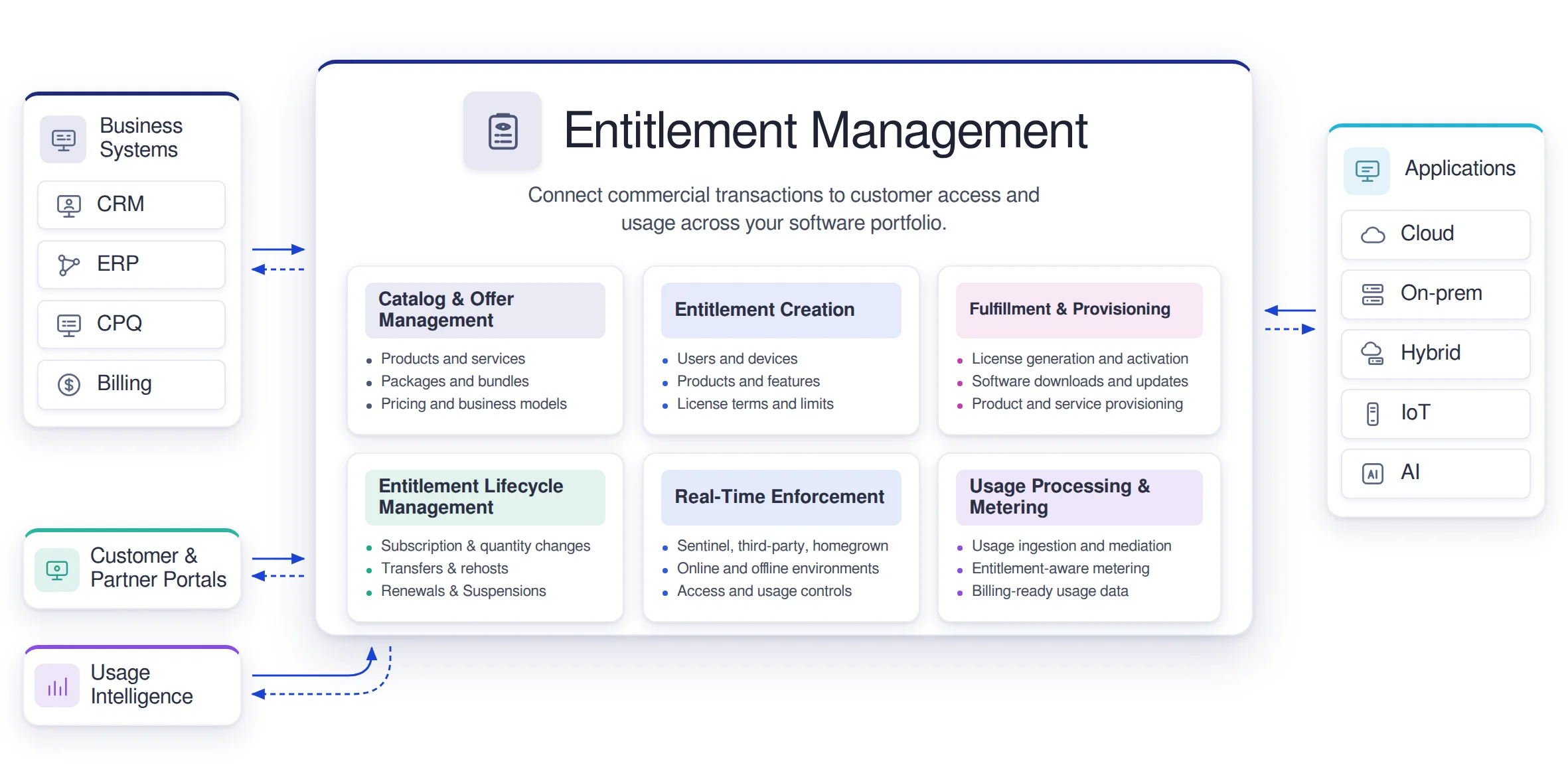
Get a single view of what every customer is entitled to use. Manage rights and changes across your software portfolio from one place, keeping access accurate throughout the customer lifecycle.
Automatically generate accurate, enforceable entitlements as orders come in. Automate fulfillment and entitlement updates across business systems to reduce manual work, delays, and errors.
Gain visibility into what customers own, what they've activated, and how they're using software. Combine entitlement and consumption data to identify upsell, cross-sell, and renewals.
Sentinel EMS combines enterprise-level sophistication with everyday simplicity. Meet your most demanding customer requirements. Win bigger deals. Enter new markets. Take on new challenges without adding more work for your teams.
Define exactly what each customer can access and how they can use it.
Control customer rights with comprehensive, granular permissions in every entitlement. Specify who has access, which products and services they can use, and the commercial terms and usage conditions that apply.
Keep customer entitlements accurate as subscriptions, licenses, and commercial agreements change.
Manage customer rights throughout the relationship, from initial activation through renewals, changes, and expiration.
Configure products, packages, and commercial models to meet different customer needs.
Manage your entire portfolio in one catalog and create offers for different markets, customers, and deployment environments.
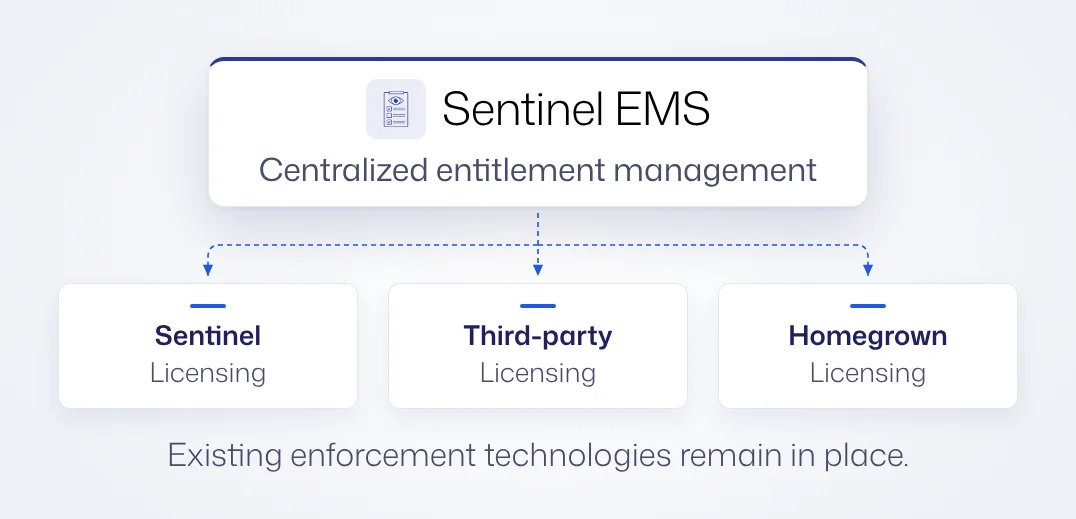
Manage multiple licensing technologies from one system.
Bring Sentinel, third-party, and homegrown licensing technologies under one entitlement management system. Maintain a single source of truth for customer rights across your portfolio, regardless of how individual products enforce licenses.
Turn commercial transactions into accurate customer entitlements and product fulfillment.
Connect entitlement management to your existing business systems so orders, renewals, and commercial changes can trigger the appropriate entitlement and fulfillment processes.
Turn raw consumption data into trusted, billing-ready usage records.
Capture, process, and measure consumption across products and environments. Connect usage records to customer entitlements to support usage-based and hybrid pricing models, accurate billing, and visibility into consumption against purchased plans.
Give customers and partners self-service access to their licenses and entitlements.
Provide dedicated portals where customers and channel partners can access information about the products and services they purchase or distribute, and manage supported activities throughout the customer lifecycle.
Turn consumption data into account growth opportunities.
Give finance, sales, customer success, and product teams trusted information about customer deployments and usage to support account growth and product planning.
Sentinel Pulse delivers usage-based upsell and cross-sell signals directly into your CRM, helping sales and customer success teams identify expansion opportunities based on how customers use your products.
Embed entitlement management into your existing systems and workflows while maintaining centralized control.
Operate Sentinel EMS through user interfaces, APIs, or AI agents, with governed access to products, commercial terms, customer rights, and entitlement data.
Keep the systems and workflows your business already relies on. Sentinel's headless architecture lets your teams manage entitlements through familiar interfaces, APIs, or AI agents. Automate more. Move faster. Keep products, commercial terms, and customer rights managed in one system.

Advanced user interface gives your teams a way to quickly configure and iterate pricing and packaging. Separately, portals let your customers and partners fulfill and manage the products they purchase or deliver throughout the customer lifecycle.

Make your headless systems work together for revenue. Sentinel’s cloud-native, microservices-based platform uses rich REST APIs and webhooks as the connective layer across your commercial systems, so you can launch offers and process changes faster and more accurately.

Sentinel’s native bidirectional MCP support securely connects your LLMs to entitlement data so agents can automate business processes, with fine-grained OAuth permissions controlling what they can access and do.
Integrate entitlement management with your CRM, ERP, billing, and other business systems using prebuilt integrations and flexible APIs.
Combine granular features into products, versions, add-ons, and bundles. Roll out and dynamically update offers as your product and monetization strategy evolves.
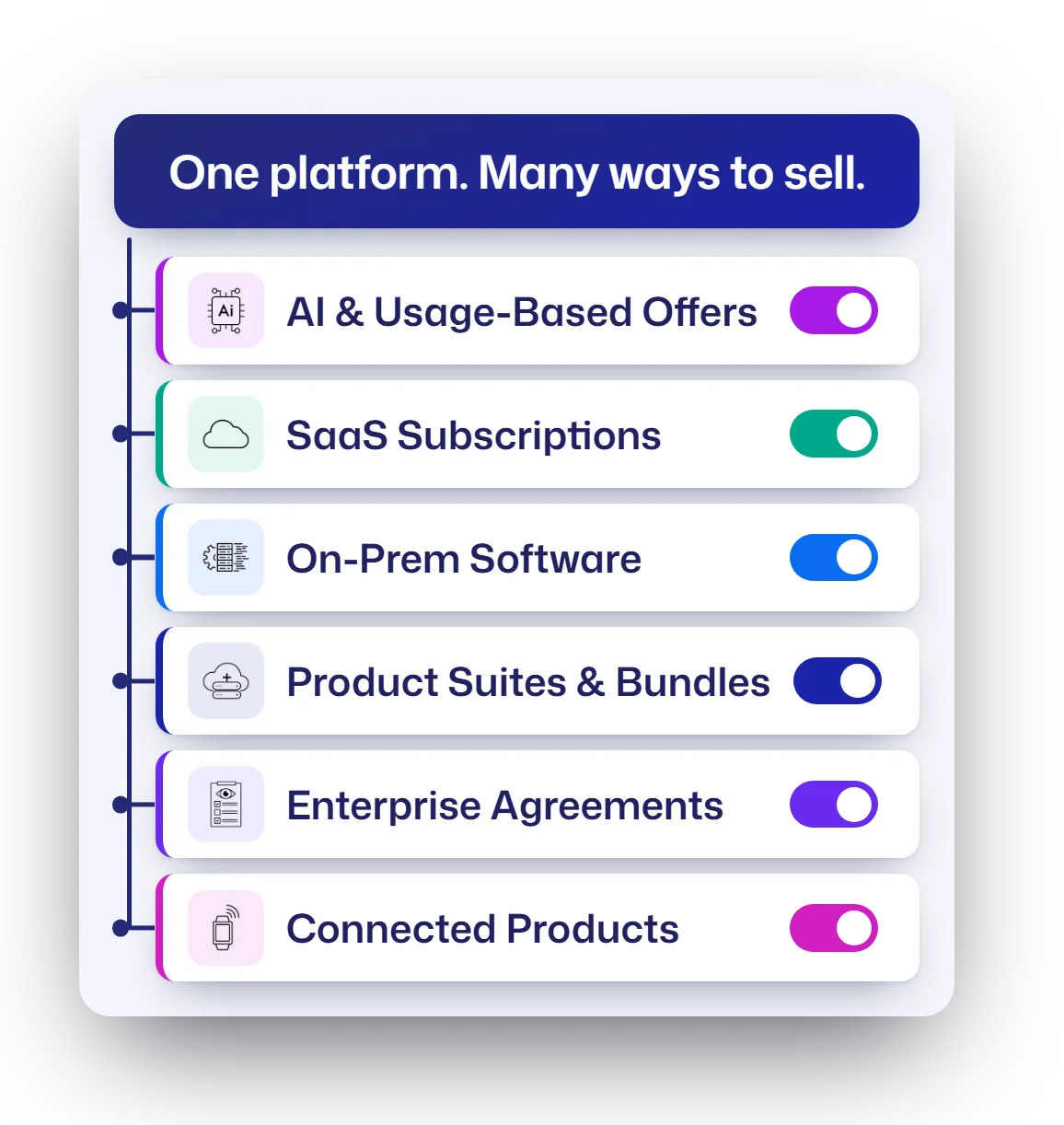
Sell the way your customers want to buy, including subscriptions, usage-based pricing, evolving AI monetization models, perpetual licenses, trials, and hybrid models from the same system.
Package every product you sell, including SaaS, on-premises software, disconnected systems, IoT connected endpoints, and AI edge devices.
Process millions of active entitlements and heavy transaction volumes securely, reliably, and seamlessly as your business grows.
Turn consumption from across your software portfolio into data your business can trust. Sentinel Meter is built into Sentinel EMS, connecting usage to the customer entitlements and commercial terms you already manage. It handles ingestion, mediation, and metering, then delivers billing-ready data and valuable usage insights to your existing business systems.
Most teams choose to deploy Sentinel without extra support. Thales' Professional Services are there for organizations that need more help migrating from a homegrown, competitor, or legacy hardware system — or for those who want a managed program with dedicated specialists. Because you don’t know what you don’t know. But we do.
Identify missed software revenue, define success criteria, and establish a clear case for change.
Technical validation in your environment is important. Proof-of-concept design, integration scoping, and migration planning.
Managed deployment with predictable timelines. Architecture, entitlement setup, and full production readiness.
Continuous strategic partnership post-go-live with a named Technical Account Manager and regular reviews.
See why software vendors trust Thales Sentinel to manage customer entitlements, simplify licensing operations, and support evolving business models across their software portfolios.
“Exceptional Onboarding Support and an Easy-to-Use UI for License Entitlements. What was most helpful for our adoption of Thales Sentinel was the great level and depth of onboarding support by the Thales team. The tool itself gives us an easy to use UI to manage each aspect of creating entitlements integrated into our order system and having the customer activate their licenses.”


Software entitlements define who can access your products, which features they can use, how much they can consume, and for how long. Sentinel Entitlement Management (Sentinel EMS) manages these rights centrally and connects them to your products through features that are linked to enforcement models. You can mix and match these features in different combinations to come up with new product offerings, changing packaging and access terms without reliance on application code changes.
AI software are increasingly being offered in a usage based business model. Sentinel supports usage-based and hybrid models across your portfolio. You can include an AI allowance in a subscription, sell additional capacity, or offer premium AI features while keeping customer rights under central control.
Entitlement management is also important for preventing runaway cost associated with customer use of your AI features. AI features can generate costs with every token, API call, or inference. If you use a usage-based billing model, entitlement management connects that consumption with the commercial terms established in the entitlement and enables runtime enforcement of the limits you set.
Enterprise entitlement management systems, like Sentinel EMS, use a cloud-native, API-first architecture to support multiple products, business units, and deployment environments.
As order volumes grow, automated workflows reduce manual processing. Shared governance helps teams manage entitlements consistently across SaaS, on-premises, hybrid, and embedded products.
Entitlement management is especially useful for businesses managing multiple products, commercial models, or sales channels. It helps software vendors and device manufacturers coordinate customer rights across software, hardware, and services.
Thales Sentinel’s entitlement management system is used by organizations across more than 30 industries, including telecommunications, cybersecurity, industrial automation, medical technology, and IoT. It gives businesses a consistent way to manage entitlements as their portfolios grow.
Sentinel EMS lets you manage commercial offers and customer rights across software, cloud services, hardware, and services such as support and training. Combine products into bundles, apply different business models, and manage entitlements across cloud, on-premises, and offline environments from one platform.
For example, one offer can include an on-premises software license, a cloud subscription, an AI usage allowance, and support. Each component retains its own quantities, terms, and fulfillment requirements. This gives you the flexibility to sell products individually or together and evolve your packaging as your portfolio grows.
Yes. An entitlement system records the rights granted under a licensing agreement and makes them available to the technology that controls product access.
Sentinel EMS works with Sentinel enforcement products (LDK and legacy Sentinel enforcements) and connect to third-party or homegrown licensing systems. Together, these systems can apply feature permissions, license periods, capacity limits, and usage allowances at runtime. to third-party or homegrown licensing systems. Together, these systems can apply feature permissions, license periods, capacity limits, and usage allowances at runtime.
Sentinel automates entitlement fulfillment and connects purchased rights to product enforcement, which ensures customer access is consistent with what was sold. Ensuring customers can only access the software that they were sold prevents overuse byond agreed terms, and therefore reduces revenue leakage.
For channel sales, visibility into delegated entitlements helps vendors maintain control as partners distribute rights to their customers.
Entitlement management helps customers get access sooner and keeps their rights current as purchases change. Robust, enterprise entitlement management systems like Sentinel EMS connect fulfillment, activation, upgrades, and renewals - reducing delays and support requests caused by manual handoffs.
Customer self-service is also enhanced through self service portals that accurately reflect entitlement and usage. Portals, like those that come with Sentinel EMS, give customers a clear and up-to-date view of licenses, access rights, and usage. Automated notifications keep them informed of relevant changes.
Comparing what customers have purchased with what they use can reveal opportunities for expansion. Customers approaching an allowance may need more capacity. Low usage may indicate an adoption issue to address before renewal.
Sentinel EMS makes entitlement and usage information available in Salesforce and Microsoft Dynamics with Sentinel Pulse add-on. Sentinel Pulse delivers account level product engagement insights directly to your CRM so that sales teams can act on high-intent revenue opportunities.
Sentinel captures usage from over 600 formats with online and offline connectivity, then cleans, reconciles, and standardizes the data through advanced usage mediation capabilities. It then meters and connects measured usage to each customer's purchased rights, allowances, and overage terms.
Once the data is cleaned, the processed usage data goes to your existing billing system. In this way, entitlement management becomes a central usage monetization layer, augmenting billing to support pay-as-you-go and subscription-plus-overage models with a consistent record of consumption.
Not all entitlement systems support AI-powered software or autonomous AI agents, but Thales Sentinel EMS fully supports the complex demands of AI-powered applications. While traditional systems struggle with the unpredictable nature of AI workloads, Sentinel EMS provides a modern, cloud-native architecture explicitly designed to handle high-frequency, automated systems.
Sentinel combines central entitlement management with usage collection, mediation, metering, and billing integration. Connected enforcement technologies let vendors apply purchased rights and consumption limits within their products.
For device manufacturers, Sentinel licensing options support embedded and offline environments, including hardware, software, and cloud-based licenses. Vendors can manage perpetual, subscription, seat-based, concurrent, usage-based, and hybrid models across their portfolios. Availability depends on the licensing technology and deployment.
Yes. Sentinel uses events and webhooks to notify connected systems when relevant changes occur. APIs let those systems retrieve current information and perform supported operations.
For example, an entitlement expiry or usage allowance event can trigger a downstream workflow. Delivery timing depends on the integration, connectivity, and receiving system. Retry mechanisms help handle temporary delivery failures.
Look for a vendor that can support growing order volumes, complex portfolios, and the deployment environments your customers need. Evaluate service commitments, security, recovery provisions, integration options, and implementation support.
Thales Sentinel combines central entitlement management with licensing and protection technologies, business-system integrations, and implementation services. That breadth gives you room to add products and commercial models while keeping entitlement operations consistent.
Without an entitlement layer, organizations may need separate SKUs for different product features, deployment methods, licensing models, or configurations. As combinations increase, this can create significant operational complexity.
EMS helps decouple the commercial offer from its technical fulfillment. One commercial offer can therefore map to a richer set of entitlement rules rather than requiring a one-to-one relationship between every SKU and every possible product configuration.
M&A frequently produces fragmented product catalogs, licensing technologies, fulfillment processes, and systems of record. A robust entitlement system, like Sentinel EMS, provides a common operational framework across those products without requiring an immediate rip-and-replace of every underlying technology.
That creates a foundation for presenting acquired and organically developed products as a more cohesive portfolio.