Retail & E-Commerce Cybersecurity Solutions
Reduce risk of ransomware, payment fraud, and PCI non-compliance while adopting AI and the cloud.

Reduce risk of ransomware, payment fraud, and PCI non-compliance while adopting AI and the cloud.
Retail cybersecurity refers to the strategies, technologies, and practices used to protect both physical and digital retail operations from cyber threats. It focuses on retailer’s systems, applications, customer data, payment information, employees, and business operations from cyber threats.
Attackers focus on retailers because they hold vast amounts of valuable information, making them highly lucrative targets for cybercriminals. The most common data stolen includes:
The 2026 Thales Data Threat Report Retail & E-commerce edition summarizes the most important findings gathered from a survey of leaders and practitioners working for bricks and mortar, e-commerce, and omni-channel retail organizations in 20 countries.

2026 Edition Retail and E-commerce
Read more about data security in the agentic age:
AI is the new insider threat to retail and e-commerce organizations




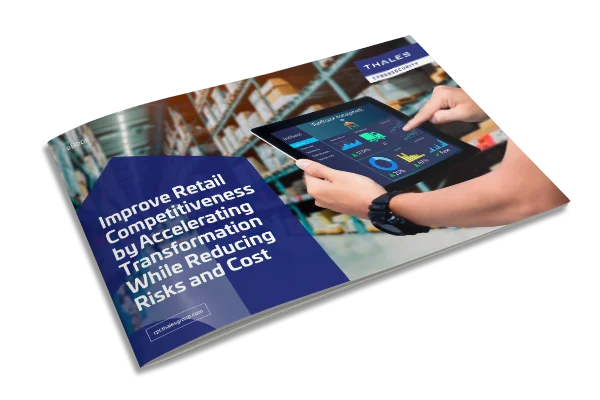
The growth of cyber incidents is challenging the transformation that is essential to the future of retailers. Thales enables retailers to improve competitive advantages by accelerating transformation while reducing risk of data breach, complexity, and cost.
Get the eBook41% of retail traffic is not made up of bad bots that can abuse checkout, pricing, inventory, and loyalty workflows, posing as real shoppers and attacking APIs at scale. Protect your websites, mobile applications, APIs, and customer payment data from automated threats and account takeover attacks without affecting the flow of business-critical traffic.

Learn how Imperva Web Application Gateway (WAF) was deployed to stop attacks to critical customer-facing applications, providing total visibility on attacks, while allowing legitimate traffic through.
Protect cardholder data, personal information, and other sensitive data by discovering and classifying data anywhere and automatically applying the right security to meet requirements such as PCI-DSS or GDPR. Stop ransomware by monitoring and blocking malware before it takes hold with ransomware protection.
Learn how this large department store chain dramatically improved PCI compliance by protecting credit card and other customer sensitive data across multiple systems and locations with the CipherTrust Platform.
Many retailers are increasingly utilizing new technologies such as Internet of Things to enhance customer experience and optimize operations. However, these initiatives could create new vulnerabilities if security best practices are not followed. Thales Hardware Security Modules (HSM) protect transactions, identities, and applications, securing cryptographic keys and provisioning encryption, decryption, and authentication.
A major North American grocery chain with thousands of stores nationwide wanted to improve its cyber security defenses and lower its risk of data breach. The retail chain implemented Luna HSMs to establish comprehensive data security and key management best practices and improve PCI compliance.
Protect data in motion with solutions that provide a single platform to encrypt everywhere, from network traffic between data centers and the headquarters to backup and disaster recovery sites, whether on premises or in the cloud.
A regional grocery chain with hundreds of stores across several states was concerned about ongoing leaks of product pricing and time-sensitive offers. The retailer implemented Thales High Speed Encryptors to provide end-to-end protection for data in motion between main offices.
Get insights from the 2026 Thales Data Threat Report - Retail and E-commerce Edition. Analysis on evolving security challenges, regulatory mandates, and emerging technologies to enhance security.

This paper examines in detail many of the vital Payment Card Industry Data Security Standard (PCI DSS) 4.0 requirements for securing sensitive cardholder data and reveals how the encryption, key management, data protection, and access control products from the Thales Data Security portfolio address them to streamline your compliance needs.
The Payment Card Industry Data Security Standard (PCI DSS) is an information security standard that provides a baseline of technical and operational requirements designated to protect payment data and reduce credit card fraud.
Technological innovation is changing the face of retail, from omni-channel and e-commerce to hyper-personalization and automation. Retailers face a competitive landscape where innovation is key.
Retailers face a unique combination of cyber threats because they manage valuable customer data, payment card information, online transactions, and extensive supplier networks. The most common retail cyberattacks include:
1. Phishing and Social Engineering
Phishing remains one of the most effective attack methods against retailers. Cybercriminals impersonate trusted brands, executives, suppliers, or IT teams to trick employees into revealing credentials, transferring funds, or installing malware. Most attacks, be it ransomware, malware, or supply chain, start with an original phishing attack that compromises credentials.
Retail employees are often targeted because of high staff turnover, seasonal hiring, and broad access to customer-facing systems.
2. Ransomware
Ransomware attacks encrypt critical systems and data, disrupting store operations, e-commerce platforms, warehouses, and supply chains. Modern ransomware groups also steal sensitive data before encryption and threaten to publish it unless a ransom is paid.
For retailers, ransomware can halt sales, inventory management, order fulfillment, and customer service operations.
3. Point-of-Sale (POS) Malware
POS malware is specifically designed to steal payment card data from checkout terminals. Attackers infect POS systems and capture cardholder information during transactions.
Some of the largest retail breaches in history involved attackers compromising POS environments and stealing millions of payment card records.
4. Credential Theft and Account Takeover
Attackers use stolen usernames and passwords obtained from phishing campaigns, previous breaches, or credential-stuffing attacks to gain access to customer and employee accounts.
Common targets include:
5. E-commerce Attacks
Online retail platforms are frequent targets because they process large volumes of customer and payment data. Retailers are especially vulnerable to attacks such as DDoS during high-volume shopping periods such as holidays, major sales events, and product launches.
Common e-commerce attacks include:
6. Supply Chain and Third-Party Attacks
Retailers depend on numerous vendors, logistics providers, payment processors, cloud services, and software suppliers. Attackers often compromise a less secure third party to gain access to the retailer's environment.
As retail ecosystems become more interconnected, third-party risk has become a major cybersecurity concern.
7. Insider Threats
Insider threats can originate from employees, contractors, partners, or increasingly, AI-enabled agents and automated systems with access to sensitive data.
Insiders may intentionally steal information or inadvertently expose data through mistakes or poor security practices.
8. AI-Powered Attacks
AI is making cybercriminals more effective by enabling:
These attacks are increasing both the speed and scale of threats facing retailers.
Retailers can prevent data breaches by taking a layered approach to protecting customer, payment, employee, and business data. The most important measures include:
1. Discover and classify sensitive data
Retailers need visibility into where sensitive information—such as payment-card data, personally identifiable information (PII), loyalty data, and employee records—is stored and processed. Data discovery and classification help prioritize protection based on risk.
2. Encrypt sensitive data everywhere
Encryption should protect data at rest, in transit, and wherever appropriate while it is being processed. Retailers should also use strong, centrally managed encryption keys and avoid hard-coding keys into applications.
3. Strengthen identity and access controls
Use least-privilege access, strong authentication, privileged-access controls, and continuous monitoring. Access should be based on what employees, applications, partners, and devices actually need—not simply on their network location.
4. Protect payment-card data
Retailers should minimize the amount of cardholder data they store and use technologies such as tokenization to replace sensitive payment information with non-sensitive tokens. This can significantly reduce the impact of a breach.
5. Secure third party cloud and SaaS environments
Retailers increasingly rely on cloud platforms, e-commerce applications, SaaS, and third-party services. Security teams need visibility across these environments and consistent policies for protecting data regardless of where it resides.
6. Secure APIs, applications, and e-commerce platforms
Web applications and APIs are attractive targets because they directly interact with customer and payment data. Secure development practices, application security, vulnerability management, API security, penetration testing, and runtime monitoring are important defenses.
7. Monitor for anomalous activity
Continuous monitoring can help identify unusual data access, credential abuse, privilege escalation, large data transfers, and other indicators of compromise. Maintaining detailed audit trails also helps with investigation and compliance.
8. Protect encryption keys and secrets
Encrypting data is not enough if attackers can obtain the keys. Retailers should use dedicated key-management systems and, for high-value cryptographic operations, hardware security modules (HSMs). API keys, passwords, certificates, and application secrets should also be centrally managed.
9. Prepare for ransomware and destructive attacks
Critical data should have protected, tested backups, and retailers should maintain ransomware protection, incident-response and recovery procedures. Backup systems should be isolated sufficiently that an attacker cannot simply encrypt or delete them.