Get in contact with a Data Security Specialist
THALES GLOSSARY
What is Data Encryption?
Encryption transforms sensitive data (e.g., name, address) into an unreadable format known as ciphertext using a mathematical algorithm and a secret key. Encryption can only be reversed by authorized parties who possess the corresponding decryption key. Ciphertext can be a mixture of numbers, characters and symbols and typically requires more storage space than format-preserving tokens.
Enterprise data encryption with centralized control
Whether storing data in a physical data center, private or public cloud, or third‑party storage application, strong encryption and key management are essential to protect sensitive data.
Our CipherTrust Data Security Platform delivers enterprise data encryption for data at rest, in motion, and in use—combining transparent encryption, tokenization, and role‑based access controls across databases, applications, APIs, files, and storage containers. Centralized key management and a hardened root of trust help enterprises protect master keys and keep data secure.
What others are saying
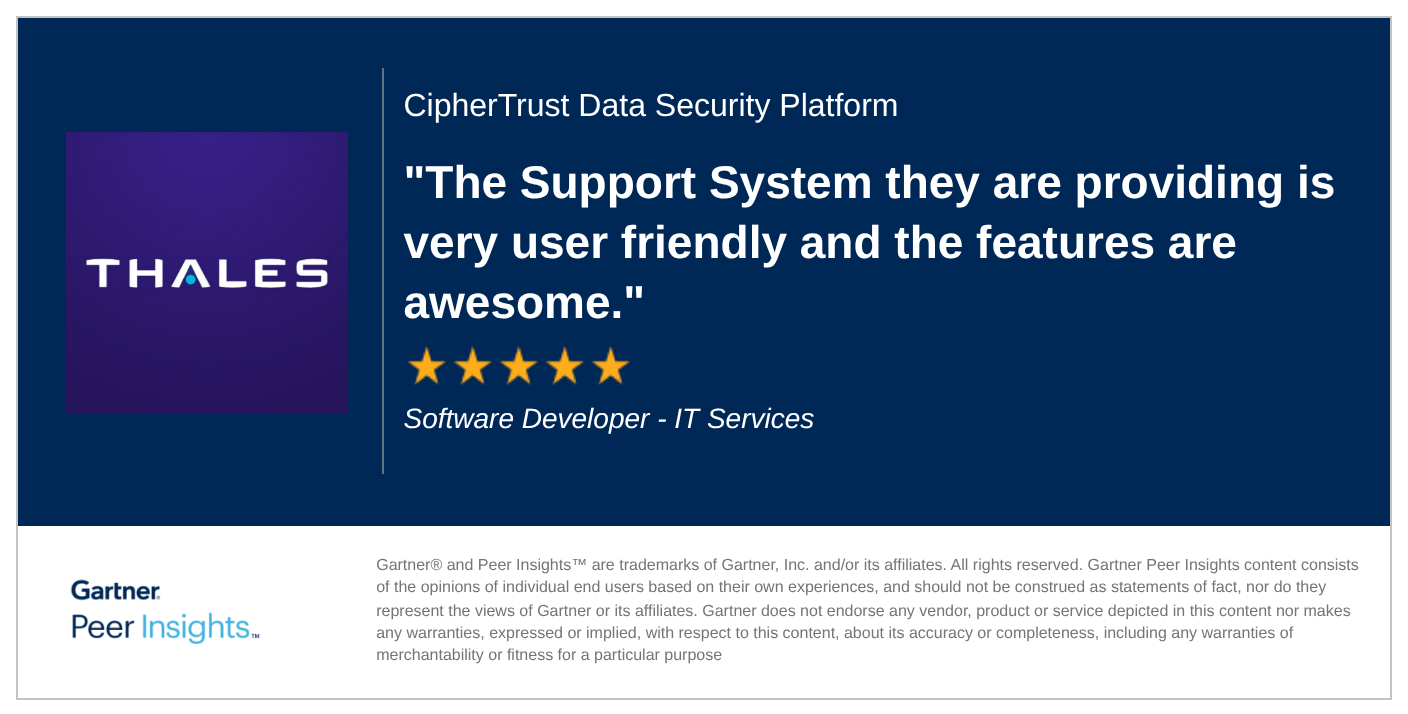
Software Developer in the Software Industry gives CipherTrust Data Security Platform 5/5 Rating in Gartner Peer Insights™ Data Security Platforms Market
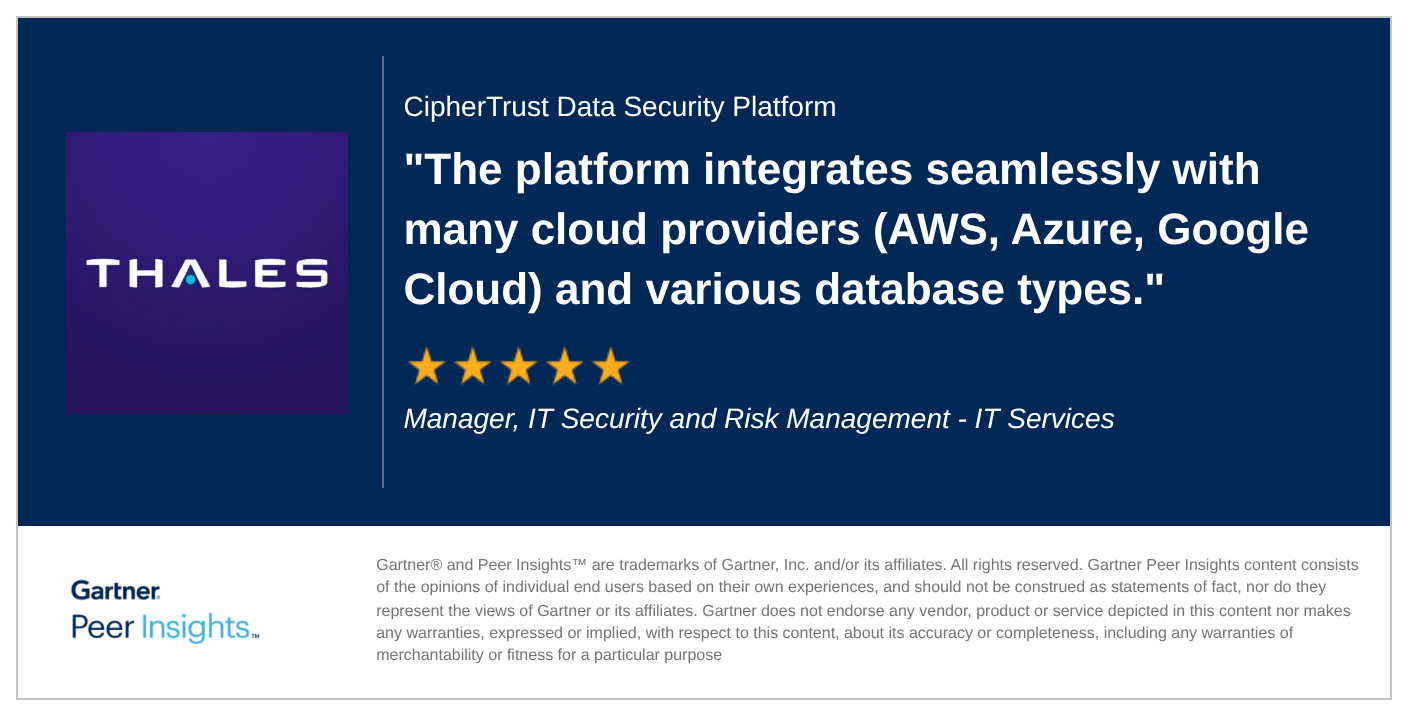
Software Developer in the Software Industry gives CipherTrust Data Security Platform 5/5 Rating in Gartner Peer Insights™ Data Security Platforms Market
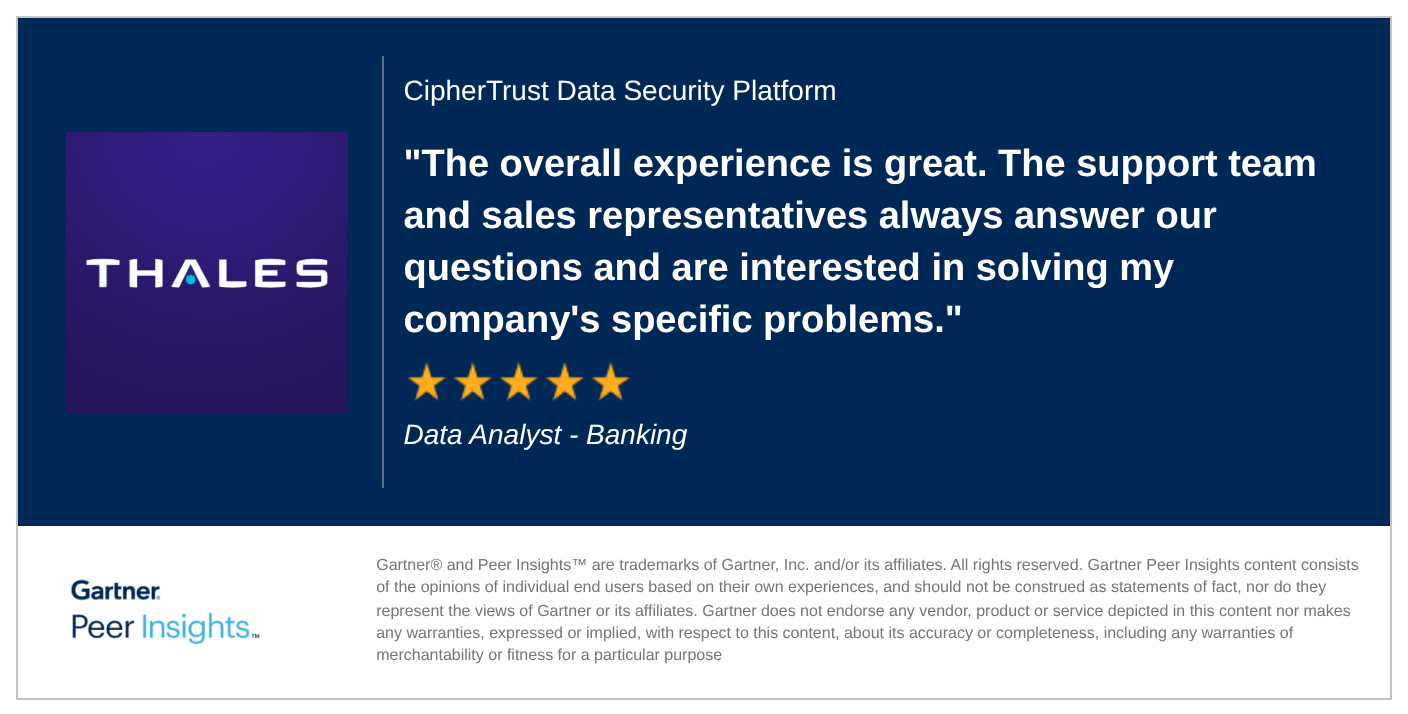
Software Developer in the Software Industry gives CipherTrust Data Security Platform 5/5 Rating in Gartner Peer Insights™ Data Security Platforms Market
Enterprise-grade data encryption that scales with your business
Protect sensitive data everywhere with unified encryption, key management, and centralized controls across hybrid environments.

Comply with regulations
Meet global data protection and privacy requirements such as GDPR, HIPAA, and PCI DSS with encryption and key management designed to support audits, reporting, and policy enforcement—helping teams demonstrate compliance while reducing operational burden.

Reduce breach risk
Protect sensitive data from insider threats, ransomware, and compromised credentials with strong encryption and tokenization. Keep data protected even if attackers gain access, minimizing exposure and reducing the impact of security incidents.
Secure data on premises and across clouds
Apply consistent data protection across on‑premises, hybrid, and multi‑cloud environments. Eliminate security gaps as data moves between platforms, while maintaining control and flexibility to support modern enterprise architectures.

Streamline encryption operations
Simplify encryption management with a unified platform for keys, policies, and controls. Reduce complexity, eliminate silos, and scale data protection efficiently as environments, data volumes, and compliance demands expand.

Control data sprawl
Gain visibility into where sensitive data lives across structured and unstructured environments. Discover, classify, and monitor data to eliminate blind spots, reduce risk, and maintain control as data volumes and locations continue to grow.

Enforce access controls
Ensure only authorized users and applications can access sensitive data using role‑based access controls and centrally managed policies. Enforce least‑privilege access consistently to reduce misuse, insider risk, and unauthorized exposure.
Get Started
Enhance your security posture with enterprise-grade data encryption
Forrester Total Economic Impact of Thales CipherTrust Data Security Platform
Cost Savings and Business Benefits Enabled by the CipherTrust Data Security Platform

Prior to implementing CipherTrust Platform, we struggled with encrypting and tokenizing data spread across such a complex IT landscape, but CipherTrust Platform has made it possible to centralize all encryption and key management across all platforms.”
How organizations prevent data exposure with CipherTrust Data Security Platform
Encrypt enterprise databases without application changes
Protect sensitive data stored in enterprise databases using CipherTrust Transparent Encryption, a data‑at‑rest encryption solution that secures database files without modifying applications or schemas. Maintain performance while protecting regulated and sensitive data.
Secure data exchanged through APIs and services
Protect sensitive data in motion as it flows between applications, services, and microservices using CipherTrust Application Data Protection. Secure API requests and responses without rewriting application code, ensuring encrypted data exchange across modern architectures.
Protect production data copied into non‑production environments
Prevent exposure when production data is copied into development, testing, analytics, or AI training environments. Use CipherTrust Transparent Encryption and CipherTrust Data Masking to protect sensitive data while supporting safe data reuse.
Publish usable datasets without exposing sensitive fields
Enable secure data sharing by removing sensitive information before datasets are distributed. Apply CipherTrust Data Masking and Redaction to permanently mask PII and confidential fields across databases, files, and analytics datasets.
Control access to cleartext data in shared systems
Limit who can view sensitive data in cleartext across enterprise databases and applications. Use CipherTrust Key Management and policy‑based controls to reveal, mask, or encrypt data based on user role, application, or context.
Security that integrates with your technology ecosystem
With one of the industry’s largest cyber security technology ecosystems, Thales solutions integrate with the most widely used technologies to protect and secure access to your mission-critical applications and data.





















Explore the CipherTrust Data Security Platform portfolio
CipherTrust Application Data Protection
Application Data Protection empowers developers to easily add application-level protection.
CipherTrust RESTful Data Protection
Simplify data protection and allow developers to call a data protection method without having to manage security themselves.
CipherTrust Data Protection Gateway
Protect RESTful web services and microservices with no change to code, ever.
CipherTrust Transparent Encryption
Secure files, volumes, and linked cloud storage across your environment through data-at-rest encryption.
Related Resources
Encryption helps organizations reduce the impact of ransomware by preventing unauthorized access to sensitive data and limiting the usefulness of stolen information. When combined with centralized key management, access controls, and security monitoring, encryption creates multiple layers of defense that help organizations maintain control of critical data even if systems are compromised.
Encryption converts sensitive information into unreadable ciphertext that can be restored with a cryptographic key. Tokenization replaces sensitive data with non-sensitive tokens, while data masking hides or obscures specific information from users. Organizations often use these technologies together to protect data, reduce compliance scope, and secure sensitive information across applications, databases, and cloud environments.
Organizations can maintain control of encryption keys across multiple cloud providers through centralized key management. This approach allows security teams to enforce consistent policies, manage key lifecycles, support compliance requirements, and reduce dependence on cloud-provider-managed keys. Centralized key management also improves visibility across hybrid and multi-cloud environments.
AI, machine learning, and analytics platforms often process large volumes of sensitive business and customer data. Encryption helps protect that data during storage and processing while supporting privacy regulations and internal security policies. Organizations increasingly use encryption and centralized key management to secure AI training data, analytics environments, and cloud-based data pipelines.
The right encryption approach depends on where sensitive data resides and how it is used. File-level encryption can protect unstructured data, database encryption secures structured information, application-layer encryption protects data before storage, and network encryption safeguards information in transit. Many organizations adopt a layered strategy that combines multiple encryption methods with centralized key management for comprehensive protection.