 Thales | Security for What Matters Most
More About This Author >
Thales | Security for What Matters Most
More About This Author >
Thales | Security for What Matters Most
More About This Author >
Thales | Security for What Matters Most
More About This Author >
You book a plane ticket, breeze through the e-gate, connect to airport Wi-Fi, check into the hotel, and once at your destination, you end up sipping a cocktail by the pool while checking out your bank account online.
It all feels effortless.
Travel today is a carefully orchestrated digital experience, with most of the friction removed from the customer journey. What most people never see is the security infrastructure working behind the scenes to make that convenience possible.
Whether it's keeping online booking systems safe from bots, verifying identity at borders, or ensuring that digital footprints created along the way are secure, digital trust is just as important for travel as passports and luggage.
Summer holidays may involve more security checks than you realize.

The Booking: When You Compete With Robots for Your Hotel Room
The first challenge of your summer holiday often arrives before you've even packed your bags.
Airlines, hotels, and travel platforms face enormous volumes of automated traffic every day. Some of it is helpful, such as search engine crawlers and service integrations, which keep the digital ecosystem running. Much of it is not.
According to the 2026 Thales Bad Bot Report, bots accounted for 53% of all web traffic in 2025, with the biggest share being bad bots (40%).
Most never see the attack itself, but you certainly experience its symptoms: a booking site takes forever to load, prices shoot up from what they were an hour ago, and the number of available seats drops to zero. Under the hood, automated tools may be scraping prices, testing stolen credentials, monitoring inventory, or trying to make fraudulent bookings.
It’s no surprise that attackers are eyeing travel companies. They combine high transaction volumes with time-sensitive purchasing decisions. Nobody wants to waste time on a glitchy booking platform when they're trying to get their hands on that last available seat on a flight.
Application security and bot protection step in here to help separate genuine travelers from automated abusers. Their job is to block malicious traffic and, importantly, preserve the customer experience by ensuring genuine holidaymakers can access services without competing with armies of bots.
The irony is that when these systems work well, nobody notices them. The booking completes successfully, and the countdown to your summer holiday begins.

The Airport: Your Face, Your Passport, and Three Seconds of Trust
Few travel experiences have changed more over the years than airport border control. Endless queues, manual passport inspections, and repeated document checks are being replaced by automated e-gates. For travelers, the process is painless. Scan your passport, look at the camera, and stroll through in a matter of seconds. The technology underneath is doing the heavy lifting.
Modern electronic passports have a secure chip holding digital identity information protected by cryptographic certificates. When you present your passport at an e-gate, the system verifies that the document is genuine and that you match the biometric information associated with it.
It is an ideal example of identity verification infrastructure operating at such a scale. Millions of people pass through airports each day, and digital identity systems are built to establish trust quickly without creating friction.
Most people only think about this technology when something goes wrong. But the more revealing measure is how rarely it does. Millions of border crossings happen daily, each one quietly resolved by the same identity infrastructure that once required a human and a stamp.

The Hotel Check-in: Your Room Key Moved to the Cloud
The humble hotel key has also changed over the years. Today, a plastic card is no longer the norm. Guests can check in through an app, get a digital room key on their phone, and head straight to their room without visiting reception.
Convenient? Absolutely. Simple? Not necessarily.
The moment hotel services go digital, guest information begins moving across a much larger technological landscape. Booking details, payment information, loyalty program data, room access credentials, and stay history are stored, transmitted, and shared across multiple systems.
Protecting that information is vital. The 2026 Thales Data Threat Report found that only 34% of organizations have complete knowledge of where their data is stored. This is important because visibility is the starting point for security. You cannot effectively protect data if you do not fully understand where it lives.
There are many tools that allow convenience and security to peacefully coexist. Encryption, access controls, authentication, and data governance policies limit the risks of modern hospitality platforms, even as guest data moves between the cloud, mobile apps, and third-party services.
Room keys may have changed, but the responsibility to protect guest information has not.
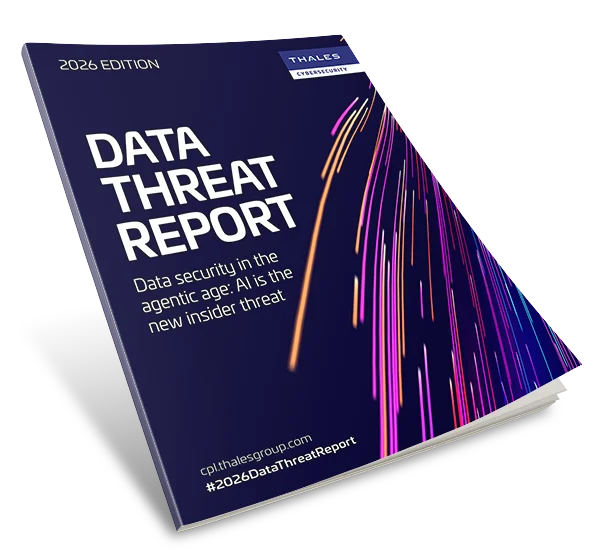
2026 Edition
Thales Data
Threat Report
Data security in the agentic age:
AI is the new insider threat
Out and About: The Wi-Fi Password Everyone Knows
The final stage of the journey has the most invisible risks.
Holiday routines relax more than the way we dress. Holidaymakers connect to public Wi-Fi networks, access banking apps from unfamiliar locations, sync their digital wallets, share photos, and update their location on social media. These are all normal parts of travel, but they generate a surprising amount of data. Every connected service relies on information about identities, locations, devices, transactions, and behaviors. Some of that data helps create better experiences, some helps prevent fraud. All of it needs protection.
The challenge goes beyond securing a hotel network or airport hotspot. Information must be protected as it moves between devices, applications, cloud platforms, and service providers. Consumers understand the importance of these experiences. The 2026 Thales Digital Trust Index found that 68% of people have abandoned or switched away from a company online because of issues with its website or app.
Trust, it turns out, is as important as convenience.
Before your holiday snaps appear on social media, various systems for authentication, authorization, and data protection will have done their jobs. The cocktail, at least, was entirely your own work.