Get in contact with a Data Security Specialist
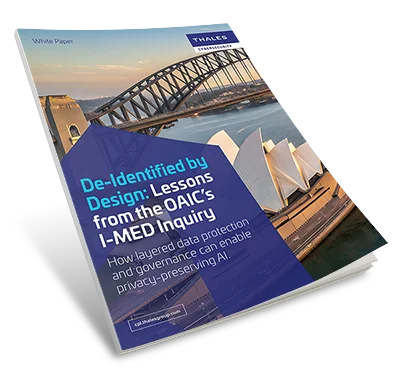
De-Identified by Design: Lessons from the OAIC’s I-MED Inquiry
How layered data protection and governance can enable privacy-preserving AI.
Organizations adopting artificial intelligence (AI) must find ways to use sensitive data for model training and development without exposing personal information. The Office of the Australian Information Commissioner's (OAIC) inquiry into I-MED and Harrison.ai provides valuable lessons on how layered technical and governance controls can reduce re-identification risks when sharing diagnostic imaging data.
This white paper examines the OAIC's findings and explores practical approaches to privacy-preserving AI, including data discovery, de-identification, tokenization, encryption, masking, access controls, and ongoing monitoring. Learn how Thales CipherTrust Data Security Platform helps organizations protect sensitive information, strengthen data governance, and prepare datasets for AI initiatives while supporting compliance and responsible innovation.
What you will learn:
- What the OAIC's I-MED inquiry reveals about de-identification and re-identification risk.
- Which technical and governance controls help protect sensitive data used in AI training.
- How tokenization, encryption, masking, and redaction support privacy-preserving AI.
- How to enforce access controls, separation of duties, and monitoring across sensitive datasets.
- How to apply a layered data security approach to support AI innovation and regulatory expectations.