What is fine-grained authorization (FGA)?
Fine-grained authorization (FGA) defines who can access what, and under which conditions, at the level of individual resources such as APIs, transactions, or data fields.
Access decisions are evaluated dynamically at runtime using policies that consider identity attributes, resource attributes, and contextual signals. This enables precise, context-aware access control without embedding authorization logic into application code.
Flexible authorization for complex digital services
Static role-based access control (RBAC) cannot meet the demands of modern digital services, especially when managing third-party and external access. Roles become too broad, difficult to maintain, and unable to reflect real business relationships.
Fine-grained authorization (FGA) enables organizations to define access policies based on users, resources, and context, and enforce them consistently across applications, APIs, and data.
Benefits of fine-grained authorization
Standardized authorization and consistent security
Centralize policy definition and enforce consistent access decisions across APIs, applications, and data layers
Relationship-based access control
Define access based on relationships, attributes, and context, not just static roles
Agile policy management
Update access policies without changing application code, enabling faster response to business and regulatory changes
Enforce fine-grained authorization with Thales Policy-based Authorization Manager
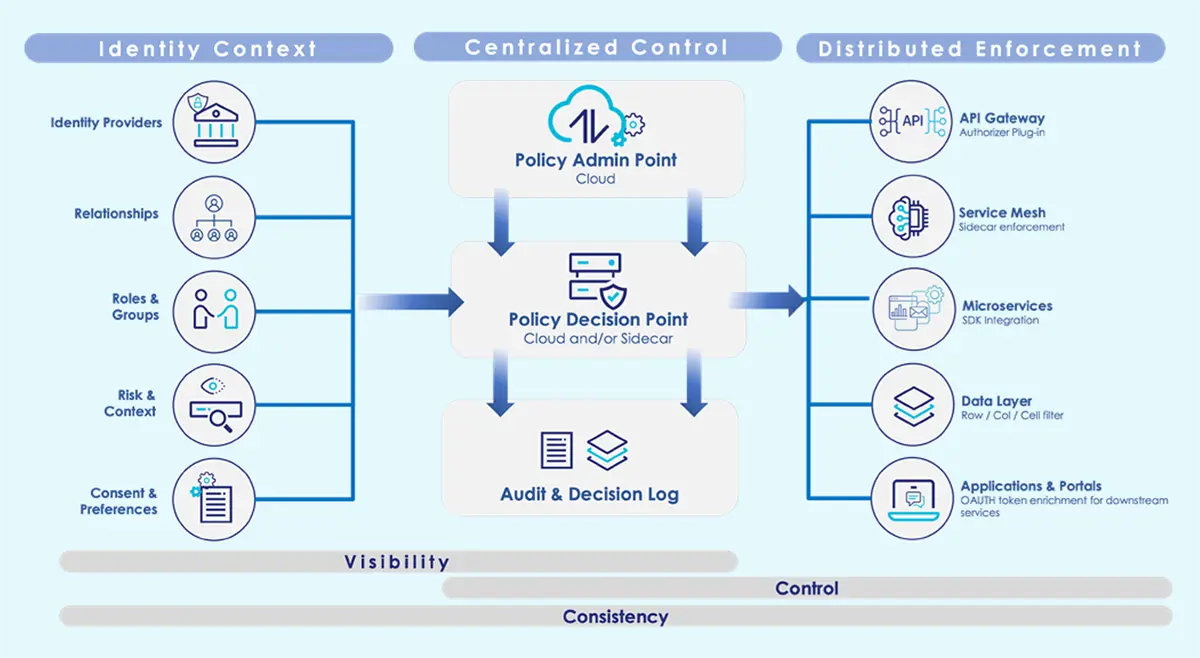
Thales Policy-based Authorization Manager (PBAM) – part of the OneWelcome Identity Platform – is a centralized authorization layer that enables fine-grained, policy-driven authorization control across your entire architecture. It separates what access should be allowed from how applications are built.
PBAM complements your existing IAM and CIAM systems and governs what happens after authentication.
Identity Security That's Easy to Scale

Policy-based authorization control (PBAC)
Define access using subject, resource, and condition-based policies

Attribute and relationship-based decisions
Combine ABAC and ReBAC models for precise control

Fine-grained data protection
Enforce access at row, column, and field level

Policy-as-code
Integrate with CI/CD pipelines

Audit-ready decisions
Generate traceable, business-readable access decisions

Zero standing privileges
Grant access dynamically based on real-time context
Implement fine-grained authorization without rewriting your applications
Define access once—then enforce it everywhere. Centralize authorization with Policy-based Authorization Manager (PBAM) and apply fine-grained, policy-driven control across your APIs, applications, microservices, and data platforms.

Recommended resources
Frequently asked questions
Fine-grained authorization evaluates access decisions in real time based on policies that consider identity, resource, and context.
Instead of relying on static roles, access is defined through policies that express how users interact with specific resources under specific conditions.
Several principles define how fine-grained authorization operates in practice:
- Relationship-based access (ReBAC): Access is determined by relationships between entities, such as a user’s connection to a customer, account, or organization.
- Attribute-based access (ABAC): Decisions are based on attributes like user type, resource sensitivity, action, or contextual signals such as time and location.
- Granular control: Policies operate at the level of individual resources, such as a specific record, transaction, or data field, not just at the application level.
- Dynamic evaluation: Access decisions are calculated at runtime, adapting to changes in context without requiring updates to application code.
- Policy-driven model: Access rules are explicitly defined and consistently enforced, enabling transparency, auditability, and alignment with business logic.
Implementing fine-grained authorization
Fine-grained authorization defines how access decisions should be made but applying it consistently across systems requires more than isolated policy logic.
Policies must be centrally defined, evaluated in real time, and enforced across APIs, applications, and data layers without embedding authorization logic into each system.
Policy-based access management provides the structure to operationalize fine-grained authorization across distributed environments, ensuring consistency, auditability, and control.
Thales delivers this capability through Policy-based Access Manager (PBAM), part of the OneWelcome Identity Platform.
As part of the OneWelcome Identity Platform, Thales Policy-based Access Manager (PBAM) delivers:
Resource-level authorization
Most solutions stop at the API. PBAM enforces access at the actual resource level, such as a transaction, record, or data field.
No role explosion
RBAC creates complexity as systems scale. PBAM replaces static roles with dynamic policies that reflect real business logic.
Consistent enforcement
Policies are defined once and applied everywhere. No duplication. No drift between systems.
Built for change
Policy updates do not require application changes. Access evolves at the speed of business, not development cycles.