 Gaurav Chander | Director, Product Management
More About This Author >
Gaurav Chander | Director, Product Management
More About This Author >
Gaurav Chander | Director, Product Management
More About This Author >
Gaurav Chander | Director, Product Management
More About This Author >
How Thales, Microsoft, and Intel® are setting a new standard and closing the trust gap
Organizations are racing to unlock the value of AI, yet their most valuable data, from patient records to proprietary engineering designs, often remains on the sidelines. That creates more than a technology gap. It limits model quality, slows innovation, and prevents enterprises from applying AI to some of their highest-value use cases. The challenge is clear: how can organizations leverage cloud scale and AI innovation without sacrificing control, compliance, or sovereignty?
From a Thales CyberSecurity Solutions perspective, the question is not whether enterprises can technically run sensitive AI workloads in the cloud. They can. The real question is whether they can do so without transferring too much trust to the cloud infrastructure itself. Moving confidential AI from pilot projects to production requires more than hardware isolation. It requires independent verification, customer-controlled keys, and enforceable policy controls that prove sensitive data is used only in approved, trusted environments.
Earlier this year, Microsoft announced the general availability of Azure Intel® TDX confidential VMs, a major milestone that provides hardware-enforced isolation for sensitive workloads.
Closing the Confidence Gap in Confidential AI
Traditional confidential computing deployments can create what many European cybersecurity and regulatory stakeholders would recognize as a high concentration of risks: a single cloud provider may manage the hardware, the attestation, and the encryption keys. For highly regulated sectors, such as banking, healthcare, and government, this lack of separation of duties can be a non-starter.
Through our joint collaboration, Thales, Microsoft, and Intel are introducing a confidential computing control gate capability as part of an End-to-End Data Protection (E2EDP) framework. We aren't just protecting data; we are building an independently verified control layer that helps organizations strengthen the technical and organizational safeguards expected under Article 32 of the GDPR, while also supporting broader resilience and AI governance goals under DORA and the EU AI Act.
What Sets This Solution Apart?
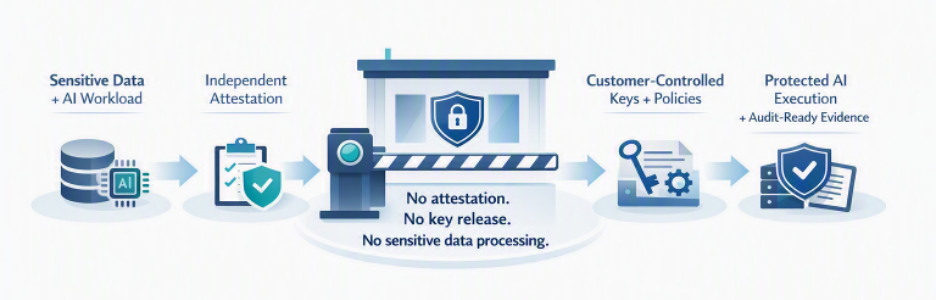
The Thales-Microsoft-Intel solution mitigates a foundational challenge: who controls the trust boundary. The solution separates control across independent parties. Rather than relying on a single cloud provider to manage infrastructure, attestation, and encryption keys, it combines hardware-enforced isolation, independent verification, and customer-controlled keys and policies. This creates a stronger trust boundary for organizations that want to scale confidential AI without giving up control of their most sensitive data.
Our approach delivers:
- Independent Verification: Verify the integrity of the hardware and software before sensitive data is processed, using Intel® Trust Authority as a SaaS attestation service independent of the cloud service provider.
- Customer-Controlled Keys and Policies: Retain control of encryption keys and data execution policies through the Thales CipherTrust Data Security Platform, reducing reliance on the cloud provider as the sole trust authority.
- Protection from Data Preparation to Execution: Move beyond pilot projects to production-ready AI by securing the lifecycle from data ingestion and preparation to verified execution and audit-ready evidence.
High-Performance Confidential AI: Run complex AI pipelines with lower latency and higher throughput by leveraging 5th Gen Intel® Xeon® processors with AMX acceleration.
Confidential AI Control Gate
Real-World Impact: From Banking to Healthcare
This isn't just theoretical. This framework allows a European bank to train LLMs on sensitive PII and transaction records while retaining sovereign control over how that data is accessed, processed, and governed in line with EU regulatory expectations. It enables healthcare organizations to collaborate on disease diagnosis models while reducing exposure of raw patient datasets to other parties or unnecessary infrastructure layers.
These use cases also underscore the need for a defense-in-depth approach that can stand up to real-world operational and supply-chain risks.
A Defense-in-Depth Reality Check
Confidential Computing must be hardened against hostile administrators and supply-chain attacks. Our solution is designed precisely for this hostile host threat model by:
- Attesting the entire Trusted Computing Base (TCB): Ensuring the manufacturer-provided hardware and the user-provided VM image are both verified.
- Tying secrets to attestation: Tying secrets to attestation: Keys are only released to the environment after a successful, independent attestation.
Bring More Sensitive Data into AI, Safely
The AI race should not force organizations to choose between innovation and control. With Thales, Microsoft, and Intel, enterprises can bring more sensitive data into AI workflows while maintaining independent verification, customer-controlled keys, and a stronger foundation for sovereign cloud adoption.