
Proudly Partnering With...


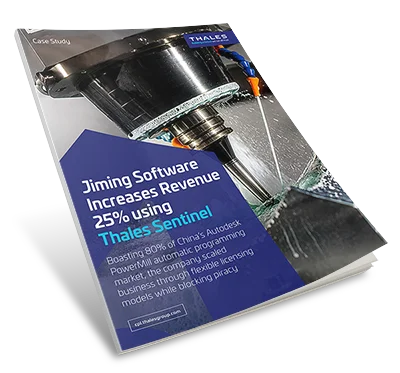
Jiming Software, a leading developer of CAM CNC programming automation solutions in China, faced growing software piracy, fragmented licensing processes, and limitations in its ability to support flexible business models. After implementing Thales Sentinel, the company automated license provisioning, improved customer self-service, and strengthened protection against unauthorized software use.
The case study shows how Jiming Software used Sentinel to transition from primarily hardware-key licensing toward software, cloud, and subscription licensing. The company achieved a 25% increase in revenue, in addition to its existing 20% annual organic growth, while creating a foundation for future SaaS and usage-based licensing models.
What you will learn:
Founded in 2008 and headquartered in Dongguan, China, Jiming Software is a leading developer of CAM CNC programming automation solutions. Its flagship product, Machine Ming Automatic Programming Software, helps manufacturers automate CNC programming, improve processing quality, increase efficiency, and reduce production costs through intelligent programming workflows. With nearly 10,000 enterprise customers and 100,000 end users, Jiming Software leveraged its deep technical expertise for Autodesk PowerMill automatic programming, boasting more than 80% market share in the Chinese market.
Jiming Software growth was steady at 20% YoY, and by implementing Thales Sentinel, its revenue further increased an additional 25%.
While Jiming Software had built an industry-leading product showing substantial growth, its success was curtailed by widespread software piracy and inconsistent licensing. Despite successfully pursuing legal action against software piracy, the company recognized that litigation alone could not adequately protect its intellectual property or support long-term business growth.
Its existing licensing environment combined homegrown tools with competitor solutions, resulting in fragmented licensing processes, manual operations, and limited scalability. Manual license creation meant delivery delays for customers and avoidable administrative overhead.
The lack of a unified licensing platform also limited the company’s ability to modernize its business model. While demand for flexible subscription licensing was growing, its previous infrastructure could not support cloud-based licensing or scalable customer self-service capabilities.
Jiming looked for a licensing platform that could:
Protect valuable intellectual property from software cracking and piracy
Prevent software overuse and associated revenue leakage
Configure new software monetization models
Integrate with Autodesk
Foster a consistent licensing experience for customers
Allow self-service activation
Automate license provisioning and lifecycle management
Provide product usage insights to guide future product development
Ultimately, an excellent product could not reach full revenue potential because unauthorized copies entered the market, and inflexible licensing blocked product diversification and customer satisfaction.
Jiming Software evaluated several options before selecting Thales Sentinel in 2021.
Alternative solutions lacked the scalability and cloud capabilities required to support Jiming Software’s long-term strategy. Sentinel distinguished itself through its powerful software protection capabilities, flexible licensing architecture, and ability to support both current and future business models.
Jiming Software implemented Thales Sentinel LDK using HL (hardware keys), SL (software licensing), and CL (cloud licensing), alongside Sentinel Envelope for software protection and LDK Data Export for product usage analysis.
The implementation integrated seamlessly with the company’s existing ecosystem through APIs for on prem and SaaS deliveries. Sentinel enabled a complete range of licensing operations, including:
Perhaps most importantly, the solution enabled Jiming Software to transition from primarily hardware-key licensing toward software and cloud licensing. Customers now receive licenses immediately through a self-service portal instead of waiting for manual provisioning.
The introduction of Sentinel fundamentally changed how Jiming Software delivers and manages software licenses. License issuance became fully automated, eliminating repetitive manual work while improving both speed and accuracy. Customers can now activate their licenses immediately through Sentinel’s self-service capabilities, significantly improving onboarding and reducing delays.
Operational improvements included:
These improvements also established a single, unified licensing process across the organization, simplifying administration while creating a stronger foundation for future growth.
The implementation delivered measurable business value across software revenue growth, customer experience, and business transformation. Most significantly, Jiming Software achieved a 25% increase in revenue, in addition to its already strong annual organic growth of 20%. By dramatically reducing piracy, the company was able to convert more users into legitimate paying customers while better protecting its intellectual property.
The 25% revenue increase was a result of:
The new licensing platform enabled entirely new revenue opportunities through subscription. Notably, the company plans to implement usage-based licensing models in the future as well.
Sentinel has become an important foundation for Jiming Software’s long-term product strategy. By supporting SL and CL licensing, the company has expanded beyond traditional perpetual licensing into cloud-based subscription models. In 2025, Jiming Software launched its first SaaS version using Sentinel’s User-Based Licensing, allowing customers to authenticate through user logins rather than traditional license keys. Looking ahead, the company plans to continue expanding its cloud offerings while integrating AI capabilities, including Copilot-style functionality, into its products. Sentinel provides the flexible licensing infrastructure needed to support these evolving business models and future innovations.
For Jiming Software, reducing piracy has delivered benefits beyond increased revenue. Stronger software protection has also reduced the likelihood of hacking while enabling flexible licensing models that support subscription, SaaS, and future cloud services. Today, Jiming Software can focus its resources on product innovation, confident that its intellectual property is protected, and its licensing infrastructure is ready to support continued business growth. “Our company can now focus on developing better and stronger products because Thales Sentinel handles all product security and licensing automation,” emphasizes General Manager Liu LiaoJunFang.