Accelerate AI adoption
Securely leverage your enterprise data
AI apps and agents are being deployed across the organization and with access to sensitive data, often without adequate security - introducing new risks. Thales AI Security Fabric runtime security solutions enables organizations to adopt AI confidently while protecting sensitive data, maintaining compliance, and preserving brand trust.
What is blocking rapid and safe AI GenAI adoption?
The most concerning risks of GenAI security include integration of new systems into an already complex Hybrid IT and the integrity, trust and confidentiality powering AI.

The Thales AI Security Fabric reflects the company’s strengths in data encryption, key management, and application and identity security, capabilities that create a strong foundation for AI security”

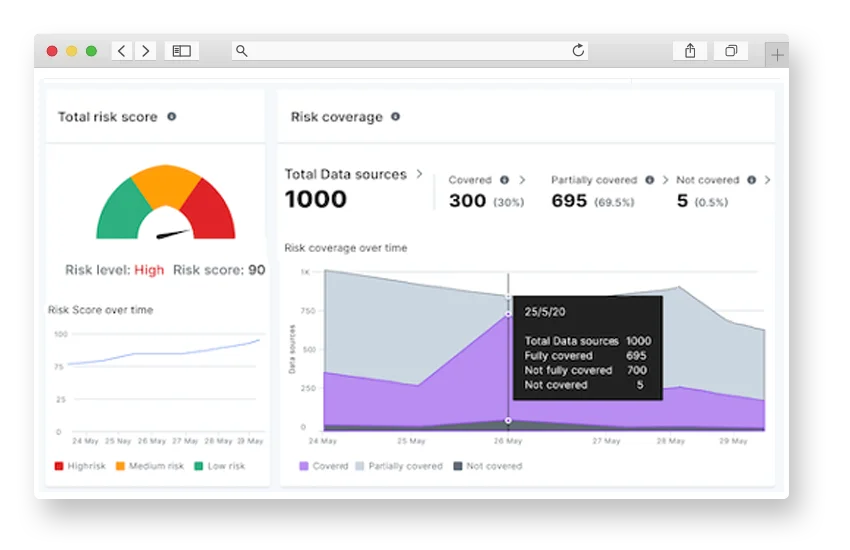
Unlock business value with AI data security posture management
AI thrives on large datasets. But for AI to be effective for business, it must incorporate enterprise data that may include sensitive or proprietary data.
Thales AI runtime security solutions allow organizations to improve their AI data security posture management, allowing Agentic AI and Gen AI access to datasets while protecting sensitive data based on policy.

Logo and materials © OWASP GenAI Security Project, used under the project’s branding and license guidelines.
Address the top LLM vulnerabilities
Attacks on AI applications and models is on the rise.
From reducing the risk of data poisoning and model manipulation to identifying and blocking common prompt injection techniques, Thales AI runtime security solutions address a majority of the OWASP GenAI Security Project's top 10 threats to LLMs by uncovering vulnerabilities, protecting data and applications, and detecting and stopping malicious activity in real time.
Accelerate AI adoption while maintaining compliance
AI adoption is a priority for a majority of organizations, but the pressure to integrate AI fast is overwhelming already overextended security and compliance teams.
Thales AI runtime security solutions automate key security functions by enforcing custom policies aligned with desired security requirements and security or privacy regulations such as GDPR, HIPAA or PCI.

Thales AI Security Fabric Runtime Security Solutions

AI Application Security
Enterprise-grade protection for GenAI applications
- Analyze every input and output in real time, detecting and stopping malicious activity
- Block malicious or manipulative prompts before they reach the model
- Detect and blocks exposure of sensitive information or harmful, AI outputs

Rag Security
Protect sensitive data in Retrieval-Augmented Generation systems
- Identify, classify, and protect sensitive data before Retrieval-Augmented Generation (RAG) ingestion
- Protect data during the ingestion, embedding and within the vector database
- Continuous, real-time monitoring of all interactions with databases and unstructured data across the RAG lifecycle
Thales provides security at scale for more than
30,000 organizations worldwide

$150 Trillion
in interbank money transfers
protected every year

113+ Billion
application attacks
blocked every month

184
countries monitored for threats
every day







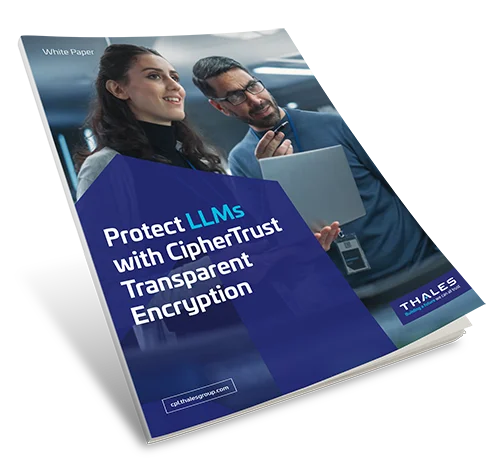
Thales AI cybersecurity resources
Extract the value out of AI while safeguarding sensitive data at rest, in transit and during execution and preventing model manipulation.
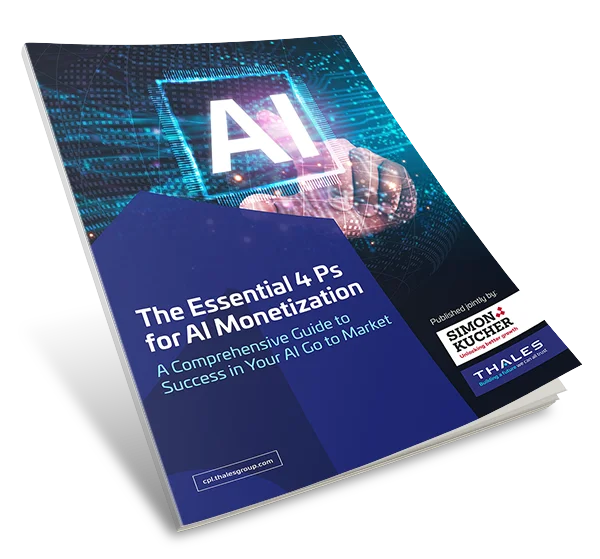
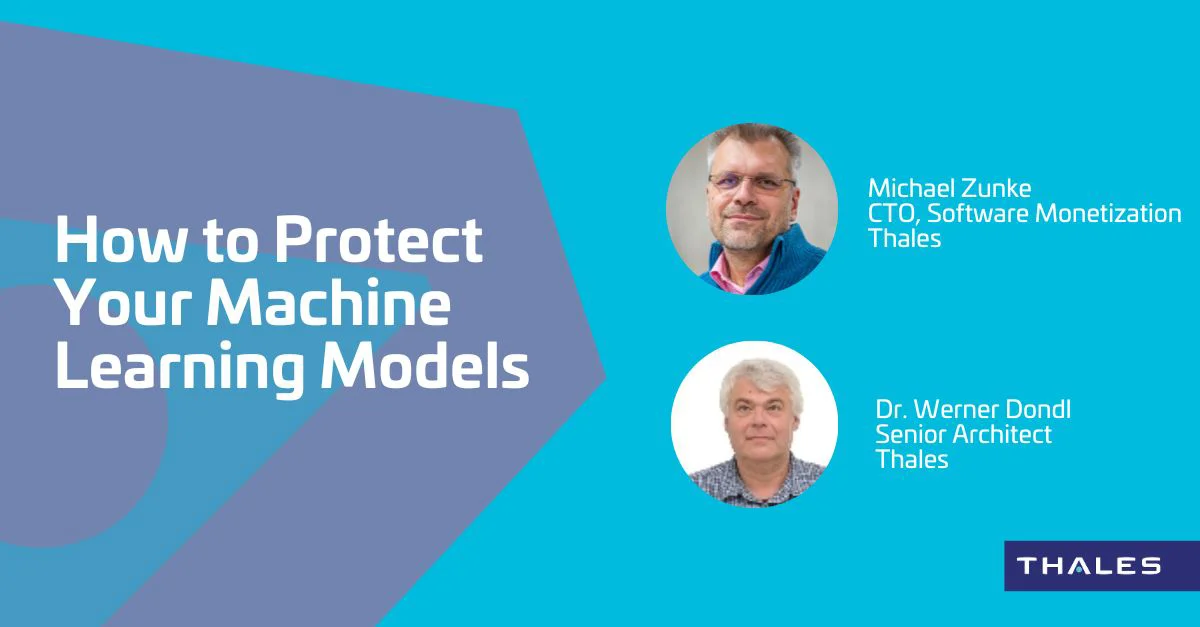
Featured Resource: IP & Revenue
Protect against model extraction, reverse engineering or modification while monetizing AI with a strong licensing platform.






Frequently asked questions
You protect company data from AI by limiting what data AI systems can access, masking or encrypting sensitive information, and continuously monitoring how AI tools use and expose that data. The aim is to give AI the data it needs to be useful and nothing more.
AI models use data in several ways. They learn from it in training and fine-tuning, retrieve it through retrieval-augmented generation (RAG), and receive it directly in user prompts. Any of these can accidentally expose personal data, intellectual property, financial records or customer information.
Key steps to protect company data from AI include:
- Discover and classify your data. Before any data is used for training, fine-tuning or RAG, identify what is sensitive and where it is stored. Data security posture management (DSPM) tools can automate this across complex environments.
- Apply least-privilege access. Make sure AI tools, copilots and agents can only reach the data their task requires. An AI assistant that can read every file in the company can also leak every file in the company.
- Encrypt, tokenize or anonymize sensitive data. Replace personal and regulated data with tokens or anonymized values before it enters AI workflows, encrypt everything, so models can work with the data without seeing the real values.
- Control shadow AI. Employees often use unapproved AI tools without realizing the risk. Provide approved alternatives, block unsanctioned services where needed, and monitor for unauthorized use.
- Inspect prompts and responses. Use AI-aware DLP and filtering to stop employees from pasting confidential data into AI tools, and to stop AI applications from exposing sensitive information in their answers.
- Protect the data pipeline. Secure the vector databases, data lakes, Retrieval-Augmented Generation (RAG) pipelines, and integrations that feed AI systems, since attackers increasingly target these components.
- Manage encryption keys centrally. Keep keys in a hardware security module (HSM) or centralized key management system so you, not your AI or cloud provider, control access to your data.
Organizations can deploy AI agents securely by treating each agent as a privileged digital identity: give it narrowly scoped permissions, authenticate it strongly, keep humans in control of high-risk actions, and log everything it does.
Unlike traditional chatbots, AI agents act on their own. They can browse the web, read and send email, query databases, call APIs, run code and complete multi-step tasks with little human involvement. That makes them powerful, and it also means a compromised, misconfigured or manipulated agent can cause real damage at machine speed.
Best practices for secure AI agent deployment include:
- Assign a unique, managed identity to every agent. Each agent should have its own credentials. Use short-lived tokens instead of static, shared API keys so access can be tracked, limited and revoked.
- Enforce least privilege. Grant only the permissions needed for each task, and review them regularly. Avoid giving agents broad administrative rights "just in case."
- Keep a human in the loop for high-impact actions. Require human approval before an agent makes payments, deletes data, changes configurations or sends messages outside the organization.
- Defend against prompt injection. Agents often process untrusted content from websites, documents and emails, any of which can contain hidden malicious instructions. Validate inputs, separate trusted instructions from external content, and limit what an agent can do based on what it reads.
- Protect secrets and keys. Store credentials in a secrets vault or HSM, never in prompts, code or configuration files the agent can expose.
- Secure the tools and integrations. Vet every plugin, API and Model Context Protocol (MCP) server an agent connects to, and protect those connections with strong API security.
- Monitor and audit continuously. Keep detailed logs of every agent action with continuous runtime monitoring, set alerts for unusual behavior, and have a way to quickly suspend an agent that misbehaves.
- Start small and expand gradually. Pilot agents in low-risk environments before giving them access to production systems or sensitive data.
Organizations mitigate LLM security risks by layering several controls: input and output filtering, strict access controls, strong data protection, secure APIs, supply chain checks, and continuous testing and monitoring. No single control is enough. Effective LLM security uses defense in depth.
LLMs bring new threats that traditional security tools weren't designed to catch, including prompt injection, jailbreaks, data poisoning, model theft and sensitive information disclosure. Because LLMs work with natural language, attacks can be subtle, creative and hard to tell apart from legitimate use.
A comprehensive LLM risk mitigation strategy includes:
- Guardrails for inputs and outputs: Deploy filters that detect prompt injection, jailbreak attempts and malicious instructions in inputs, and that block harmful, inaccurate or sensitive content in outputs.
- Data protection: Encrypt, tokenize or remove sensitive information from training data, RAG sources and prompts so it can't be exposed through model responses.
- Access control: Limit who can use, configure or change LLM applications, and restrict which data and systems the model can reach.
- API security: LLMs connect to applications through APIs, which makes those APIs a prime target. Protect them with authentication, rate limiting and bot protection to prevent abuse, data scraping and runaway costs.
- Supply chain security: Check third-party models, open-source components, plugins and datasets for vulnerabilities, backdoors or poisoned data before using them.
- Red teaming and adversarial testing: Regularly test LLM applications with simulated attacks, both before deployment and as models and threats change.
- Monitoring and incident response: Log LLM activity, detect anomalies and include AI-specific scenarios in your incident response plans.
- Governance and frameworks: Align your program with established guidance such as the OWASP Top 10 for LLM Applications, the NIST AI Risk Management Framework, ISO/IEC 42001 and the EU AI Act.
You secure large language models by protecting the full LLM lifecycle: the data used to train and ground the model, the model itself, the infrastructure it runs on, and the applications, APIs and users that interact with it. Security has to be built in at every layer, not added at the end.
Each layer of an LLM deployment has its own risks and needs its own controls:
- Data layer: Training, fine-tuning and RAG data often contain sensitive or proprietary information. Encrypt it, restrict access, track where it came from, and check it for poisoning, where attackers insert malicious data to manipulate model behavior.
- Model layer: Model weights are valuable intellectual property and a target for theft or tampering. Protect them with encryption, strong key management, access controls and integrity checks. Confidential computing can add protection while models are in use.
- Infrastructure layer: Harden the cloud, on-premises or hybrid environments that host your models. Isolate AI workloads, patch systems regularly and secure the GPUs, containers and orchestration platforms involved.
- Application layer: Secure the APIs that expose the model, filter inputs and outputs, limit which plugins or tools the model can call, and treat all model output as untrusted until it is validated, especially before passing it to other systems.
- User and identity layer: Authenticate users strongly, apply role-based access, and make sure the model only returns information each user is authorized to see.
- Operations layer: Continuously monitor activity, log interactions for auditing, run regular red-team tests, and update defenses as new attack techniques appear.
Securing LLMs is an ongoing process. Models, data sources and threats change constantly, so security controls need regular review.
The largest risk of using large language models is the exposure of sensitive data, most often through prompt injection. Prompt injection ranks first in the OWASP Top 10 for LLM Applications, and sensitive information disclosure ranks second.
In a prompt injection attack, malicious instructions are hidden in user input or in external content the model processes, such as a web page, document or email. These instructions can override the model's intended behavior and trick it into revealing confidential data, ignoring safety rules or, for AI agents, taking unauthorized actions such as sending data to an attacker. Prompt injection is hard to fully prevent because LLMs can't reliably tell the difference between trusted instructions and untrusted content.
Other significant LLM risks include:
- Sensitive information disclosure: Models revealing personal data, credentials or proprietary information from training data, RAG sources or previous interactions.
- Data and model poisoning: Attackers corrupting training or retrieval data to manipulate model outputs.
- Excessive agency: AI agents given more permissions or autonomy than they need, which increases the impact of any compromise.
- Improper output handling: Applications trusting model output without validation, which can lead to downstream attacks.
- Supply chain vulnerabilities: Compromised third-party models, plugins or datasets.
- Misinformation and hallucinations: Confident but incorrect outputs that lead to poor business decisions.
Because so many of these risks end in data exposure, the most effective defense is to protect the data itself through discovery, classification, encryption, tokenization and strict access control. Then even a successful attack has far less to steal.
AI LLM security is the set of practices, technologies and policies that protect large language models, the data they use and the applications built on them from attack, misuse and data leakage. It lets organizations adopt generative AI with confidence while keeping sensitive data, intellectual property and customers safe.
As generative AI becomes part of everyday business, from customer service chatbots to coding assistants to autonomous AI agents, it brings a new attack surface. Traditional security tools protect networks, endpoints and applications, but they weren't built for threats that arrive as natural language. AI LLM security fills that gap.
AI LLM security typically covers:
- Data security: Protecting the training, fine-tuning, RAG and prompt data that LLMs use, through discovery, classification, encryption and tokenization.
- Model protection: Safeguarding model weights and configurations from theft, tampering and unauthorized access.
- Threat defense: Detecting and blocking AI-specific attacks such as prompt injection, jailbreaks, data poisoning and model extraction.
- Application and API security: Securing the interfaces that connect LLMs to users, business systems and AI agents.
- Identity and access management: Controlling which people and which AI agents can use models and reach data.
- Governance and compliance: Meeting regulatory requirements such as GDPR, the EU AI Act and industry-specific rules, and following frameworks like the OWASP Top 10 for LLM Applications and the NIST AI Risk Management Framework.
Put simply, AI LLM security makes sure the AI systems an organization depends on stay trustworthy, resilient and compliant, so the business can innovate without putting its most valuable data at risk.