 Sara Sokorelis | Senior Marketing Communications Specialist, Thales
More About This Author >
Sara Sokorelis | Senior Marketing Communications Specialist, Thales
More About This Author >
Sara Sokorelis | Senior Marketing Communications Specialist, Thales
More About This Author >
Sara Sokorelis | Senior Marketing Communications Specialist, Thales
More About This Author >
So many of us live our lives on the move. We’ve built a life that depends on systems recognizing us, wherever we might be in the world. That recognition relies on identity. And that means identity must move with us.
Danny de Vreeze, VP of Identity and Access Management at Thales, sums up this concept succinctly: “Today, digital identity is expected to be just as mobile as we are. It has to work across borders, devices, networks, and companies - across the full ecosystem of modern life.”
In the Spring 2026 edition of IAM 360 Magazine, experts from around the globe cut to the heart of that very idea. Here are some of the key themes they discuss.
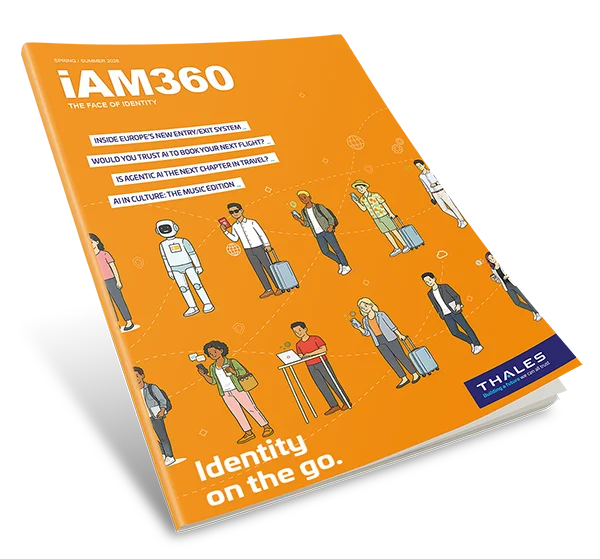
Read the latest edition of IAM 360
Explore how identity now travels across borders, devices, and platforms – and what that means in an agentic AI world.
“Travel is the most identity-intensive environment”
People today expect travel to be simple and pain-free. For Phillip Vallée, Executive Vice President of Cybersecurity and Digital Identity at Thales, Europe’s new Entry/Exit System (EES) will do just that, moving us away from passport stamps and manual checks, and towards digital verification that makes border crossings simple and secure.
However, don’t think of digital systems as a replacement for traditional borders; digital verification is a rethinking of how we move through them. Vallée believes that borders should be something travelers “barely notice.” A well-designed border isn’t invisible; it’s just trustworthy enough to feel invisible.
As Martin Kuppinger, Founder and Principal Analyst at KuppingerCole, highlights, “Travel is one of the most identity-intensive environments in modern life, and identity checks appear at every step of the journey.”
That intensity is exactly why travel is the ultimate stress test for digital identity. He argues that if a digital identity works for travel, then it works almost anywhere. If it fails under these circumstances, the entire concept fails.

Are we ready for AI agents to book our next trip?
Summer is right around the corner, are we ready for AI to move beyond the holiday itinerary and start acting on our behalf?
This question is the foundation of the AI trust gap. As Thalles Silveira, Product Manager for Cargo at Air France-KLM, notes, many passengers trust AI-generated information, but fewer are comfortable letting AI make independent choices.
This reticence is understandable: it’s one thing to ask someone for advice, but ceding control to them is something else entirely. Agentic AI is an enormous leap of faith for travelers.
However, agentic AI offers passengers huge potential benefits. By comparing prices, booking flights and hotels, and making decisions on their behalf, it can help people get better deals with a fraction of the effort required with manual processes. Closing that trust gap will benefit everyone.
At its heart, the AI trust gap is an infrastructure problem. We've built infrastructure to make our identity travel with us; we haven't yet built the infrastructure to make AI agents act with our identity in a trustworthy way.

Identity as infrastructure
The reason borders are changing is that the underlying infrastructure of identity is also changing. It’s all connected. Our smartphones are becoming wallets, and eIDs are becoming the norm.
That’s why, with passkey rollout well underway, Andrew Shikiar, Executive Director & CEO of the FIDO Alliance, believes his organization’s next logical step is to solve the identity problem. Their new digital credentials initiative aims to accelerate a secure, interoperable ecosystem for digital identities. Pedro Martinez’s interview with Andrew brings this to life, exploring what the shift could mean in practice and why it matters now.
We also wanted to look at what it means to stay connected while we’re on the move. In her contribution to this edition of IAM 360, Pauline Pinzuti, Marketing Manager for Digital Telco Services at Thales, points to a more everyday version of this same shift: the rise of the eSIM. When your SIM becomes software, the friction, costs, and awkward conversations in a foreign language required to pick a new SIM become a thing of the past.
Is your next favourite artist just a bot?
When we chose the theme “Identity on the Go”, I knew music had to be part of the conversation. Our favourite songs follow us through commutes, workouts, heartbreaks and holidays, soundtracking who we are as we move through the world. But as AI pushes deeper into music (and into all creative spaces), what will happen to the future of music? If a voice can be cloned, a style mimicked, and an artist’s creative identity reproduced without consent, what exactly are we listening to — and who gets to own it?
In Silvia Pietrosanti's piece on AI and the future of music, she argues that protecting an artist's identity isn't just a legal issue, but a cultural one. AI-generated impersonations pose a serious risk to artistic identity and trust. And when identity is on the go, it's also exposed in more places than ever. Protecting it is no longer just a security discipline. It's a question of what we value.
Identity touches everything
The issue isn't really about travel, or AI, or music. It's about the systems that recognize us, wherever we are, and what we're asking of them.
Download the full IAM 360 Magazine for insights from all the above contributors, and a whole lot more.
Read the latest edition of IAM 360
Explore how identity now travels across borders, devices, and platforms – and what that means in an agentic AI world.