 Krishna Ksheerabdhi | VP, Product Marketing
More About This Author >
Krishna Ksheerabdhi | VP, Product Marketing
More About This Author >
Krishna Ksheerabdhi | VP, Product Marketing
More About This Author >
Krishna Ksheerabdhi | VP, Product Marketing
More About This Author >
Data Security Posture Management (DSPM) has rapidly evolved from an emerging cybersecurity category into a core enterprise security priority. According to the Omdia Universe: Data Security Posture Management (DSPM), 2025 report, 80% of IT decision-makers are already using, adopting, or planning DSPM implementations, up from 73% the previous year. Omdia also estimates the broader DSPM market could reach approximately $34.5 billion by 2030.
At the same time, organizations face increasing pressure from AI adoption, cloud sprawl, and tightening regulatory enforcement. Omdia notes that GDPR penalties alone exceeded €6.2 billion across 2,435 enforcement actions as of mid-2025.
As sensitive data spreads across cloud platforms, SaaS applications, databases, data lakes, collaboration tools, hybrid infrastructure, and on-premises environments, security leaders increasingly need more than isolated discovery or compliance tools. They need platforms that can continuously discover, classify, monitor, and protect sensitive data while helping maintain a resilient security posture over time.
This guide compares leading DSPM solutions through an enterprise buyer lens, focusing on the capabilities organizations should evaluate when selecting a platform for cloud, hybrid, SaaS, and AI-driven environments. It is designed to help security, risk, and data leaders evaluate the market without reducing the decision to a generic “top tools” list.
Scope and methodology
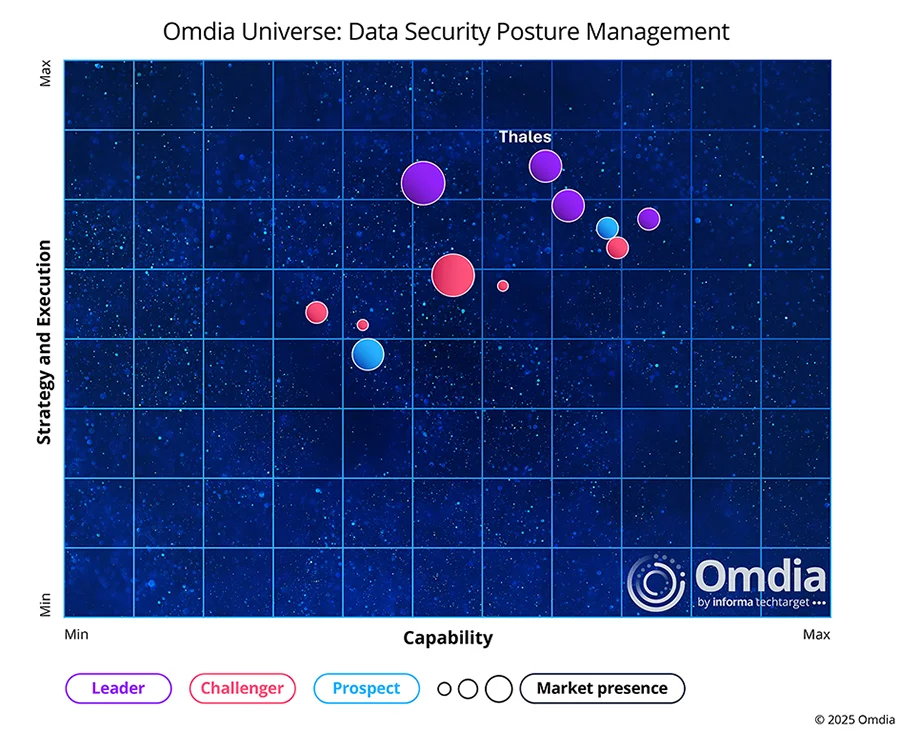
This comparison uses the market analysis conducted by Adam Strange, Principal Analyst of Data Security at Omdia, as part of the market framework. The main vendor profiles include Omdia-recognized Leaders and Challengers: Thales, BigID, OpenText, Concentric AI, Rubrik, Securiti, Sentra, and Varonis.
IBM was also categorized as a Leader in the Omdia report, but it is not profiled here because of product lifecycle considerations related to the Guardium platform evaluated in the report. Other known DSPM vendors may still be relevant for specific buyer needs but are outside the Omdia-based vendor set used for this comparison.
The evaluation criteria also reflect broader market guidance from independent DSPM buyer resources, such as Gartner and Expert Insights. These emphasize discovery coverage, classification accuracy, remediation capabilities, AI governance features, and fit with wider security and compliance workflows as important evaluation themes.
What is DSPM?
Data Security Posture Management helps organizations discover sensitive data, classify it, understand access and exposure, monitor how data is used, and prioritize remediation across cloud, SaaS, hybrid, and on-premises environments. DSPM is especially valuable when organizations do not have a complete picture of where sensitive data resides, who can access it, whether it is properly protected, or how its security posture changes over time.
In a Dark Reading discussion on what “best-in-class” DSPM looks like, Adam Strange described DSPM as a platform approach that brings these formerly siloed data security capabilities together, while also noting that the category is evolving into broader data security platform architectures.
Omdia describes DSPM as a more holistic approach to data security that combines data security capabilities with posture management capabilities. In practical terms, this means DSPM should help teams move from “where is our sensitive data?” to “how exposed is it, who can access it, how is it being used, and what should we do next?”
For a deep dive into foundational architecture, read our comprehensive guide: What Is DSPM? Data Security Posture Management Explained.
How DSPM is evolving toward broader data security platforms
DSPM originally emerged to give organizations a more holistic view of sensitive data risk. The strongest solutions now go beyond one-time discovery or static classification. They help security teams understand posture continuously and, increasingly, connect risk findings to protection, access control, monitoring, and remediation workflows.
For enterprise buyers, this distinction matters. A visibility-led DSPM tool may help identify where sensitive data is exposed, but a broader data security platform can also help enforce controls such as encryption, tokenization, dynamic data masking, centralized key management, access governance, and data activity monitoring. Vendor fit depends heavily on the buyer’s environment, risk tolerance, regulatory obligations, and operating model.
Key features to look for in DSPM solutions
Analyst research and independent DSPM evaluations increasingly point to the same core buying criteria: discovery breadth, classification accuracy, identity-aware access visibility, remediation depth, compliance alignment, AI governance, deployment fit, and the ability to connect posture findings to protection controls.
The following framework combines Omdia’s DSPM capability model, Gartner-aligned data security platform requirements, and buyer-guide criteria emphasized by Expert Insights and other market resources.
| Capability | What to Evaluate |
|---|---|
| Discovery coverage | Cloud, SaaS, on-premises, databases, data lakes, file shares, collaboration tools, structured and unstructured data, and shadow data. |
| Classification accuracy and tuning | Accurate identification of sensitive data across formats without excessive false positives or heavy manual rule creation. |
| Identity-aware access analysis | Mapping sensitive data to human and non-human identities, entitlements, excessive permissions, and risky access paths. |
| Data protection controls | Encryption, field-level encryption, format-preserving encryption, tokenization, dynamic data masking, and policy-based access controls. |
| Key, secrets, and credential governance | Centralized key management, secrets visibility, rotation, separation of duties, and ownership of encryption controls. |
| Monitoring, activity analysis, and threat context | Data activity monitoring, behavioral analytics, anomaly detection, audit trails, and operational telemetry. |
| Remediation depth | Ability to prioritize findings and support actions such as access revocation, masking, encryption, quarantine, retention enforcement, or workflow routing. |
| AI data security and governance | Shadow AI visibility, training data lineage, RAG/LLM pipeline protection, AI agent access controls, and sensitive data de-identification before AI use. |
| Compliance and reporting | Mapping data, controls, access, and activity to GDPR, HIPAA, PCI DSS, CPRA, and other regulatory requirements. |
| Deployment model, scalability, and ecosystem fit | Agentless vs. agent-based deployment, hybrid/on-premises support, platform integrations, time to value, and fit with existing security workflows. |
Five buyer questions to guide evaluation
The best DSPM solution is the one that answers the questions your security, compliance, and data teams are already asking. Use the following five questions as a lightweight evaluation framework.
1. Where is my sensitive data?
Evaluate discovery coverage across cloud data stores, SaaS applications, databases, file shares, data lakes, structured data, semi-structured data, unstructured data, and shadow data. The stronger the discovery foundation, the more confidently teams can classify, protect, and remediate risk.
2. Who has access to my sensitive data?
Assess identity-to-data mapping, entitlement analysis, excessive privilege detection, third-party access visibility, and support for human and non-human identities. DSPM should help teams see not only who is accessing data, but who could access it.
3. How well are credentials, keys, and secrets protected?
Look for secrets exposure detection, key management, credential hygiene, rotation visibility, separation of duties, and encryption key control. For organizations with regulated or highly sensitive data, also validate support for advanced controls such as field-level encryption, format-preserving encryption, tokenization, dynamic masking, and policy-based authorization.
4. How has sensitive data been used?
Evaluate data activity monitoring, access analytics, anomaly detection, audit trails, forensics, and business context. This becomes more important as organizations deploy GenAI, copilots, RAG pipelines, and AI agents that may access large volumes of enterprise data.
5. What is the security posture of my data stores?
Assess continuous scanning, misconfiguration detection, risk scoring, policy drift monitoring, compliance mapping, and prioritized remediation guidance. This is the posture management layer that helps teams focus on the exposures most likely to create business risk.
Evaluate DSPM through a risk-based lens
Use this practical guide to evaluate whether a DSPM solution can help you find sensitive data, understand access, protect credentials, monitor usage, and improve data security posture.
| Vendor | Omdia Category | Primary Orientation | Key Strengths | Consider When |
|---|---|---|---|---|
| Thales | Leader | DSPM + data protection platform | Native encryption, tokenization, masking, key and secrets management, hybrid/on‑premises support, AI data‑layer controls. | Enterprises needing posture visibility plus enforceable data‑layer protection. |
| BigID | Leader | Discovery, privacy, and governance | Broad discovery and classification, privacy automation, identity‑aware risk, strong partner ecosystem. | Organizations prioritizing data governance, privacy operations, and data intelligence. |
| OpenText | Leader | Cybersecurity platform integration | Broad cybersecurity platform, integrated data security capabilities, governance alignment. | Teams seeking DSPM as part of a larger cybersecurity or information management stack. |
| Concentric AI | Challenger | Semantic intelligence | AI‑assisted classification, semantic context, access risk analysis, remediation workflows. | Security teams focused on understanding sensitive data context and access exposure. |
| Rubrik | Challenger | Cyber resilience | DSPM integrated with backup, recovery, and resilience workflows. | Organizations linking data posture management to backup and recovery strategy. |
| Securiti | Challenger | AI governance and data intelligence | Data flow mapping, Data+AI Command Center, privacy automation, posture management. | Enterprises with advanced privacy, compliance, or AI governance initiatives. |
| Sentra | Challenger | Cloud‑native DSPM | Cloud data discovery, pipeline visibility, risk scoring, modern cloud data stores. | Cloud‑first teams focused on data stores, pipelines, and exposure risk. |
| Varonis | Challenger | Unstructured data and access governance | Behavioral analytics, least‑privilege enforcement, SaaS and file access governance. | Organizations with large volumes of unstructured or collaboration data. |
Vendor profiles
Vendor capabilities can vary by deployment model, data source, file type, integration path, and roadmap status.
Use the profiles below as a shortlist guide, then validate coverage, classification accuracy, remediation workflows, and protection controls against your own data environment during a proof of value.
Thales: CipherTrust Data Security Platform for DSPM
Summary
Thales is a strong fit for organizations that want DSPM capabilities as part of a broader data security platform strategy. Omdia named Thales a Leader in its 2025 DSPM Universe and highlighted Best in Class ratings for core technology, market momentum, and vendor execution. Expert Insights also recently listed Thales among top DSPM vendors, reinforcing its visibility in independent DSPM buyer research.
Key capabilities
Data discovery and classification across complex enterprise environments
Native encryption, tokenization, and dynamic data masking
Centralized key and secrets management through CipherTrust
Granular access controls and broader identity and HSM strengths
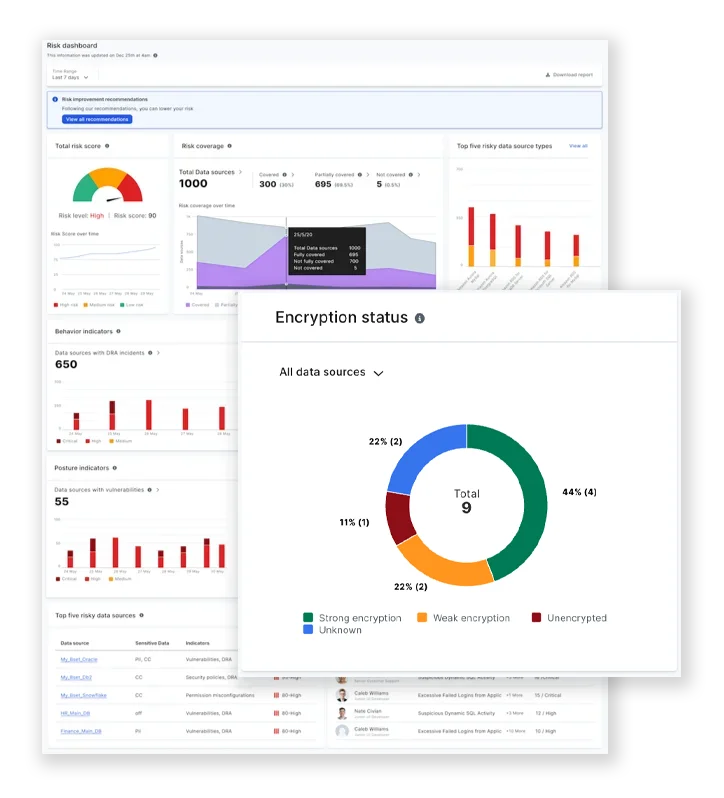
Data activity monitoring, posture analysis, and risk assessment through the broader Thales data security portfolio
Policy-driven controls that can help protect RAG pipelines, LLM workflows, and AI agents by de-identifying, masking, tokenizing, or encrypting sensitive data before it reaches downstream AI systems
Support for hybrid, multi-cloud, and on-premises deployment models
Enterprise scale, global partner ecosystem, and strong execution profile
Consider when
Consider Thales when your organization needs DSPM capabilities connected to native data protection controls, centralized key/secrets management, hybrid and on-premises coverage, and data-layer enforcement for regulated or AI-exposed data.
BigID: BigID Next for DSPM
Summary
BigID is a strong option for organizations that prioritize data discovery, classification, privacy, and governance. Omdia recognized BigID as a Leader and highlighted its broad portfolio and market momentum. Its strengths are especially relevant for organizations with diverse data estates and privacy-driven data governance programs.
Key capabilities
Broad data discovery and classification coverage
Dark, shadow, and unknown data discovery
Privacy and governance workflows
AI-driven, context-based remediation recommendations
Access and privilege management assessment
Strong partner ecosystem and responsive mid-sized vendor profile
Consider when
Consider BigID when your organization needs broad data discovery, classification, privacy operations, and governance workflows across a large and diverse data estate.
OpenText: OpenText Data Security Platform
Summary
OpenText should be included because it is one of the Omdia-recognized DSPM Leaders. Omdia highlighted OpenText for Best in Class scores in strategy and solution breadth, reflecting a broad and well-constructed set of data security technologies under its Cybersecurity Cloud.
Key capabilities
Broad data security platform capabilities
Cybersecurity Cloud integration
Discovery and classification across a wide variety of repositories and file types
In-house encryption, tokenization, data masking, and identity management capabilities
Enterprise-scale governance and security workflows
Large partner base and global operating footprint
Consider when
Consider OpenText when your organization is evaluating DSPM as part of a broader cybersecurity cloud, data security, or enterprise information management ecosystem, especially where solution breadth matters.
Concentric AI: Semantic Intelligence
Summary
Concentric AI is a Challenger with roots in the original DSPM market. Its differentiation centers on semantic intelligence, helping organizations understand the meaning and sensitivity of data rather than relying only on static rules. Omdia highlighted its innovation, posture management tools, and strong execution for a smaller vendor.
Key capabilities
Semantic analysis of sensitive data
Context-aware AI discovery across cloud, SaaS, and on-premises locations
Access risk intelligence and anomalous behavior identification
Remediation actions such as moving, deleting, archiving, classifying, managing permissions, blocking, masking, and relocating
Data security for GenAI and shadow GenAI visibility
Focused vendor model with responsive delivery
Consider when
Consider Concentric AI when your organization needs semantic understanding of sensitive data, AI-assisted classification, and access-risk analysis across cloud, SaaS, and on-premises data repositories.
Rubrik: Rubrik DSPM
Summary
Rubrik brings a cyber resilience perspective to DSPM through its acquisition of Laminar and integration with its backup and recovery portfolio. This makes Rubrik relevant for buyers that want to connect proactive data posture management with reactive recovery and remediation capabilities in the event of an incident.
Key capabilities
DSPM capabilities stemming from the Laminar acquisition
Integration with Rubrik Security Cloud and cyber recovery workflows
Sensitive data discovery and classification
Data access governance and posture management
On-premises, cloud, and SaaS support through a single management approach
Backup, restore, and breach recovery alignment
Consider when
Consider Rubrik when your organization wants to connect data posture visibility with cyber resilience, backup, restore, and post-incident recovery workflows.
Securiti: Data+AI Command Center
Summary
Securiti (acquired by Veeam) is a Challenger with a strong story around AI governance, data flow visibility, privacy operations, and advanced DSPM capabilities. Omdia highlighted Securiti’s expansive portfolio and Best in Class advanced capabilities, noting that the vendor is well positioned to serve larger enterprise and upper mid-market use cases.
Key capabilities
AI governance and Data+AI Command Center capabilities
Data flow mapping and contextual risk intelligence
Privacy and compliance automation
Native tokenization and support for data masking
Native identity management within the DSPM portfolio
Monitoring, risk assessment, analysis, and incident response planning strengths
DataCommand Graph as a foundational intelligence layer
Consider when
Consider Securiti when your organization has a mature privacy, data governance, or AI governance initiative and needs an expansive platform for mapping data flows, assessing posture, and managing governance obligations across complex environments.
Sentra: Sentra Data Security Platform
Summary
Sentra is a cloud-native DSPM Challenger with a focused strategy and growing market visibility. Omdia describes Sentra as especially relevant for cloud-centric medium to large organizations that need discovery and classification as the foundation for a wider data security platform.
Key capabilities
Cloud-native data discovery and classification
Agentless discovery across cloud data stores
Data movement and exposure visibility
Risk scoring based on data sensitivity, permissions, activity, and misconfiguration
Data Authorization Graph for access and movement understanding
AI agent and knowledge base discovery
Security tool integrations such as Jira, Splunk, and Slack
Consider when
Consider Sentra when your organization is cloud-centric and needs strong discovery, classification, data movement visibility, and risk scoring across cloud data stores and pipelines.
Varonis: Unified Data Security Platform
Summary
Varonis is an experienced data security vendor and Omdia Challenger with a strong data-centric posture. Its strengths are especially relevant for organizations with sensitive data in unstructured repositories, collaboration platforms, SaaS applications, and complex user access patterns.
Key capabilities
Unstructured data visibility and classification
Access governance and entitlement analysis
Behavioral analytics and anomaly detection
Insider risk and excessive privilege identification
DLP and data access governance capabilities
Athena AI engine powering broader platform intelligence
Case study and customer proof depth
Consider when
Consider Varonis when your organization has significant sensitive data exposure in user-driven environments such as file shares, SaaS applications, collaboration platforms, and unstructured repositories, and when access governance, behavior analytics, and insider-risk monitoring are primary concerns.
How to choose the right DSPM platform
Choosing a DSPM platform should start with your operating reality, not the vendor list. Many platforms sound similar at the category level, but the differences become clear when you test them against your own data estate, risk model, and workflow requirements.
A useful starting point is to map the environments where sensitive data is most likely to reside: cloud object stores, SaaS applications, databases, data lakes, collaboration platforms, file shares, AI/ML pipelines, and on-premises systems. The goal is not to create a perfect inventory before evaluation, but to understand which environments must be covered during a proof of value.
From there, identify your dominant security gap. Are you trying to find unknown data, govern excessive access, reduce compliance exposure, secure AI data flows, or enforce stronger protection controls? The answer should shape the shortlist.
| If Your Biggest Gap Is... | Prioritize... |
|---|---|
| Unknown or shadow data | Discovery breadth and classification accuracy. |
| Excessive access | Identity-to-data mapping and entitlement analysis. |
| Compliance pressure | Reporting, audit workflows, and policy alignment. |
| Cloud data exposure | Cloud-native discovery, data movement visibility, and misconfiguration detection. |
| AI data risk | RAG/LLM pipeline visibility, shadow AI detection, and de-identification controls. |
| Weak data protection | Encryption, tokenization, masking, centralized key management, and policy enforcement. |
| Incident recovery | Integration with backup, restore, and cyber resilience workflows. |
After narrowing the vendor set, test claims against your own data. DSPM vendors often use similar language around discovery, classification, AI, and remediation. The meaningful differences usually appear during evaluation: which repositories are supported today, how accurate classification is, how much tuning is required, whether remediation can be automated, and whether findings can be routed into existing security and compliance workflows.
For organizations with hybrid infrastructure, regulated data, or AI workloads, it is also important to look beyond visibility. A DSPM solution should help teams reduce risk by guiding or enforcing action: reducing excessive access, improving classification, strengthening encryption, masking sensitive data, routing remediation to owners, or generating compliance evidence. The more directly posture findings connect to protection controls, the easier it becomes to move from awareness to risk reduction.
Proof-of-value checklist
Validate supported data stores and file types against your actual environment.
Test classification accuracy against real sensitive data, including business-specific data types.
Confirm how the platform handles human and non-human identities.
Measure whether remediation reduces work or simply creates another queue.
Confirm whether protection controls are native, integrated, or dependent on third-party tools.
Evaluate whether AI/RAG-related controls can prevent sensitive data exposure before ingestion or retrieval.
Why Thales stands out for DSPM plus data protection
Many DSPM platforms focus primarily on visibility, posture analysis, and remediation guidance. Thales differentiates itself by combining DSPM capabilities with native data protection controls, including encryption, tokenization, dynamic data masking, centralized key management, secrets management, access control, monitoring, and risk analysis.
This distinction becomes increasingly important as organizations expand AI adoption, hybrid infrastructure, and multi-cloud data environments. Rather than simply identifying sensitive data exposure, Thales helps organizations apply policy-driven controls directly at the data layer itself, including within AI and Retrieval-Augmented Generation workflows.
For CISOs, that matters because DSPM findings are most valuable when they can drive action. A platform approach can help security teams move from identifying exposed sensitive data to enforcing controls, reducing excessive access, improving audit readiness, and strengthening data security posture over time.
Design a Stronger DSPM and Data Protection Strategy
What is the best DSPM solution for enterprise data security?
The best DSPM solution depends on the organization’s environment, risk profile, and operating priorities. Thales is a strong fit for enterprises that need DSPM plus native protection controls across hybrid, cloud, and on-premises environments, especially when discovery, classification, encryption, tokenization, masking, and centralized key management need to work together. Buyers may also evaluate more specialized vendors when a narrow requirement—such as privacy workflow automation, cloud-only deployment, unstructured data access analytics, or cyber resilience integration—is the primary driver.
Which DSPM vendors were named Leaders by Omdia?
Omdia named BigID, IBM, OpenText, and Thales as Leaders in its 2025 DSPM Universe. This article profiles BigID, OpenText, and Thales, while excluding IBM because of product lifecycle considerations.
What should CISOs look for in a DSPM solution?
CISOs should evaluate whether a DSPM solution can find sensitive data, classify it accurately, map who has access, identify key and credential risks, monitor usage, assess posture continuously, and help teams prioritize remediation.
How is DSPM evolving?
DSPM is evolving from standalone visibility and posture management toward broader data security platforms that connect discovery, classification, protection, access governance, monitoring, and remediation.
Why does native data protection matter in DSPM?
Native protection controls help organizations move from identifying risk to reducing it. Capabilities such as encryption, tokenization, dynamic masking, and key management help protect sensitive data even when environments are complex or access patterns change.
Which DSPM vendors are frequently recognized by analysts and industry reviewers?
Vendors such as Thales, BigID, OpenText, Varonis, Securiti, Sentra, and Concentric AI frequently appear across analyst reports, peer reviews, and independent DSPM evaluations. The best fit depends on factors such as governance, AI security, hybrid infrastructure support, cloud posture visibility, or integrated protection controls.