 Thales | Security for What Matters Most
More About This Author >
Thales | Security for What Matters Most
More About This Author >
Thales | Security for What Matters Most
More About This Author >
Thales | Security for What Matters Most
More About This Author >
Quantum-resistant encryption has moved from a theoretical research topic to a board-level security concern. The shift is happening for two reasons. First, quantum computing research continues to accelerate, casting doubt on the long-term viability of today’s cryptographic standards. Second, attackers do not need to wait for cryptographically relevant quantum computers (CRQCs) to arrive before acting. Harvest now, decrypt later (HNDL) campaigns are already underway, with threat actors collecting encrypted data today in anticipation of future decryption capabilities.
In parallel, the sector has entered a new era of standardization and implementation. The National Institute of Standards and Technology (NIST) finalized its post-quantum cryptography (PQC) standards, including ML-KEM (formerly CRYSTALS-Kyber), ML-DSA (formerly CRYSTALS-Dilithium), and SLH-DSA (formerly SPHINCS+), in August 2024.
For enterprise security professionals, the issue of quantum-proofing no longer hinges on whether quantum-resistant encryption is relevant. The task now lies in figuring out how to accomplish the process without disrupting regular business processes, complicating matters unnecessarily, or entrenching their companies in rigid cryptographic frameworks.
The following guide aims to provide businesses and cybersecurity practitioners with a blueprint for navigating their journey into a quantum-resistant future.
The Quantum Challenge
Overview of Quantum Computing and Its Impacts
Encryption in the modern era relies heavily on mathematical functions that conventional computers cannot compute quickly. Public-key encryption cryptosystems like RSA, Diffie-Hellman key exchange, and elliptic curve cryptography (ECC) leverage the inherent hardness of mathematics to ensure secure communication, authentication, trust, and digital signatures. Those assumptions change with quantum computing.
Shor's algorithm, considered one of the most talked-about quantum algorithms, has the potential to drastically reduce the time required to solve the complex math underlying RSA and ECC. This implies that once sufficient computational power becomes available on a quantum computer, many of the public-key mechanisms used today will be vulnerable to attack.
Grover's algorithm introduces a new risk. Although this does not entirely compromise the symmetric cryptography, it can make brute-force attacks on ciphers like AES and SHA-256 far easier. For this reason, organizations might be forced to use larger key sizes and more robust hash functions to maintain their quantum security level. The implications extend far beyond encrypted communications.
Public-key cryptography that forms the basis of digital trust itself. From certificate management to identity to code signing, firmware updates, and key exchange: all of these rely on cryptography. When these trust models are compromised, the effects are felt across all levels of enterprise infrastructure.
That is why quantum cryptography security now includes considerations beyond the encryption problem alone.
Current Threats from Quantum Computing
The most immediate quantum-related risk is not a sudden overnight collapse of encryption. It is the gradual accumulation of exposed data through harvest now, decrypt later (HNDL) attacks.
In the case of HNDL, the attacker captures and saves the encrypted communication today but waits for quantum computing capabilities to become available before breaking the encryption. Information that can remain confidential for a long period of time is a suitable target. Examples include financial, medical, intellectual property, defense-related, and other infrastructure information. This significantly changes the security timeline.
Organizations can no longer assume they have until the arrival of large-scale quantum systems before acting. If sensitive data must remain confidential for 10, 15, or 20 years, protecting it against future decryption threats starts now. The industry is already responding. According to the 2026 Thales Data Threat Report, 61% of respondents cited the HNDL threat as their top quantum-related concern.
Guidance related to regulatory compliance and national security considerations is also rapidly changing. Guidance for NSA CNSA 2.0 migration is compelling federal agencies and suppliers to be ready for post-quantum cryptography, while regulators worldwide are considering crypto-agility a resilience imperative rather than a desirable modernization initiative.
The Importance of Preparing for Quantum Threats
One of the most lethal fallacies in quantum-safe cryptography is the myth that firms can delay decision-making until they have absolute clarity. This is not possible.
Quantum migration initiatives will mean massive shifts in infrastructure. Firms will need to assess cryptographic dependencies, renew certificates, upgrade PKI architectures, test compatibility, recode software, train personnel, and collaborate with vendors and regulatory agencies.
The uncertainty in the timeline itself is the reason to start early. No organization wants to be in the position of discovering critical cryptographic dependencies only after regulators mandate rapid migration or a major quantum breakthrough accelerates deployment timelines.
There is also the operational reality in terms of how things work. Cryptography has been integrated into the core of an organization's infrastructure. It exists within applications, databases, cloud computing, the Internet of Things, virtual private networks, identity management, application programming interfaces, DevOps pipelines, hardware security modules, firmware signing solutions, and partner integration systems.
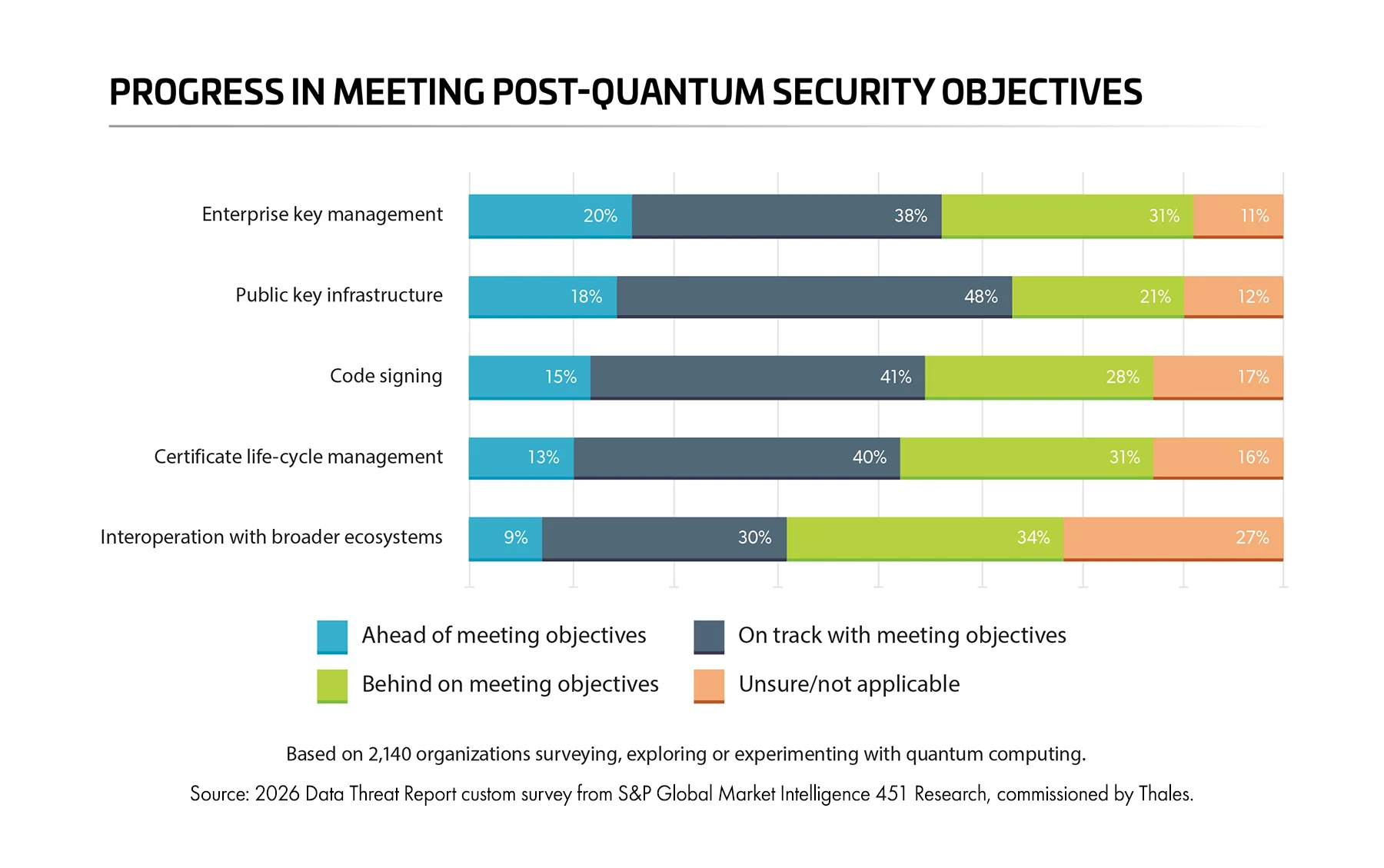
The 2026 Thales Data Threat Report illustrates the scale of the challenge. Looking at organizations' self-assessed PQC progress across critical trust infrastructure elements, only 39% rated themselves as on track or ahead of plan for interoperability with broader ecosystems, which is the lowest of any category, and 27% were unsure or said it was not applicable. Even where enterprises are making PQC progress internally, the ecosystem dependencies that surround them remain a visibility blind spot.
Preparing for quantum-resistant encryption, therefore, takes more than algorithm replacement. It requires operational readiness, governance discipline, and long-term cryptographic agility.
Components of Quantum-Resistant Encryption
What Are Quantum-Resistant Encryption Algorithms?
Quantum-resistant encryption is the process of developing encryption standards that resist both classical computers and future quantum computers.
This type of encryption comes under the umbrella term of post-quantum cryptography. Unlike traditional cryptographic systems like RSA and ECC, post-quantum cryptography is based on mathematical problems that cannot be solved by quantum computers.
Importantly, post-quantum cryptography does not require the construction of an entirely new network infrastructure. Most post-quantum cryptography solutions work with current software and communication channels; hence, they have become the industry standard for migrating to quantum computing.
NIST’s first standardized algorithms illustrate the direction the industry is taking.
- ML-KEM, standardized under FIPS 203, is a key encapsulation mechanism designed for secure key exchange.
- ML-DSA, standardized under FIPS 204, is intended for digital signatures.
- SLH-DSA, standardized under FIPS 205, provides an alternative hash-based signature approach.
These standards form the foundation for many future enterprise implementations.
Organizations evaluating quantum-resistant encryption algorithms should also understand that the field continues to evolve. NIST selected HQC in 2025 as a backup key encapsulation mechanism, reinforcing the principle that cryptographic diversity and adaptability remain important.
NIST Post-Quantum Cryptography (PQC) Standards
Standard Reference | Algorithm Name | Original Submission Name | Cryptographic Basis | Primary Purpose & Use Cases | Status |
|---|---|---|---|---|---|
FIPS 203 | ML-KEM | CRYSTALS-Kyper | Module-LWE | General Encryption & Key Exchange | Finalized |
FIPS 204 | ML-DSA | CRYSTALS-Dilithium | Module-LWE | General-Purpose Digital Signatures | Finalized |
FIPS 205 | SLH-DSA | SPHINCS+ | Cryptographic Hash Functions | Stateless Digital Signatures | Finalized |
FIPS 206 | FN-DSA | FALCON | FFT over NTRU-Lattice | Bandwidth-Constrained Signatures | Draft Standard |
Exploring Different Quantum-Resistant Encryption Methods
Lattice-based cryptography
Presently, lattice-based cryptography is attracting greater attention from commercial organizations. ML-KEM and ML-DSA fall into this category. These algorithms use complex mathematical problems involving multidimensional lattices, which are considered difficult to break using a quantum computer. Lattice-based algorithms perform well and can be applied in large-scale systems.
Hash-based cryptography
Hash-based cryptography takes a different approach. SLH-DSA belongs to this category. Hash-based methods rely on the security properties of cryptographic hash functions rather than algebraic structures. They are often viewed as more conservative from a security perspective because hash functions are relatively well understood. However, they typically involve larger signatures and can introduce performance trade-offs.
Code-based cryptography
Code-based cryptography is yet another vital type. The Classic McEliece cipher is the most famous among these. Code-based ciphers use codes for error correction and have withstood decades of attacks. However, their biggest limitation lies in the huge size of the keys.
In addition, multivariate and isogeny-based cryptography have received attention, though some candidates in these categories have been successfully attacked during the NIST evaluation process.
Quantum-Key Distribution vs PQC Comparison
| QKD | PQC |
|---|---|---|
Approach | physics-based key exchange | algorithmic crypto |
Applicability | point-to-point links, high-security fixed sites | broad software replacement, cloud/PKI |
Infrastructure | fiber/free-space, costly hardware | existing networks |
Pros/Cons | detection of eavesdropping; distance/cost limits | quantum-resistant math; larger keys |
Transitioning Strategies
Steps for Implementing Quantum Key Distribution
Quantum Key Distribution is of interest to researchers because it relies on quantum physics principles to detect any interception attempts during key exchange.
For very specific applications, QKD can offer essential security assurances.
QKD can be used for government systems, military operations, and high finance applications where sensitive communications require it despite its complexity. Some point-to-point backbones might also be candidates for QKD implementations.
However, organizations must have realistic expectations when adopting QKD. The deployment of QKD technology is associated with high costs, limited transmission distances, and operational complexity. This technology requires specialized links for deployment and focuses only on key exchange.
For most enterprise organizations, post-quantum cryptography offers broader applicability because it integrates more naturally into existing software, cloud, PKI, and identity ecosystems. The practical question is therefore not whether QKD is “better” than PQC. The better question is where each technology makes sense.
For most enterprise settings:
- PQC can serve as the scaling platform to support cryptography modernization
- QKD could be used for additional securing of very sensitive point-to-point communication links
- Certain hybrid options may be considered in selected cases
Organizations evaluating QKD should focus first on business requirements, operational feasibility, and long-term maintainability.
Integrating Quantum Resistant Techniques With Existing Systems
Migration to quantum-resistant cryptography won’t be achieved in one fell swoop. Hybrid cryptographic schemes are what most institutions will deploy initially.
A hybrid cryptographic approach involves running classical and post-quantum cryptographic schemes concurrently during transitions between them. For instance, in a TLS session, classical cryptographic algorithms such as elliptic curves can be used alongside PQC key exchanges.
Hybrid approaches are especially relevant given that enterprise ecosystems are interconnected. Organizations do not have full control over all endpoints, supplier connectivity, cloud services, customer platforms, or third-party applications.
Before any migration, organizations need cryptographic discovery and inventory tools. Security professionals must identify:
- Applications of cryptography
- Algorithms being used
- Certificates and keys in use
- Legacy cryptographic algorithms relied upon by which systems
- PQC roadmaps supported by which vendors
- Data that requires enduring secrecy
Such a discovery often highlights significant shortcomings in terms of visibility.
Another important consideration during this phase is modernizing the Public Key Infrastructure (PKI). Traditional PKIs are simply not geared toward fast certificate turnover, hybrid algorithms, or widespread cryptographic refreshment. Automation of certificate lifecycle management is thus a top priority.
Key management is another vital aspect to consider.
As highlighted in the Thales 2026 Data Threat Report, 59% of organizations are prototyping and evaluating post-quantum cryptographic (PQC) algorithms. This is because many of them are concurrently rethinking their approaches to key management, HSM solutions, and certificate automation processes.
Strategizing Implementation Steps
Developing a Phased Transition Plan
Successful quantum-resistant encryption implementation does not necessarily come from those making the greatest strides, but rather from those who have put together a well-thought-out migration program.
A systematic approach can minimize disruptions and allow room for standard development and interoperability testing.
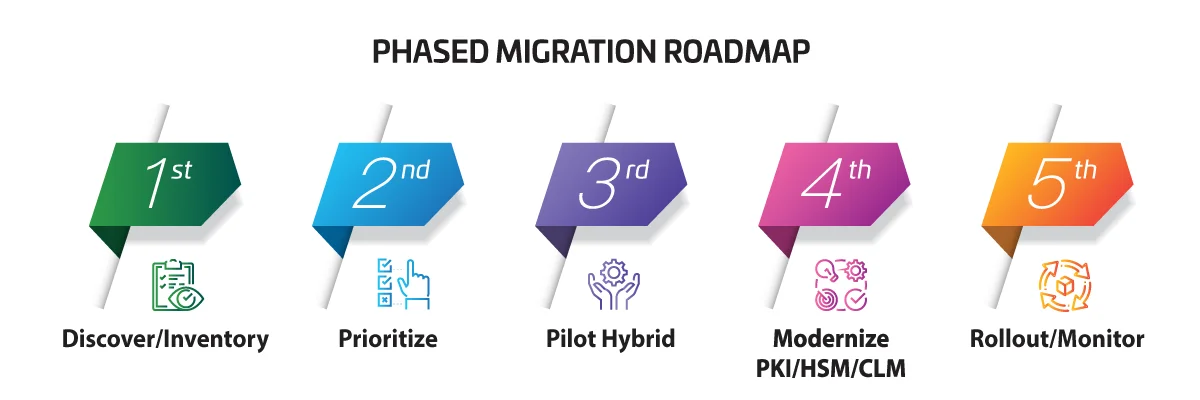
Phase one: Discovery
A detailed knowledge of cryptographic use in applications, cloud services, databases, endpoints, Internet of Things infrastructure, API interactions, firmware signatures, code signatures, and partner connections is vital for enterprises. Knowledge of certificate issuance, key storage, algorithm use, and the presence of legacy dependencies is needed. This is not given enough importance.
Organic development of cryptography happens in many organizations. Different departments are responsible for their certificate authorities; their cloud providers use different encryption models; and application departments could use cryptographic libraries within the application without proper management. If nothing is seen, nothing can be done.
Phase two: Prioritization
Not all systems pose an equal quantum risk. The organization must consider:
- Data sensitivity
- Lifespan of confidentiality
- Risk to regulation
- Criticality to operation
- Connectivity with external parties
- Third-party exposure
- Business risks associated with a cryptographic breach
Priority should be afforded to those systems that contain sensitive information that may be stored for an extended period. Systems that are related to healthcare records, intellectual property, national security, critical infrastructure monitoring, and finance transactions are examples.
Phase three: Piloting
Most organizations start with hybrid cryptography deployments in lower-risk or internal environments. Testing can be conducted on internal services, non-production infrastructure, or isolated application environments.
This is important because PQC presents real-world engineering problems.
For example, some PQC algorithms have large keys or signatures. Certificate management procedures might need to be adjusted. The performance attributes might differ from those seen with traditional cryptography. Network overhead, compatibility issues, and hardware limitations are not unexpected during testing. Such programs can ensure early detection of these concerns.
Phase four: Infrastructure upgrade
It entails upgrading the following:
- Infrastructure for PKI
- Systems for managing certificates’ entire life cycle
- Hardware security modules
- Systems for enterprise key management
- Secrets management
- Code-signing procedures
- DevSecOps pipelines
This phase is essential, since cryptographic and quantum-resistant algorithms will continue to evolve. Firms should not assume the standards will remain static. They will change in the future. Crypto-agility will enable firms to adjust without starting afresh.
Final phase: Rollout and governance
The migration process is ongoing. Monitoring should always be ongoing regarding standard development, supplier preparedness, certificate automation processes, threat intelligence, and regulatory trends. This means that quantum-safe encryption software solutions will need to be adopted into business processes.
Case Studies of Successful Implementation
Use cases are emerging as most organizations have moved beyond testing into deployment.
Federal organizations and military contractors in the U.S. are adopting CNSA 2.0 migration guidelines. Organizations will focus primarily on cryptography inventory, certificate automation, and modernizing national security systems.
Financial services organizations have also been early adopters. Major banks and financial networks now understand that persistent financial information and trusted transactions pose significant HNDL risks and other quantum attacks. Several organizations have already experimented with hybrid TLS deployments, PQC-based certificate management systems, and post-quantum code signing.
Telecommunications service providers are yet another important segment. Telecommunication companies operate large-scale, distributed infrastructure ecosystems with long hardware refresh cycles. For many such companies, the idea of implementing hybrid cryptography ecosystems that facilitate migration without interruption is becoming popular.
Healthcare firms have their own concerns. Electronic medical records remain sensitive for extended periods, and healthcare infrastructure may include legacy systems that do not allow quick cryptographic migrations. Therefore, the focus of healthcare migration plans is gradually shifting to inventory awareness and infrastructure segmentation.
Across sectors, the same lesson appears: those businesses that are succeeding with post-quantum planning treat quantum technology as a long-term operational transformation, not a single procurement exercise.
The Role of Stakeholders
Engaging Technical and Non-Technical Teams
Quantum-safe encryption tools will not thrive on their own within cybersecurity departments. Although data security and architects can spearhead a technically sound strategy, implementing it successfully requires collaboration across several parts of the organization, including infrastructure, networking, software development, compliance, procurement, law, and management teams.
Platform leaders should check for compatibility. Application managers should understand cryptographic dependencies. Procurement teams should consider vendor road maps. Compliance leaders should decipher regulatory requirements. Board members are now demanding to see resilience plans.
These diverse stakeholders become all the more critical because cryptographic modernization is a dual technology/governance problem.
Applications teams will need assistance incorporating post-quantum libraries into their applications and updating their dependencies. Infrastructure teams will be responsible for verifying hardware compatibility and automating the certification process.
Regulated organizations may face further challenges. Companies operating in financial services, healthcare, federal contracts, and critical infrastructure may be required to follow national and industry-specific guidance, as well as prepare for audits that may last several years.
Senior management is critical in this process. Quantum migrations take time and money. Therefore, communication with the boards and senior management teams regarding business risks and their long-term goals must be clear.
Building a Culture of Security Awareness
Transitioning to quantum-safe encryption may prove to be the biggest shift the entire encryption industry has ever seen.
This situation demands organizational vigilance. Post-quantum cryptography is not just about compliance and ticking a box, or an easy technical refresh, but about changing how the organization operates across trust models, software development processes, certificates, and more.
Establishing a security awareness culture involves enabling the stakeholders to recognize the importance of crypto agility.
Security complexity, in itself, poses risk too.
The 2026 Thales Data Threat Report illustrates how complexity already strains security operations. Organizations report running an average of five key management systems, with 39% using five or more. Layering a post-quantum migration on top of an environment already burdened by tool sprawl will only amplify the risk of misconfiguration and oversight unless governance and visibility are simplified in parallel.
The goal is not simply stronger algorithms, but building a trust infrastructure capable of adaptation amid changing risks, technologies, and standards.
The Future Landscape of Cryptography
Trends in Post-Quantum Cryptography
The post-quantum future will continue to develop in the coming years.
NISΤ’s first standards are significant, but they are just the start. Further testing is underway on additional algorithms, such as HQC, which NIST selected as an alternate key encapsulation method in 2025.
Governments and Regulators Accelerate Migration Expectations
NSA CNSA 2.0 guidelines establish ambitious migration paths towards PQC adoption by 2035. Meanwhile, there is growing emphasis on cryptographic security, sovereignty, and the evolution of trust infrastructure in European/North American organizations.
Certificate Management Becomes a Major Pressure Point
With the CA/Browser Forum plans to reduce the lifetime of TLS certificates to 47 days by 2029, much higher levels of automation will be needed to manage them. This presents an opportunity for organizations to evolve their CLM processes to become PQC-ready simultaneously.
Adapting Strategies as Technology Evolves
The key attribute necessary for long-term success is adaptability. It is vital for an organization not to assume that a single set of algorithms or migration strategy will always be the best. It is precisely for that reason that crypto-agility is crucial.
Crypto-agility enables:
- Algorithm replacement without having to change the entire application
- Certificate rotation at an accelerated pace
- Effective renewal of certificate chains
- Addressing new threats
- Compliance with future standards with minimal disruptions
Without crypto-agility, each change within cryptography creates an engineering disaster. Crypto-agility gives organizations more adaptability.
This kind of adaptability will prove crucial as the hybrid cloud, multicloud, artificial intelligence, and interconnected software-as-a-service systems grow.
Maintaining Up-to-Date Knowledge in Cryptography
Post-Quantum Cryptography is in constant flux. With this in mind, security leaders should bear several key considerations in mind:
- NIST Post-Quantum Cryptography standardization changes
- ENISA recommendations
- CNSA 2.0 advancements
- Certification life cycle management
- Cloud providers’ post-quantum cryptography plans
- HSM compatibility with post-quantum cryptography algorithms
- Vendor testing for interoperability
Collaboration among industry players is important, too. For many enterprises, issues of interoperability, migration sequencing, and governance structures remain unresolved. It is clear that these efforts will be crucial in the coming years.
It is important to note that organizations well-suited to the future may not be the ones to try out every new algorithm. In the future, what will benefit organizations is the ability to build resilient operations that can adapt to change.
Conclusion
Quantum-resistant cryptography is no longer a speculative conversation; the process has already begun.
NIST standards have been published, regulations are working on migration schedules, and harvest-and-decrypt attacks are forcing businesses to rethink their long-term data exposure. In parallel, the environment for enterprise cryptography is becoming increasingly complex with the rise of cloud-based infrastructure, SaaS ecosystems, artificial intelligence platforms, and distributed applications.
Organizations cannot address the problem by merely swapping out algorithms.
Strategic transition needs to involve cryptographic breakthroughs, hybrid architectures, PKI upgrades, automated certificate management, cross-enterprise key management, and future-proof cryptography. Those who are far ahead on the curve treat their post-quantum migration not as a compliance project but as an ongoing operational process.
While the timing of quantum systems from a cryptographic perspective remains unclear, the operational effort required to migrate is apparent. Organizations that start investing now in visibility, governance, and crypto-agility will have a much easier time adapting to future changes in standards, threats, and technology.
For further reading regarding post-quantum readiness, crypto-agility, and the modernization of enterprise trust infrastructure, please refer to Thales PQC Hub.