
What is software protection and licensing?
Software licensing and protection is a combination of technologies that ensures software is used legitimately and software IP and code is protected. The result of robust protection and licensing is that you can maintain the integrity and profitability of software products, even in the age of AI assisted vulnerability detection.
Software protection and licensing is about pairing security measures with business rules.
- Software protection = security measures
Technical defenses that prevent tampering, reverse engineering, or unauthorized copying. Examples include binary wrapping, encryption, and anti-debugging shields. Modern protection mechanisms employ multiple layers, ensuring that protected binaries are extremely hard to decompile, even when attackers employ AI against the software. - Software licensing = business rules
The contractual and commercial rules that govern usage. Licensing answers questions like: Who can use the software? How many people are covered? Which features are enabled? How long does the license last? The rules translate business strategies into enforceable technical requirements.
Licensing rules can specify trial periods, concurrent user limits, feature availability, geographic restrictions, or usage quotas. The sophistication of modern licensing systems allows for complex combinations of rules that support innovative business models.- License Keys
The anchors of enforcement. Keys can take various forms: hardware dongles that must be physically present, software certificates tied to specific machines, or cloud-based credentials linked to user accounts.
Regardless of format, keys validate that users have legitimate rights to access software according to the licensing rules defined by the vendor.
- License Keys
Together, these form a software protection and licensing system: a combination of technology and process that ensures software is used legitimately, protects IP, and gives businesses flexibility to adapt pricing and packaging strategies.
How to Get Software Licensing Right The First Time
Get the practical guide to software licensing the first time with comprehensive strategies that consider people, processes, and technology.
Why Software Licensing and Protection Matters
Software vendors have long faced threats to their revenue. Piracy, unauthorized copying, and license overuse cost companies billions of dollars every year. Those risks haven't gone away.
What has changed is that the same binaries once cracked for commercial gain can now be rapidly analyzed by AI-assisted tools to expose security vulnerabilities — turning a licensing problem into a customer safety problem. For vendors shipping software on-premises, in embedded devices, or via downloads, protection now needs to address both.
Software license protection is how organizations defend against these risks. It ensures that software is accessed only by authorized users, under the terms defined by the vendor. More than that, it translates business strategy into enforceable rules — turning pricing, packaging, and distribution models into technical reality.
The stakes are high. Without robust software protection and licensing, companies risk not only revenue leakage and IP loss, but also the exposure of vulnerabilities that attackers can weaponize for ransomware, data theft, and infrastructure compromise.
Protect Today's Revenue.
Unlock Tomorrow's Growth.
When protection and licensing flexibility work together, the business outcome is the ability to monetize software more systematically. Thales' Sentinel Platform brings both aspects into a single monetization ecosystem—providing engineers with protection utilities and business teams with entitlement management so that companies can protect their existing revenue and unlock their next stages of growth.
Software Licensing in Cybersecurity Strategy
Software license in cybersecurity plays three key roles:
- Protecting intellectual property: Proprietary algorithms, methods, and code often represent years of R&D. Licensing systems act as digital locks, ensuring only authorized customers can run the software.
- Preventing piracy, copying, and tampering: Licensing makes it harder to duplicate or crack software, reducing unauthorized distribution.
- Maintaining compliance: By enforcing usage rules, licensing helps organizations avoid legal and reputational risks tied to misuse.
- Defending against AI-assisted reverse engineering: Software protection creates the friction needed to slow automated analysis, buying vendors time to detect and patch vulnerabilities before attackers can exploit them.
For business leaders, this makes licensing a strategic layer of cybersecurity—as critical as firewalls or identity management systems.
What Does a Software Protection and Licensing System Do?
A complete software licensing system bridges two domains: engineering and business. On the engineering side, developers protect the software and build in license checks. On the business side, product and operations teams decide what each customer can access based on what they purchased, and manage those permissions over time. The license key connects these two domains. It is the enforcement artifact that software uses to enforce access rights.
The Engineering Domain
Developers use tools to protect the code and integrate license checks. These include:
Protection layers like control flow obfuscation, anti-debugging, anti-tampering, and binary encryption also defend against AI-assisted reverse engineering. These mechanisms systematically breaking the workflows automated tools and traditional hackers rely on to recover application logic and locate vulnerabilities.
- Automatic wrapping tools that apply multi-layered protection without touching source code.
- Licensing APIs that let developers insert fine-grained entitlement checks at the feature level.
- Encryption utilities to secure data files that accompany the software.
The Business Domain
Product and operations teams manage entitlements and customer activations. They rely on:
- Entitlement management platforms to define product permission, issue licenses, establishes a point of control over the complete license lifecycle.
- Remote update systems to push changes or extend licenses securely.
- Customer and partner seller portals that make activation simple and seamless.
To bring these two perspectives together—engineering protection and business entitlement management—you need a unifying enforcement mechanism. That mechanism is the license key.
What Role Do License Keys Play in Software Licensing Protection?
While the system defines how software is packaged, distributed, and updated, it is the license key that makes those decisions real inside the product.
Every protection check and every entitlement rule ultimately points back to the presence and validity of a key. This is why the design of license keys, and the way they are delivered, becomes the practical foundation for all licensing strategies. A license key is the enforcement artifact that software uses to enforce access rights.
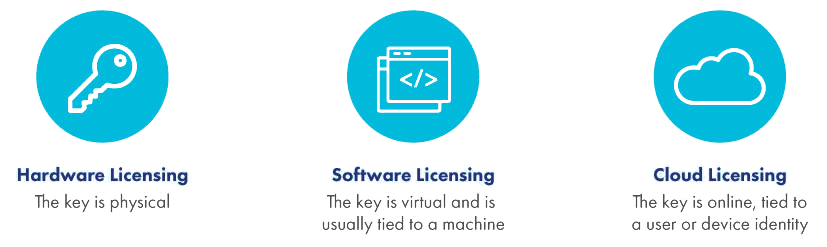
The way keys are delivered and managed creates three main licensing models: hardware-based, software-based, and cloud-based licensing.
The Logical Flow
- In hardware licensing, the key is physical.
- In software licensing, the key is virtual and is usually tied to a machine.
- In cloud licensing, the key is online, tied to a user or device identity.
Across all three models, the license key is what the software checks to enforce rules like trial periods, seat counts, or feature access. The differences lie in where the key lives (USB, local machine, or cloud) and the trade-offs between security, convenience, and flexibility.
Hardware-Based Licensing (USBs, Dongles)
Definition
A license key stored on a physical USB device (dongle). The software checks the dongle at runtime; if it’s present and valid, the program runs. The dongle itself holds license data and often cryptographic functions, making it the root of trust.
Advantages
- Highest level of security: Very difficult to tamper with; license terms stored directly on the device.
- Portability: Move the dongle between machines to use the software elsewhere.
- Flexible deployment: Can support both individual licenses and network pools
- Advanced features: Supports secure on-device code execution, time-limited licenses (via virtual clock), and network seat sharing.
- Offline use: Works without internet access.
Limitations
- Physical logistics: Requires manufacturing, shipping, and managing USB devices.
- Less convenient for electronic delivery: Slower to deploy at scale compared to software or cloud models.
- Dependency on hardware access: No dongle, no software — which can be a hurdle for remote or virtualized environments (though dongle servers exist to bridge this).
Software-Based Licensing (Virtual Keys)
Definition
A license key stored virtually on a specific computer or device. The software checks entitlements stored on the local key whenever it runs. The key is bound to that device, making the machine itself the enforcement anchor.
Advantages
- Instant activation: Users can download, activate, and start using software immediately.
- Low logistics cost: No shipping or physical handling required.
- Flexible deployment: Can support both individual licenses and network pools (with “detached” licenses for offline use).
- Good fit for electronic software distribution (ESD).
- Emergency and trial licenses: Unlocked Software-Based licensing key can be used to issue temporary access or trials.
Limitations
- Device lock-in: If the license tied to one machine; reinstallation or hardware replacement may require reactivation. (In these cases, virtual keys that are “unlocked” are the more flexible solution, and not bound to a specific machine)
- Lower maximum security: Easier to attack than a hardware dongle, though still highly secure when implemented correctly.
Cloud-Based Licensing
Definition
A license key stored in the cloud. The user logs in (user-based licensing) or a device presents a digital identity string (device-based licensing). The software checks entitlements against the cloud license server, which grants or denies access.
Advantages
- License mobility: Works across devices; the license follows the user, not the machine.
- Easy sign-on: User access can be established through a username and password, coordinated with existing identity systems, instead of through a typical license key containing a string of letters and numbers.
- Virtualization-friendly: Ideal for cloud, containers, and VMs — no fingerprinting headaches.
- Centralized control: Vendors or IT admins can enable/disable access instantly.
- Business insights: Usage data can be collected to support usage-based billing, or upsell and cross sell strategies.
Limitations
- Connectivity required: Needs online access for validation, though some systems allow temporary offline detachment.
- Service dependency: Relies on a stable cloud infrastructure.
Strategic Implementation Considerations
Successful software protection and licensing requires careful attention to strategic factors that extend beyond immediate technical implementation.
- Business model enablement represents perhaps the most important strategic consideration. Modern licensing systems must support not just current business models but also future evolution as markets change and customer expectations shift. Subscription and consumption-based pricing models require robust enforcement mechanisms, while freemium approaches need seamless upgrade paths from trial to paid usage.
- Cross-platform compatibility has become essential as enterprise computing environments increasingly embrace diversity. Licensing systems must function consistently all deployments (on-premises, cloud and hybrid) while supporting virtual machines, containers, and cloud computing environments. This compatibility ensures that licensing decisions don't constrain deployment flexibility or limit market reach.
- License mobility addresses modern work patterns where users operate across multiple devices and locations. Advanced licensing systems support license transfer between devices, temporary license checkout for offline use, and cloud-based licensing accessible from anywhere with internet connectivity.
- Performance and reliability considerations often determine customer satisfaction more than security features. Protection systems must minimize impact on application startup and runtime performance while maintaining consistent operation across diverse hardware configurations and network conditions. Clear error messages and graceful failure handling become crucial for maintaining positive customer experiences.
How Thales Sentinel Helps Protect and License Your Software
Building exceptional software is only the beginning. The real test comes when you need to shield your innovations from attack while delivering frictionless access to legitimate users.
Thales Sentinel addresses both sides of that challenge through a complete platform built around two complementary layers.
Sentinel Envelope is the protection layer. It hardens your application against reverse engineering, tampering, and runtime inspection — without touching your source code. Through control flow obfuscation, anti-debugging, anti-tampering, and binary encryption, Envelope systematically breaks the workflows that attackers and AI-assisted tools rely on to recover application logic and locate vulnerabilities. Whether your software runs on-premises, in embedded devices, or via customer-controlled environments, Envelope ensures that even if an attacker accesses the binary, they cannot easily analyze what's inside it. The broader Sentinel platform is the monetization and licensing layer. It gives engineering and business teams the tools to define, enforce, and manage exactly how software is accessed and used. Hardware, software, and cloud-based licensing models support everything from individual seat licenses to usage-based and subscription pricing. Entitlement management ensures customers get access to precisely what they purchased — and that those rights can be updated, expanded, or revoked as the relationship evolves.
Together, these layers form a complete software monetization ecosystem: Envelope protects the binary, and the platform controls who uses it, how, and on what terms.
With over 30 years of experience, Thales has powered the revenue growth of some of the world's most successful software-driven businesses across healthcare, industrial automation, networking, and AI. Contact a specialist today for a personalized assessment of how Sentinel can help you protect your software, your customers, and your business.
Contact a specialist today for a personalized assessment of how Sentinel can help you protect your software, your customers, and your business.