 Thales | Security for What Matters Most
More About This Author >
Thales | Security for What Matters Most
More About This Author >
Thales | Security for What Matters Most
More About This Author >
Thales | Security for What Matters Most
More About This Author >
Application development has changed dramatically. Enterprises now release software faster, operate more digital services, and deploy applications across a mix of public cloud, private cloud, APIs, containers, and on-premises infrastructure.
As application delivery has accelerated and architectures have become more distributed, a disconnect has emerged between the teams building applications and those responsible for protecting them.
This tension is often described as the Wall of Confusion between DevOps and IT Security.
But the challenge does not stop there.
Over time, organizations have also introduced multiple security tools to protect different parts of the application stack. Each tool is managed separately, often by different teams, through different platforms, policies, and workflows.
The result is an additional layer of complexity. Security teams must navigate multiple vendors and fragmented controls, while DevOps teams experience delays as security becomes harder to integrate into fast-moving development cycles.
Understanding how to break down both the organizational and operational layers of this confusion is essential for organizations that want to maintain innovation while ensuring consistent, scalable security.
Applications Now Run Across Hybrid Environments
Modern application environments rarely exist in a single location. Today around 40% of enterprise applications run in the public cloud, and that number is expected to rise significantly to 62% over the next two years.
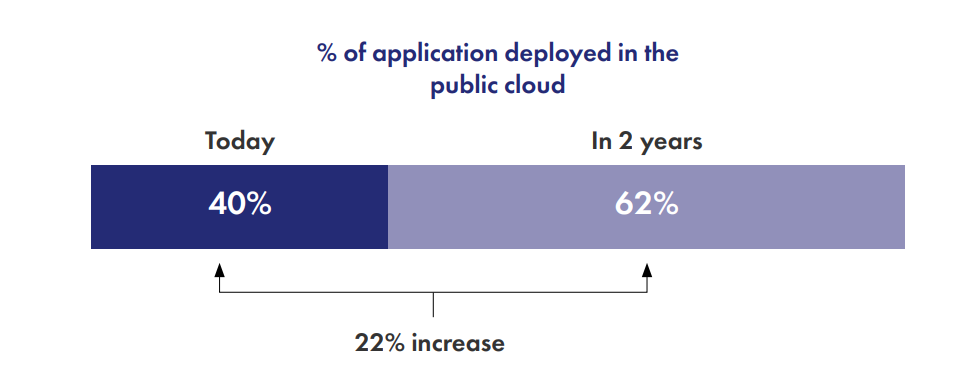
Source: Vanson Bourne Study, "DevOps vs Security: Breaking Down the Wall of Confusion in Modern Application Delivery"
Yet the shift to cloud does not mean applications live in one place. Most organizations now operate across hybrid and multi-cloud environments where applications run across public cloud platforms, private cloud infrastructure, on premises systems, Kubernetes clusters, and an expanding network of APIs.
Cloud-agnostic strategies are also becoming more common as organizations seek flexibility and avoid dependence on a single provider. At the same time, many enterprises continue to operate legacy systems alongside modern cloud-native services.
The result is a highly distributed application landscape. Applications now run across multiple environments simultaneously, and security must be able to protect them wherever they operate.
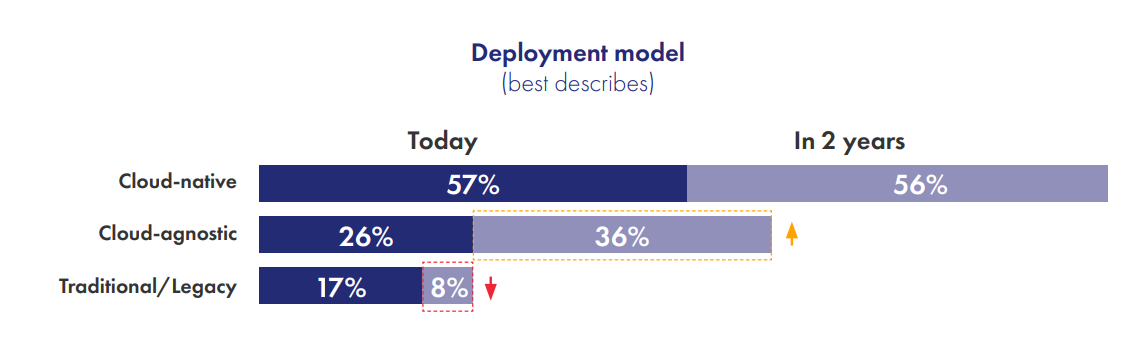
Source: Vanson Bourne Study, "DevOps vs Security: Breaking Down the Wall of Confusion in Modern Application Delivery"
DevOps and Security Want the Same Outcome
Despite the perception of conflict, DevOps and IT Security teams are largely aligned on the goals of modern application security. Both groups ultimately want the same outcome: applications that are secure, reliable, and able to scale with business demand.
Research conducted with Vanson Bourne reinforces this alignment. 96% of DevOps and 95% of IT Security professionals agree that modern environments require security that is flexible across any architecture.
This global study of 1,500 professionals across the US, Europe, and APAC highlights an important point. Modern application security is not just a technology problem. It is a workflow and collaboration challenge.
Security and DevOps want the same outcome, but they experience different frustrations. These gaps can create delays, bottlenecks, false positives, and friction that undermine the cloud-native innovation organizations are working to achieve.
Modern Application Delivery Trends
Based on a global study conducted by Vanson Bourne, this white paper reveals how organizations are addressing the challenges of modern application delivery—uncovering key gaps, risks, and opportunities to better align DevOps and Security.
The Wall of Confusion: Conflicting Priorities, Fragmented Security and Tool Sprawl
The Wall of Confusion is not just about DevOps and Security working in silos. It is also about how security is delivered. Over time, organizations have added more and more security tools. One for web applications, another for APIs, another for cloud, another for containers. Each tool solves a specific problem, but together they create complexity instead of clarity.
Security teams are left navigating multiple vendors, switching between management platforms, and maintaining different policies across environments. This makes it difficult to keep controls aligned and increases operational overhead.
At the same time, gaps begin to appear. As applications move across environments, it is not always clear if they are fully protected. Policies become inconsistent because what is set in one environment does not automatically apply to another.
In fact, based on a 2026 survey of Imperva Application Security customers, 77% of security professionals say operational complexity is their biggest challenge.
For DevOps teams, this complexity shows up as delay. Security becomes a bottleneck not because it is unnecessary, but because it is too difficult to operationalize.
That is the wall and it is what needs to come down.
Why Traditional Security Models Fall Short
When applications operate across multiple environments, security approaches designed for fixed infrastructure quickly become difficult to manage.
Many organizations rely on a mixture of embedded protections, centralized security services, and environment-specific tools to protect different parts of their application landscape. While each solution may address a particular need, together they can create fragmented security architectures. This fragmentation leads to inconsistent policies, duplicated alerts, limited visibility, and increased manual effort.
Security teams must manage multiple tools and workflows, while development teams experience delays when security is applied inconsistently or too late in the process. Both teams are constrained by the same underlying issue: security models that were not designed for modern, distributed application environments.
Security Must Move with the Applications
Modern applications are no longer tied to a single infrastructure model. They are composed of microservices and APIs, deployed through automated pipelines, and distributed across multiple environments.
Security therefore cannot remain a centralized checkpoint that appears late in the development process. Instead, protection needs to move with the application and operate consistently wherever that application runs.
This means security controls must function across public cloud environments, private infrastructure, hybrid deployments, Kubernetes clusters, APIs, and the traditional systems that many organizations still rely on.
DevOps and IT Security teams increasingly recognize this shift. They are not asking for less security. They are asking for security that works the way modern applications work.
Securing Applications Anywhere with Thales
As application architectures continue to evolve, organizations are no longer dealing with a single security challenge, but with the need to protect applications consistently across every environment they operate in.
The issue is not just distribution. It is how to secure that distribution without adding more tools, more complexity, or more operational overhead.
Security strategies built around isolated environments or disconnected tools are no longer sufficient. What is needed is a unified approach that delivers consistent protection, visibility, and control across the entire application landscape.
Now, the question becomes how to deliver that in practice.
Many vendors talk about flexibility but still require organizations to choose a single deployment model or manage multiple disconnected solutions. Imperva takes a fundamentally different approach. It meets organizations where they are, supporting multiple deployment models while maintaining a single, unified security experience.
This includes protection for internet-facing applications and APIs through Imperva Cloud, native integration for public cloud environments (Imperva for Google Cloud), container-based deployment for Kubernetes and microservices, and gateway deployment for on-premises, hybrid, and air-gapped environments.
The key is that all of these deployment options are powered by the same Imperva Security Engine.
This means one management console, consistent policies across every environment, and unified visibility across the entire application portfolio, regardless of where applications are deployed. Security teams do not need to manage multiple tools or vendors, and DevOps teams do not need to change how they build and deploy applications.
That is what securing applications anywhere really means.
Explore more key findings from our study with Vanson Bourne
Drawing on a Vanson Bourne study, this report exposes the real-world challenges organizations face in modern application delivery—and how to overcome them.