 Aamir Sardar | Director Alliances, Thales CSP
More About This Author >
Aamir Sardar | Director Alliances, Thales CSP
More About This Author >
Aamir Sardar | Director Alliances, Thales CSP
More About This Author >
Aamir Sardar | Director Alliances, Thales CSP
More About This Author >
AI Innovation is Moving Faster Than AI Security
AI is moving fast. What started as experimentation is quickly becoming a real-world deployment across nearly every industry. But as organizations scale AI initiatives, many are realizing that innovation alone is not enough. Trust, governance, and security are now among the biggest challenges in enterprise AI adoption.
From protecting sensitive training data and securing AI pipelines to defending against prompt injection and maintaining compliance across hybrid environments, security teams are being asked to move just as fast as AI innovation itself. At the same time, they still need to maintain control over sensitive data, enforce governance policies, and reduce operational risk.
Bringing Data-Centric Security to the HPE Unleash AI Partner Program
That’s why joining the HPE Unleash AI partner program feels like such a natural next step for Thales.
The HPE Unleash AI partner program is a curated ecosystem, combining ISV solutions that go through comprehensive validation testing with engineered HPE AI systems, including HPE Private Cloud AI and the broader HPE AI Factory with NVIDIA solutions, to deliver the performance, security, and scalability enterprises need for production AI. Through this collaboration, Thales and HPE are working together to strengthen AI security and compliance across data, infrastructure, pipelines, AI applications, and emerging agentic AI environments.
Thales has long been a strategic security partner for HPE, with integrations spanning HPE compute, storage, networking, and hybrid cloud solutions. Together, we help customers address growing requirements around security, sovereignty, governance, and compliance across hybrid environments.
Joining the HPE Unleash AI partner program represents the next step in that collaboration, extending our work further into enterprise AI. By integrating turnkey, sovereign, and at scale solutions from the NVIDIA AI Computing by HPE portfolio, the Thales AI Security Fabric can help protect customers' sensitive data and intellectual property while maintaining visibility, governance, and control across AI deployments.
“Organizations are moving quickly to operationalize AI, but trust, governance, and security must scale alongside innovation,” said Robin Braun, Vice President of AI Business Development, Hybrid Cloud, HPE. “Through the HPE Unleash AI Partner Program, collaborations with partners like Thales help organizations build AI environments that protect sensitive data, strengthen compliance, and accelerate responsible AI adoption across hybrid and private cloud environments.”
Securing AI Across Data, Pipelines, Applications, and Infrastructure
AI adoption is also expanding the enterprise attack surface in new ways. Companies now face risks tied to prompt injection, data leakage, insecure AI pipelines, model poisoning or misuse, and unauthorized access to underlying sensitive data. At the same time, evolving regulations and sovereignty requirements are increasing the need for stronger governance and visibility across AI deployments.
To help address these challenges, Thales and HPE bring together:
- NVIDIA AI Computing by HPE portfolio is designed for scalable AI deployments from enterprises to model builders and sovereigns.
- Thales AI Security Fabric capabilities spanning data protection, runtime AI security, encryption/tokenization, centralized key management, secrets management, and hardware-rooted trust
- Centralized governance and policy enforcement across hybrid, sovereign, air-gapped, and multi-cloud environments
Built on a data-centric security approach, Thales AI Security Fabric helps secure AI systems from data ingestion to inference and retrieval-augmented generation (RAG). Through integrated capabilities including CipherTrust Data Security Platform (CDSP), Thales Luna Hardware Security Modules (HSMs), and Imperva AI Application Security, enterprises can apply more consistent protection across AI pipelines, workloads, models, and user interactions.
But securing AI is not just about deploying another security tool. It’s about giving teams the confidence to move faster without losing control of their data, policies, or governance standards. As AI becomes more embedded in everyday business operations, security can't become a bottleneck to innovation.
Thales AI Security Use-Cases for HPE Unleash AI
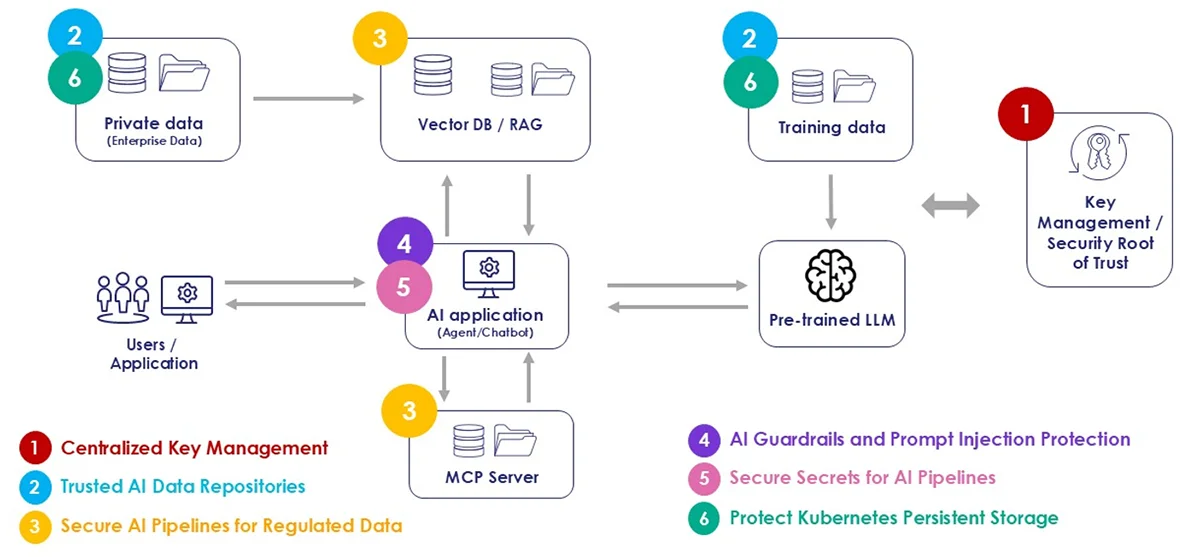
Real-World AI Security Use Cases
One of the things I find most interesting about enterprise AI right now is that every company seems to be asking the same question in different ways: “How do we move faster with AI without creating new security and compliance risks?”
These challenges show up across almost every part of the AI environment, from protecting training data and securing pipelines to governing AI applications and maintaining control in highly regulated environments.
Through the HPE Unleash AI partner program, Thales has validated several AI security use cases with HPE to help address these real-world challenges, including:
Centralized Key Management with Hardware Root of Trust
As AI deployments expand across hybrid, private cloud, and multi-cloud environments, enterprises need consistent control over encryption keys and security policies. Thales helps centralize key management and policy enforcement, strengthening governance and compliance through hardware-rooted trust.
Trusted AI Data Repositories
AI models rely on curated datasets that must be protected from unauthorized access, insider threats, tampering, and data poisoning. Thales secures AI datasets across storage, databases, and compute infrastructure through encryption, centralized key management, and policy enforcement to safeguard sensitive training data and intellectual property.
Secure AI Pipelines for Regulated Data
Organizations in industries such as financial services, healthcare, and government often need to use regulated data, including PII and PHI, in AI workflows. Thales helps de-identify sensitive data before it enters AI pipelines, enabling teams to build and analyze AI models while reducing privacy and compliance risks.
Protect Kubernetes Persistent Storage
Containerized AI workloads on Kubernetes often rely on persistent storage, which can be vulnerable to unauthorized access or privilege escalation. Thales helps secure persistent volumes with encryption and policy-based access controls, ensuring only authorized workloads can access sensitive data.
AI Guardrails and Prompt Injection Protection
Enterprise applications using LLMs are increasingly exposed to risks such as prompt injection, jailbreak attacks, malicious prompts, and unintended data leakage. Thales helps inspect prompts and responses in real time to detect unsafe activity and prevent misuse before requests reach sensitive models.
Secure Secrets for AI Pipelines
AI workflows often rely on API keys, credentials, and tokens to connect models, datasets, and services. Thales helps securely store and inject credentials into AI pipelines without embedding secrets directly in code, prompts, or repositories.
Building Trusted AI Environments
Together, Thales and HPE are enabling enterprises to build AI environments that are scalable, secure, and designed with governance in mind from the start. By combining HPE's enterprise AI infrastructure with Thales AI Security Fabric's data-centric capabilities, customers can better protect sensitive information while maintaining visibility and control across AI deployments.
This approach helps customers:
- Protect sensitive AI training and inference data
- Secure AI applications against prompt injection and misuse
- Centralize encryption key management across AI environments
- Strengthen compliance and audit readiness
- Support sovereign and air-gapped AI deployments
- Reduce operational complexity through unified security controls
“AI is reshaping how organizations innovate, operate, and compete, but the success of AI ultimately depends on trust,” said Todd Moore, Global VP of Data Security Products at Thales. “Organizations need confidence that their data, models, and AI interactions are protected in increasingly complex environments. In collaboration with HPE, we enable organizations to accelerate AI adoption without sacrificing governance, security, and control.”
What’s Next
Beyond AI, Thales and HPE continue to collaborate across a broad range of security initiatives spanning compute, storage, networking, hybrid cloud, and data protection. To learn more about Thales and HPE's collaboration, explore these resources, or feel free to contact me directly. These are conversations I’m having with customers and partners every day, and I’m always happy to connect and exchange ideas around AI security and data protection.
For further information: