What is data security governance?
Data security governance is the set of policies, controls and evidence that define how sensitive data is located, accessed, protected and reported on. Unlike periodic audits, CipherTrust DSPM keeps that evidence continuous – showing where data resides, who can reach it and whether protection matches policy – so control can be demonstrated at any time.
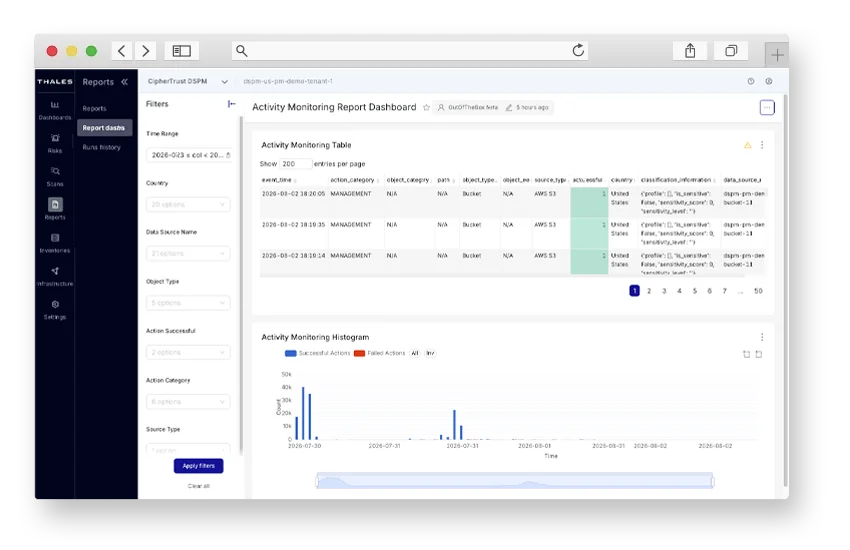
Maintain Control Over Data Risk
Prove control, strengthen governance, and reduce uncertainty across distributed data environments.

Continuous Readiness
Give compliance, audit and security teams greater confidence that business-critical data is governed and protected. Support faster evidence gathering and reduce the stress of preparing for regulatory reviews or internal audits.

Strengthen Governance
Create a more consistent approach to managing sensitive data risk across cloud, SaaS, AI and hybrid environments. Reduce policy gaps and improve accountability across data owners, security, and compliance teams.

Meet Sovereignty Needs
Deliver confidence that data is managed according to regional, regulatory, and operational requirements. Maintain control over where data resides, who can access it, and how it is protected.

Reduce Uncertainty
Provide stakeholders a clearer understanding of data location, ownership, access, exposure, and protection posture. Make faster decisions when responding to audits, incidents, policy exceptions, or governance questions.

Align Teams
Create a shared view of data risk that helps security, privacy, compliance, and data teams work from the same evidence. Improve coordination and reduce delays caused by fragmented tools or disconnected reporting.

Report on Progress
Provide leaders an understanding of how data risk is being governed over time. Deliver clearer reporting on control posture, policy alignment, audit readiness, and risk reduction across the enterprise.
Govern Data Risk
CipherTrust DSPM delivers the power to maintain control over sensitive data by connecting visibility, risk context, policy alignment, and compliance evidence. Gain a better understanding of where data resides, who can access it, how it is protected, and where governance action is needed.
Data Governance and Control Capabilities
Maintain evidence of data location, access, activity, exposure, and protection posture. Support audit, compliance, and risk reporting with current data security posture information across distributed environments.
Identify where sensitive data falls outside expected governance, access, or protection policies. Validate whether controls are in place and highlight gaps that may require policy updates, remediation, or additional protection.
Help teams review who can access sensitive data across users, groups, roles, applications, services, third-parties, and AI tools. Support least-privilege initiatives and reduce excessive or inappropriate access.
Support regional and regulatory governance by identifying where sensitive data resides and how it is controlled. Help teams align data risk management with residency, sovereignty, and customer-controlled protection requirements.
Provide reporting views that help communicate data location, exposure, access, protection posture, and remediation progress to security, compliance, audit, privacy and executive stakeholders.
As business-critical data spreads across clouds, SaaS, AI and hybrid environments, control becomes harder to maintain and prove. CipherTrust DSPM enables organizations to move from fragmented and manual governance to continuous oversight, giving teams the evidence and context needed to manage data risk with confidence.
Why Continuous Control Matters
Data governance requires ongoing evidence, policy alignment, and control.
67 %
of organizations that experienced cloud attacks cite credential theft as the leading attack technique against cloud management infrastructure. (Thales 2026 Data Threat Report)
61 %
of organizations report their AI applications are being targeted by attackers, with sensitive data the leading target. (Thales 2026 Data Threat Report)
52 %
of organizations rank identity and access management as their most pressing security discipline. (Thales 2026 Data Threat Report)
Security that integrates with your technology ecosystem
With one of the industry’s largest cyber security technology ecosystems, Thales solutions integrate with the most widely used technologies to protect and secure access to your mission-critical applications and data.
















Related solutions
Explore adjacent Thales capabilities that strengthen discovery, protection, and control across the data estate.
Maintain Control of Data Risk
Learn how CipherTrust DSPM can help your organization govern sensitive data, validate control posture, support audits, and maintain visibility across cloud, SaaS, AI, and hybrid environments.
We think Thales DSPM is a strong option for organizations that need a single platform covering discovery, classification, and native data protection without stitching together multiple vendors. The case is particularly strong for regulated industries and organizations with on-premise or hybrid infrastructure, where cloud-native DSPM tools often fall short. If your security requirements include full encryption key ownership, tokenization, and data masking enforced at the data layer across cloud and on-premise environments, Thales is well worth the investment.”

RESOURCES & FAQS
Related resources



Frequently asked questions about Data Governance and Control
CipherTrust DSPM empowers organizations to understand where sensitive data resides, who can access it, how it is exposed, and whether protection controls are in place. This gives teams the evidence needed to govern data risk more effectively.
CipherTrust DSPM helps maintain evidence of data location, exposure, activity, and protection posture so teams can respond to audit and compliance requests with greater speed and confidence.
CipherTrust DSPM helps identify where sensitive data resides and how it is controlled, supporting governance decisions tied to data residency, regional compliance, customer-controlled keys, and sovereignty policies.
Control reduces data risk by enabling teams to identify policy gaps, validate protection coverage, address excessive access, and maintain evidence that sensitive data is governed according to business and regulatory expectations.
CipherTrust DSPM gives leaders clearer visibility into data risk, control posture, and governance progress to understand where exposure exists and how the organization is reducing risk over time.
CipherTrust DSPM maps which users, groups, roles, applications, third parties and AI tools can access sensitive data, flags excessive or inherited permissions, and gives data owners the evidence to enforce least privilege. Access findings flow into the same remediation and reporting workflows as protection gaps.