Enterprise Key Management Solutions - Solution Brief
Discover how organizations can centrally manage keys for third-party devices including Microsoft SQL TDE, Oracle TDE, and KMIP-compliant encryption products.

It is costly and complex for IT organizations to protect data using multiple encryption technologies across disparate data silos, such as file-servers, databases, virtual environments, and cloud storage.
Enterprise Key Management solutions from Thales, enable organizations to centrally manage and store cryptographic keys and policies for third-party devices including a variety of KMIP Clients, TDE Agents on Oracle and Microsoft SQL Servers, and Linux Unified Key Setup (LUKS) Agents on Linux Servers. CipherTrust Enterprise Key Management delivers a robust, standards-based platform for managing encryption keys to protect data in disparate storage repositories across the enterprise. It simplifies the administrative challenges around encryption key management to ensure that keys are secure and always provisioned to authorized encryption services.
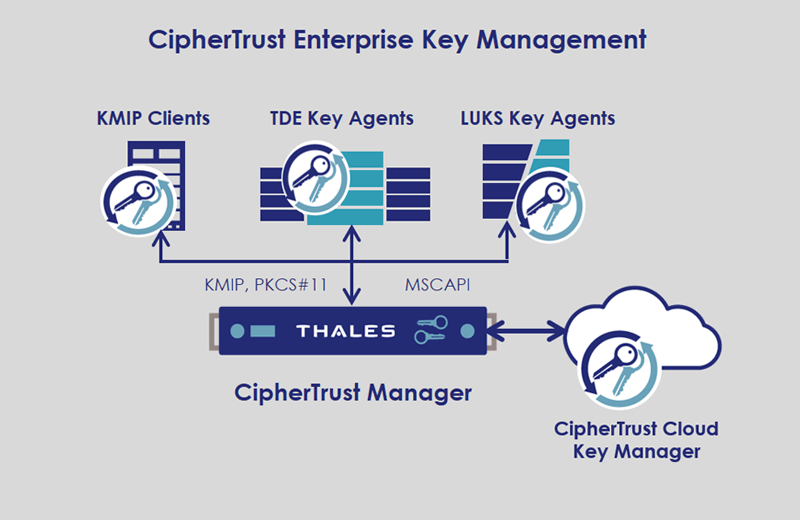
Leverage CipherTrust Manager for managing keys for Thales data protection connectors and third-party applications including Microsoft SQL TDE, Oracle TDE, and KMIP-compliant encryption products.
Enterprise Key Management simplifies the process of managing cryptographic keys, enabling security teams to gradually consolidate the management of encryption across the enterprise that can reduce cost of ownership and minimize overall risks.
Minimize key availability and redundancy, leveraging secure replication of keys across multiple appliances with automated backups. Automated alerts help prevent unexpected key expiration.
CipherTrust Manager offers the following Enterprise Key Management solutions.
CipherTrust KMIP Clients:
Centrally manage keys across a variety of KMIP clients.
CipherTrust TDE Key Agents:
Protects data in databases using Transparent Data Encryption (TDE) Key Agents on Oracle and Microsoft SQL Servers.
CipherTrust LUKS Agents:
provides transparent data encryption on Linux servers using Linux Unified Key Setup (LUKS) Agents.
CipherTrust Cloud Key Manager:
Supports BYOK use-cases by centrally managing keys for multi-cloud environments, such as AWS, Microsoft Azure, Salesforce and more.
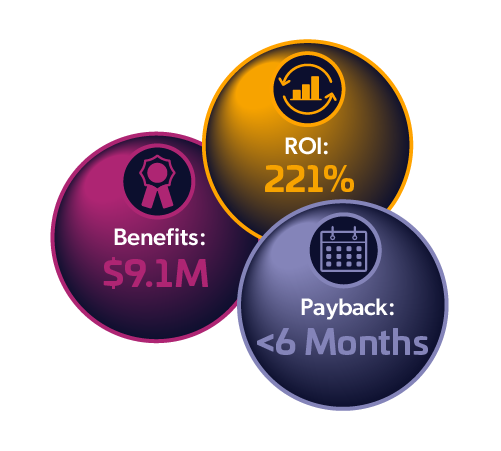
Cost Savings and Business Benefits
Enabled by the CipherTrust Data Security Platform


Discover how organizations can centrally manage keys for third-party devices including Microsoft SQL TDE, Oracle TDE, and KMIP-compliant encryption products.
Microsoft SQL Server and Oracle Database solutions provide native transparent database encryption (TDE) that protects the data stored in their customers’ enterprise and cloud-hosted databases. And, as with any encryption-based security scheme, securing and managing the...

Today, every IT organization is striving to protect valuable digital assets from accidental exposure or intentional misuse. To meet various digital privacy regulations and compliance mandates, many organizations have deployed a variety of point encryption solutions as a...

Thales offers CipherTrust Manager as the central enterprise key management solution for an expansive ecosystem of storage and archive infrastructure partners, as described in this Solution Brief
Enterprise Key Management (EKM) is a comprehensive key management term that covers the policies, tools, and strategies enterprise organizations use to provision, distribute, and rotate cryptographic keys. By adopting a trusted EKM system, like CipherTrust Key Management Solutions from Thales, enterprise organizations can centralize the management and storage of crypto keys, preventing unplanned downtime, lowering their costs, and streamlining administration.
KMS refers to Key Management solutions, services, or systems. HSM is an acronym for Hardware Security Module. KMSs are software that centralizes key generation, management, and storage, enabling businesses to track key usage and maintain regulatory compliance, while HSMs are tamper-resistant physical processors that securely store cryptographic keys.
Key Management Interoperability Protocol (KMIP) is a standardized communication protocol that allows transmission between secure apps, such as email platforms or databases, and key management systems (KMSs). KMIP is significant for key management because it enables different types of encryption systems and KMSs to operate seamlessly together, making it easy for organizations to securely work with multiple vendors.
EKM aids compliance with cybersecurity and data privacy regulations by helping enterprise businesses manage cryptographic keys securely, including processes like key activation, replacement, recovery, backup, revocation, and destruction. EKM systems also create accurate and detailed audit trails, establishing proof of compliance with FISMA, GDPR, HIPAA, and other regulatory requirements.
To successfully manage encryption keys at scale, businesses need to overcome challenges such as cryptographic sprawl, compliance gaps, human errors from manual processes, and data breaches, which pose particular risks to organizations that use multiple cloud services. Thales CipherTrust Key Management Solutions help businesses overcome these challenges by streamlining cryptographic key management, making it easy to securely store and manage keys from one centralized platform with seamless multi-cloud integration.
Centralizing an organization’s key management with a single platform reduces risk by streamlining key management across multiple clouds and environments, such as Google Cloud, AWS, and Azure. Unification prevents data silos, reduces administrative overhead costs, and makes it easier to establish consistent policies, while simultaneously eliminating human error by automating manual processes.