Software License Management vs. Software Licensing: What's the Difference?
Search for “software license management” and you quickly run into two different kinds of solutions using similar language to describe very different jobs.
One is the concept of license management which sits within the broader category of software asset management, and the other is license management which sits within the broader category of software monetization and software IP protection.
Both sides may talk about managing software licenses. The difference is whether they are managing software the company bought, or software the company sells.
Software license management is typically for software buyers. In the context of buyers, license management is how a company tracks, governs, and optimizes the licenses on the software it has purchased.
Software licensing is typically for software vendors. Within the vendor context, software license management is how a company that sells software defines, grants, and enforces what a customer is allowed to use.
In vendor contexts, terms like software licensing, software license management, and entitlement management are often used interchangeably. Licensing defines and enforces customer rights. License management refers to the operational work of maintaining those rights over time. Entitlement management is the backend system that keeps those rights accurate as customers, products, and commercial terms change.
What Software License Management Means for Software Buyers
Software license management is the internal discipline of knowing what software licenses your company has bought, how they are being used, and whether that usage matches your contracts.
If your company buys software from other vendors, software license management is the process of tracking what licenses you own, how they are being used, and whether that usage matches your contracts. It is typically handled by IT, procurement, compliance, or software asset management teams.
The purpose is internal governance. It is about controlling cost, reducing compliance risk, and improving visibility into software use across the organization. It is usually a discipline within software asset management, used to manage software the company has purchased and deployed.
A software license management platform helps answer questions like:
- What licenses does the company own?
- Are those licenses being used effectively?
- Are you paying for software that no one is using?
- Are you exposed if a vendor audits you?
- Where can you reduce waste without creating risk?
It does not manage the rights of that company’s customers. It does not enforce access inside a software product. And it is not built to support packaging, monetization, or entitlement changes on the vendor side.
Goals of enterprise software buyers when purchasing software license management platforms
Organizations usually invest in a robust software license management tool when manual tracking becomes unreliable. In practice, many organizations start looking for license tracking software when usage data, contracts, and renewals become too hard to manage manually.
What triggers a buying decision?
- Audit risk: The company cannot clearly prove that software usage matches contract terms.
- Rising software spend: Leadership wants better control over license costs, but the business lacks clear visibility into what it owns and uses.
- Low utilization: The company suspects it is paying for software that is underused or unused.
- Growing complexity: SaaS, cloud, on-premises systems, and multiple vendors make license tracking harder to manage manually.
- Renewal pressure: Teams need better data before renewing contracts or making new purchasing decisions.
- Compliance gaps: IT and procurement need a more reliable way to compare purchased rights against actual usage.
From the buyer perspective, these triggers usually signal a loss of control over the software estate. The organization may have licenses spread across departments, contracts stored in different places, and usage data sitting in separate systems. As a result, IT, procurement, and finance struggle to answer basic questions: What software do we own? Who is using it? Are we compliant with the terms? Are we paying for more than we need?
A software license management tool helps buyers bring that information together so they can manage software as a controlled business asset. It gives teams a clearer view of license ownership, usage, renewals, compliance exposure, and cost optimization opportunities. This makes it easier to prepare for audits, negotiate renewals, reclaim unused licenses, reduce waste, and make better decisions about future software purchases.
What Software Licensing Means for Software Vendors
Software licensing is a vendor-side discipline that connects the software or feature sold to what the customer is permitted to use.
The purpose of software licensing is to make sure customer access matches the commercial terms of the sale. It gives software vendors a structured way to grant, enforce, and manage those rights as products, offers, and customer agreements change over time. It is typically handled by product management, licensing operations, and revenue teams, with strong involvement from engineering.
Software licensing affects packaging, fulfillment, renewals, entitlement changes, and customer access over time. Depending on how mature the business the licensing can impact revenue operations, sales operations, customer success, support, finance, and legal.
In practical terms, teams evaluating license management software ask questions like:
- What exactly did this customer buy?
- What should they be able to access today?
- What changes when they upgrade, renew, or expand?
- How does the product know whether to allow access?
A simple licensing setup works when you have one product, one pricing model, and limited complexity. That starts to unravel once you add more products, more packaging options, new pricing approaches, or more demanding deployment requirements.
Vendor-side licensing is also closely tied to software IP protection and copy protection. Software vendors are not just trying to decide what a customer should be allowed to use. They are also trying to prevent unauthorized copying, over deployment, tampering, key sharing, and other forms of misuse that can erode revenue and expose valuable software assets.
At that point, licensing stops being a small technical task and becomes an integral function of how the business delivers and controls what it sells.
Vendor goals when purchasing a platform to manage software licensing
Software vendors usually start looking to invest in a commercial software licensing platform when a homegrown approach stops scaling. Simple licensing tools might work for a single product and a flat per-seat model. But homegrown is harder to manage when businesses introduce usage-based pricing, SaaS delivery, or multi-geography distribution. Engineering resources that should be devoted to product development are wasted building and maintaining licensing infrastructure.
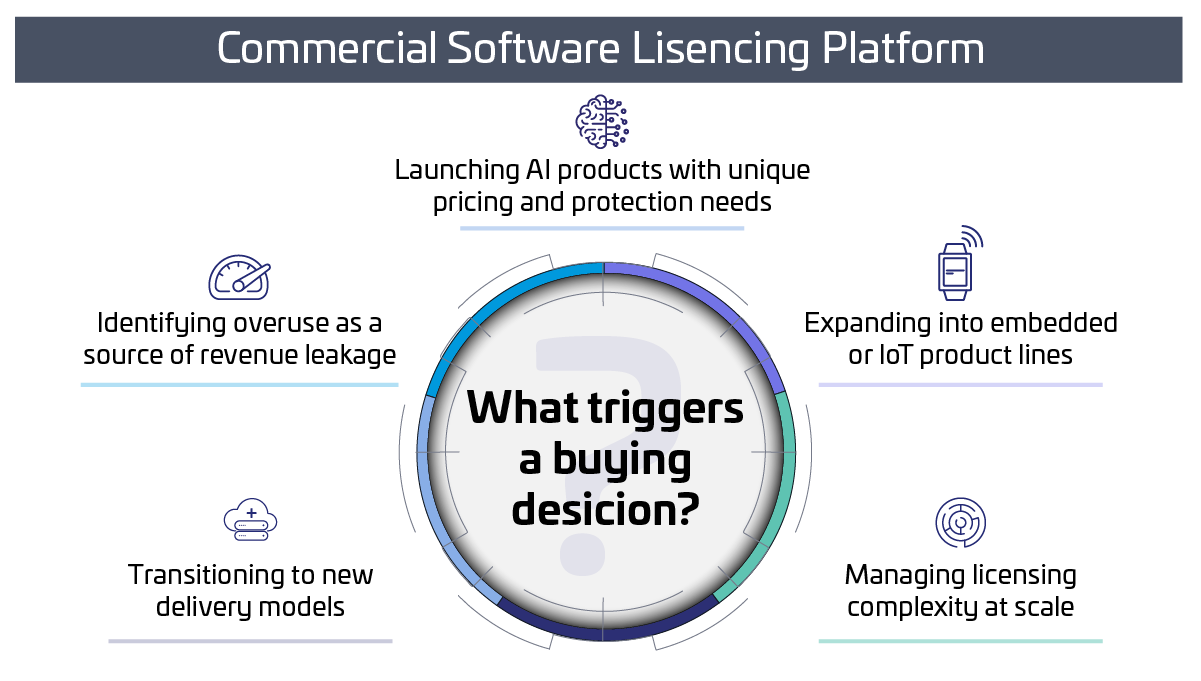
What triggers a buying decision?
- New delivery models: Moving from perpetual or on premises to SaaS, subscription, or hybrid requires a platform that can accommodate multiple concurrent licensing models.
- New business models/pricing & packaging: Engineering teams are spending more time on licensing infrastructure than on product features.
- AI-powered products: Software that includes AI models or AI-generated outputs often requires consumption-based or outcome-based pricing that traditional per-seat licensing cannot support
- Revenue leakage: Lack of enforcement visibility lets customers over-deploy without paying.
- Embedded or IoT expansion: Software shipped inside hardware devices often requires offline-capable, tamper-resistant enforcement mechanisms.
- Scale: As the customer base grows, license operations need to be automated and delegated through self-service portals.
Side-by-Side Capability Comparison
| Dimension | Buyer-Side License Management | Vendor side Software Licensing/ Software License Management |
|---|---|---|
| Primary User | IT, procurement, and compliance teams inside organizations that buy software | Product, engineering, and revenue teams inside companies that sell software |
| Parent Category | Software Asset Management (SAM) — SLM is one discipline within SAM | Software monetization, sometimes also IP, copy, software protection |
| Core Problem Solved | Controlling costs, avoiding over-licensing, staying audit-ready | Enforcing license terms, enabling monetization models, ensuring access rights, protecting IP |
| Key Capabilities | Software asset discovery, license reconciliation, usage tracking, audit management | License generation, entitlement management, activation, usage analytics, anti-piracy |
| Deployment Focus | Internal IT environment — cloud, on-prem, hybrid | Embedded in or alongside vendor products — on-prem, SaaS, IoT, connected devices |
| Value Metric | Cost avoidance, compliance, audit readiness, ROI on software spend | Revenue protection, monetization flexibility, customer experience, renewals |
The Hidden Detail: Vendor-side Licensing Fails Without Entitlement Management
Software licensing and entitlement management are two sides of the same coin. Licensing is the visible side — the rights the customer purchased. Entitlement management is what happens behind the scenes to keep those rights accurate as the business grows and changes.
A useful analogy is air travel.
- Your ticket defines what you paid for. It tells you where you are going, what class you booked, and what is included.
- To get on the plane, your boarding pass is scanned at the gate.
- The airline keeps the full record of your booking, upgrades, changes, reissues, and current travel status in a back-end management system.
Software works the same way.
- The license defines what the customer bought. It tells you what software/features you are entitled to, who has access rights, and where it can be deployed.
- To gain access to the software, the license key, token, or activation file is checked
- The entitlement management system is the backend platform that keeps the full record of what the customer bought and what they should be allowed to use now.
The License Defines What the Customer Bought
A software license defines the customer’s rights.
It describes what the customer purchased and what they are allowed to use. That can include the product, edition, features, user count, device count, time period, or other usage terms.
Discussions about licensing often jump too fast to keys, activation, or enforcement. But those are not the starting point. The starting point is the right the customer bought.
If that right is unclear, hard to update, or difficult to manage across different customers and offers, the rest of the licensing process becomes difficult very quickly.
Entitlement Management Keeps Customer Rights Accurate Over Time
If the license defines the customer’s rights, entitlement management is the behind-the-scenes system that manages those rights over time.
This is the part many teams underestimate.
It is where a software vendor manages access, considering elements like:
- new purchases
- renewals
- upgrades
- downgrades
- add-on features
- seat increases
- transfers
- exceptions
- expirations
Without that layer, licensing becomes difficult to manage as the business grows. A customer may still have a working key, but their access rights may not still match what they bought. Over time, the mismatch creates support issues, manual workarounds, inconsistent customer experiences, and revenue leakage.
That is why entitlement management matters so much when software vendors evaluate platforms. It is not just a supporting feature. It is the system that keeps customer rights accurate as the business grows.
This is where platforms like Thales Sentinel become particularly powerful. A license management system should do more than issue licenses or ensuring license enforcement. It goes even further than operationalizing the latest pricing and packaging. It is a single source of truth that gives software vendors a structured way to manage customer rights behind the scenes as products, pricing, and customer relationships become more complex.
The Bottom Line
The phrase software license management can mean different things depending on context.
If your goal is to govern software your company has purchased, control spend, and reduce compliance risk, you are looking at buyer-side software license management under the broader software asset management umbrella.
If your goal is to define customer rights, enforce access, protect IP, support changing offers, and keep those rights accurate over time, you are solving a vendor-side challenge that goes far beyond issuing licenses. You need a platform that can support the full lifecycle of software monetization, from packaging and entitlement management to enforcement, fulfillment, change management, and ongoing operational control.
That is where Thales Sentinel can help.
Sentinel is the industry-leading platform for software monetization, licensing, and protection. It covers the full scope of what vendor-side license management demands — entitlement management, IP protection, flexible packaging, fulfillment automation, self-service, and the analytics that feed back into your commercial decisions.
Whether you are selling through subscription or usage-based models, shipping AI-powered products that need new metering mechanisms, or managing a hybrid estate across SaaS, on-prem, and connected devices, Sentinel is built to move with you.
Thales brings decades of experience helping software vendors at every stage of that journey, from first deployment through continuous growth, change, and commercial evolution.