 Oren Bear | Product Manager, Thales
More About This Author >
Oren Bear | Product Manager, Thales
More About This Author >
Photoshop took Adobe more than three decades to build. In early October 2026, a free look-alike appeared on GitHub, the main site where developers share code. Six more Adobe look-alikes arrived alongside it. Most of their code was written by AI agents, in about a week.
They didn't steal Adobe's code. They didn't need to.
Key points:
- AI can now copy what your software visibly does, quickly and cheaply, without ever looking inside it.
- What it can't easily copy is the value it can't see: your algorithms, your file formats and your AI models.
- That hidden value is only safe if your software doesn't give it away. Protection keeps it hidden.
Seven Clones, Built by Watching
The team behind them, ArtCraft, calls them "Crafting Apps": PhotoCraft for Photoshop, plus look-alikes of Illustrator, Premiere Pro, Lightroom, Acrobat, After Effects and InDesign. Within eight days they had over 42,000 GitHub stars, a common measure of developer interest, according to Pasquale Pillitteri.
Developer Brandon Thomas credits Anthropic's Claude Opus 5.5. In one session, OrcaRouter reports, eight AI agents working in parallel added about 70 Photoshop menu items in a few hours, while one human handled testing and releases. How do you copy software without its code? There are two ways:
- Look inside. Decompilation turns the machine code a company ships back into readable logic. It's like stealing the chef's recipe card.
- Watch from outside. Read the documentation, try every feature, and compare what goes in with what comes out. It's like working out the recipe by tasting the dish.
PhotoCraft says it did the second. Its README states it was built from public specifications and observed behavior only. Most of the knowledge came from Adobe's own documentation, public file specifications, online tutorials and what the AI already knew. The rest took only ordinary use of a licensed copy. Nothing about it would look suspicious.
These claims are the project's own and haven't been independently verified. But the message for every software vendor is clear: anyone with a copy of your product and an AI subscription can create a seemingly identical clone.
The Look Was Easy to Copy. The Quality Wasn’t.
By PhotoCraft's own count, all 625 of Photoshop's menu items now work. But only about 68% of its test images match Photoshop's output exactly, and its AI features are close to zero. The project itself says it's not ready for daily professional work.
| Copied fast, because it's visible | Harder to copy, because it's hidden, but not impossible |
|---|---|
| Menus, shortcuts and workflows | Proprietary algorithms |
| Documented file formats | Private or encrypted file formats |
| Simple, predictable features | AI models trained on your data |
That's the good news. The bad news: "good enough" and free can still take your price-sensitive customers. And in regions with weak trademark enforcement, the next clone may not bother with a new name. It could carry your product's name and logo. When it crashes or corrupts a file, your customers will blame you. To solve this you need to identify the business advantages competitors can’t easily duplicate. That becomes your moat. Against AI cloning, your moat is the algorithms and knowhow hidden inside your product. This is where Sentinel can help you.
See How Fast You Can Stop AI-Driven Attacks
Explore how Sentinel protects your applications from automated vulnerability discovery and reverse engineering—right out of the box.
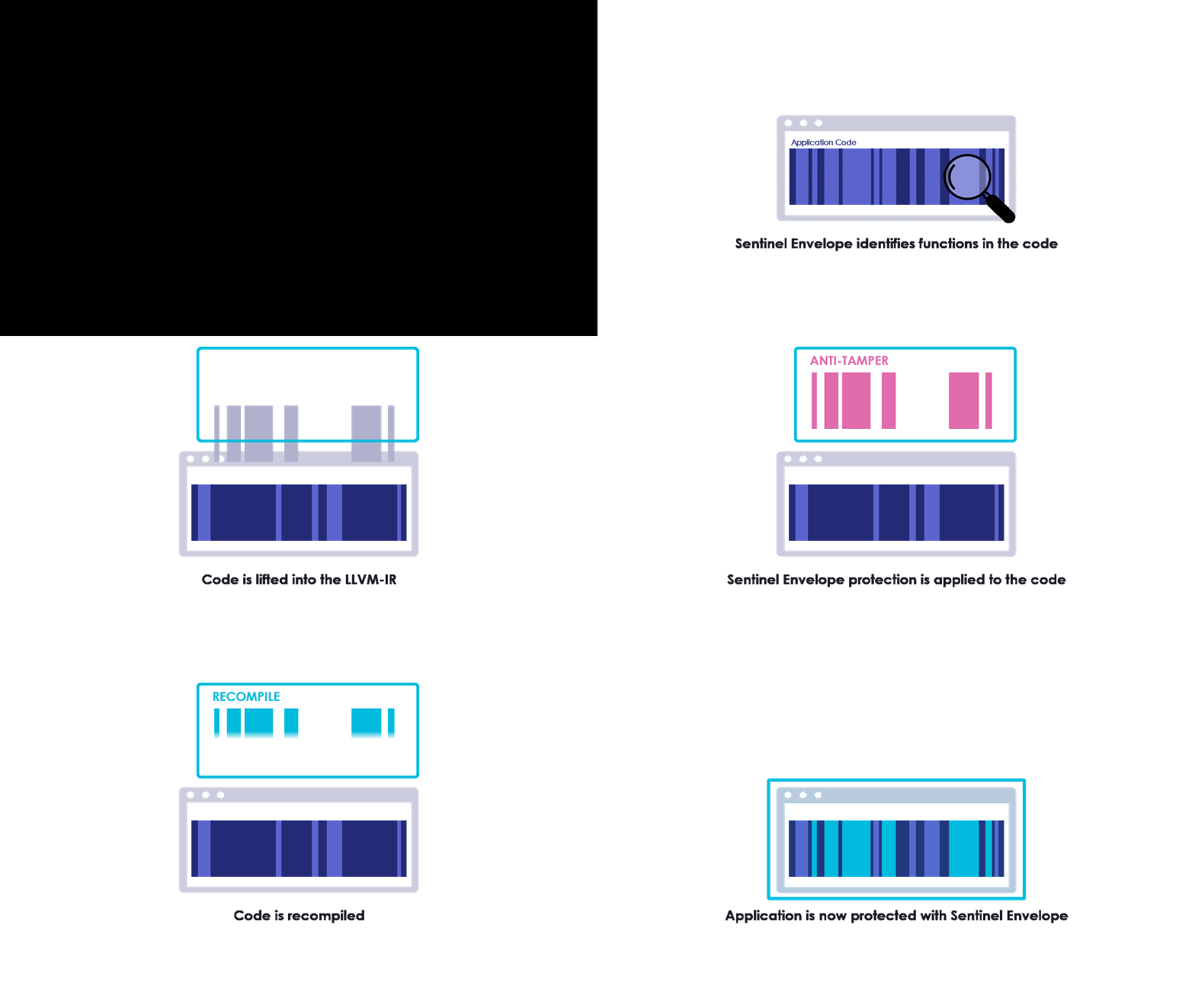
But hidden code has a weak spot. If a competitor can open your software using readily available reverse engineering tools and read it, nothing is hidden. In our AI analysis test, an AI agent using such a tool (Ghidra decompiler) read the logic of an unprotected application in about three minutes.
Three Sentinel Capabilities Keep Your Quality Protected
- Your algorithms: Sentinel Envelope Plus. It scrambles the code of the functions you choose, so it no longer reveals its logic, and adds anti-tampering and anti-tracing. In our test, the same AI agent worked on the protected version for nearly seven hours, recovered nothing, and recommended giving up. No source code changes required.
- Your files: Sentinel Envelope Data File Protection. PhotoCraft's biggest selling point is opening real Photoshop files, possible because Adobe published the format. Encrypted files can't be opened by a clone, and can't be studied to learn your format.
- Your AI models: Sentinel Script Envelope. A model trained on your data is nearly impossible to rebuild by watching. But an unprotected model file can simply be copied. Script Envelope protects PyTorch and TensorFlow model files, so they work only inside your licensed application.
The result: a cloner is left with only what they can watch.
When Customers Start Asking Questions
Clones and cracked copies also shake customer trust. Two conversations are coming, and protection gives you answers for both.
"Is that free version safe?" Unofficial and modified copies of software can carry malware, and users can't easily verify what they do with their data. You can point to the difference: Envelope Plus anti-tampering is designed to detect changes to your application, and Sentinel Up authenticates every update, so customers know it came from you.
"If they cracked it, can they reach my data?" When customers see cracked copies of your product online, they start doubting your security. Show them the layers: protected code, encrypted files and protected AI models. Each one is a lock an attacker would still have to break.
The Clock Has Started
Copying what a product visibly does used to take a team years. Now it takes one developer and a few AI agents about a week. And the clones will only get better.
You can't stop anyone from studying your menus. You can decide whether that's all they get.
Protect your algorithms, files and AI models with Sentinel Envelope, with no changes to your source code.