 Manoj Tharakan | Director of Product Management CDI, Thales
More About This Author >
Manoj Tharakan | Director of Product Management CDI, Thales
More About This Author >
Manoj Tharakan | Director of Product Management CDI, Thales
More About This Author >
Manoj Tharakan | Director of Product Management CDI, Thales
More About This Author >
In Brief
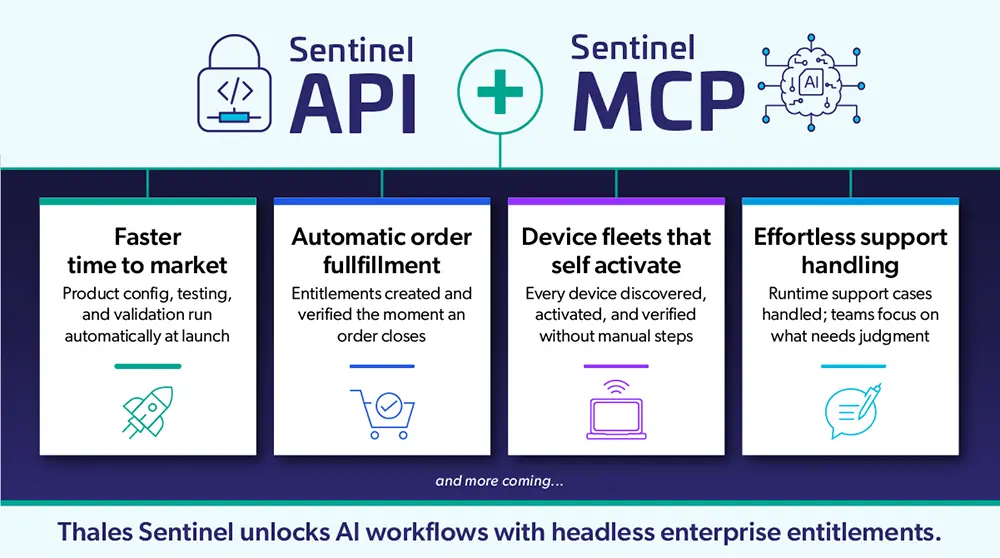
Thales Sentinel already provides a mature API foundation for licensing and entitlement management. With upcoming MCP server support, it will power AI workflows across product launches, order fulfillment, license activation, and support. Sentinel is evolving from a platform your teams manage into one that works on their behalf, turning monetization from a bottleneck into a real-time, agent-driven growth engine.
Prepare for AI-Powered Monetization Operations
Software companies are under pressure to move faster at every stage of monetization.
A new product needs to move from commercial decision to market launch quickly. A signed order needs to become a usable entitlement without delay. A customer deployment needs to activate cleanly across every device, environment, or user. A routine licensing issue needs to be resolved before it becomes a support burden or customer frustration.
Today, many of these processes still depend on human coordination. People sit between systems, interpret what needs to happen, configure the right entitlement, trigger the right license action, validate the result, and handle exceptions. That coordination creates a tax on speed, cost, and customer experience.
Agents performing entitlement workflows change what is possible.
APIs remain the foundation for connecting systems and automating fixed workflows. Model Context Protocol, MCP, adds a structured way for AI agents to discover what a system can do, understand which actions are available, invoke those actions securely, and validate the outcome.
Get Agents Doing Your Work
Creating products. Generating licenses. Activating customers. Sentinel EMS MCP lets agents do it all, automatically.
Thales Sentinel already provides a mature API foundation across licensing and entitlement management. With upcoming MCP server support, Sentinel is being built for a new model of monetization operations, where agents can help launch products, fulfill orders, activate licenses, and resolve routine support cases with less manual coordination.
The four entitlement workflows below show what Sentinel MCP is able to support today, with more capabilities on the way.
A Workflow That Operationalizes New Product Launches
Before a new product can drive revenue, it has to become a sellable, licensable offer.
That usually requires a significant amount of manual coordination between product, operations, and licensing teams who configure the license model, associate the right features, connect the right enforcement rules, update templates, create test entitlements, validate the setup, and confirm the offer is ready for market.
That manual translation becomes the new product introduction tax. Each product launch requires teams to turn product intent into operational rules the business can sell, fulfill, and support. As product lines expand across more SKUs, editions, license models, and deployment environments, the tax gets heavier.
An agentic new product introduction workflow reduces manual load by discovering what license models, features, products, enforcement rules, and usage limits exist in the entitlement system.
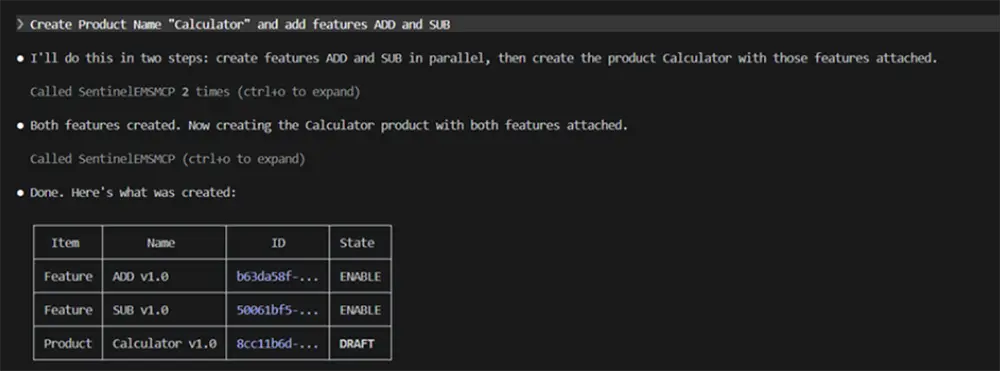
It can check whether the product already exists in the entitlement system, create or update the product record, and pull feature and license model requirements. It can also verify the right enforcement models, associate the correct features, update entitlement certificates or templates, create a test entitlement, and validate the setup before launch.
With this type of agentic workflow, product introduction stops being a manual, cross-team bottleneck and companies can truly operationalize new products and pricing changes at the speed their business demands.
A Workflow That Closes the Gap between Signed Order and Fulfilled Entitlement
A customer made the purchase. Sales closed the opportunity. Now the business has to turn that order into working access. Turning a customer's purchase into access is the key step to delivering a good customer experience and recognizing revenue. Entitlements must match the contract, which means confirming what was sold, to which customer, through which channel or partner, and under what terms, including subscription duration, usage limits, token quantities, and enforcement actions.
If any step sits in a queue or depends on manual review, the customer waits.
An AI-assisted order fulfillment workflow can move that process forward with less manual coordination.
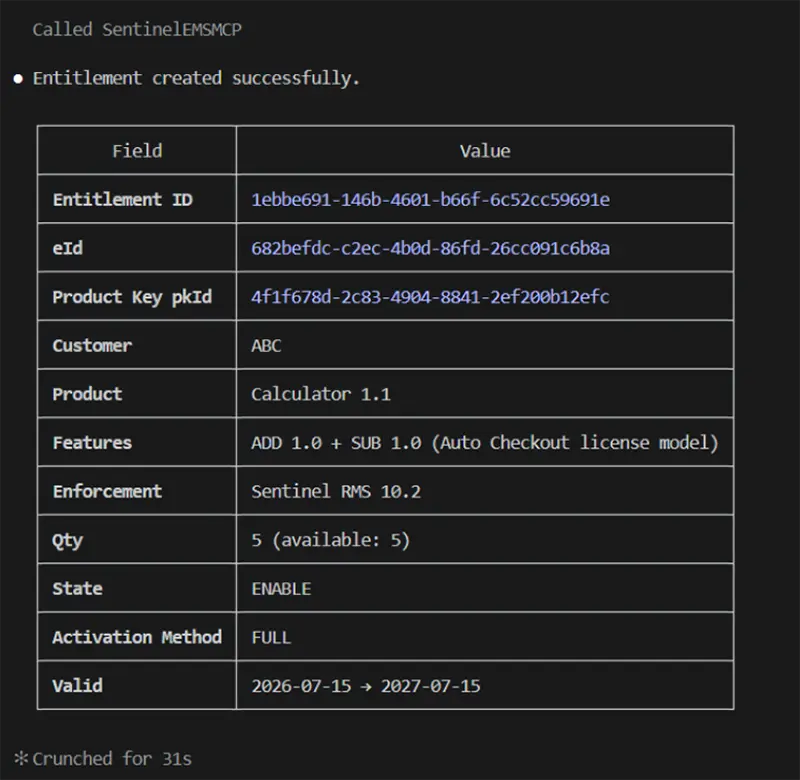
The agent can pick up the order details, create the correct entitlement, verify the entitlement record, confirm that the notification was sent, and identify whether fulfillment is fully electronic or requires additional steps.
It can also support more complex scenarios. If fulfillment depends on supply chain timing, deployment planning, or a delayed start date, the workflow can apply predefined rules, adjust the entitlement start date, add a grace period, or escalate for human review.
The business impact is faster time to value. Customers get access sooner, teams spend less time pushing orders through manual queues, and the business reduces the risk of fulfillment errors that create churn, support cost, or revenue delays.
A Workflow That Allows Device Fleets to Activate Themselves
Many of our customers sell software that runs on physical devices, such as industrial equipment, networking hardware, or medical devices. They know how painful fleet-scale license activation can be. The process involves matching entitlements to devices, converting serial numbers to lock codes, installing keys, and verifying each installation. It's a labor-intensive process that doesn't scale gracefully, and it's one of the most common sources of deployment delays for customers. Plus, not all ISVs/IDVs create a license management module in the product that automates these workflows. On top of that, it can take weeks of stakeholder management and approvals to plan a downtime window to complete these upgrades.
An agentic fleet activation workflow can reduce that burden. It can identify the devices that need to be activated, find the right entitlements, check available quantities, and apply predefined rules when coverage is limited. It can convert serial numbers to the lock codes required for activation, activate each license, extract the response, install the key, verify the license installation, and continue across the fleet before sending a completion notification.
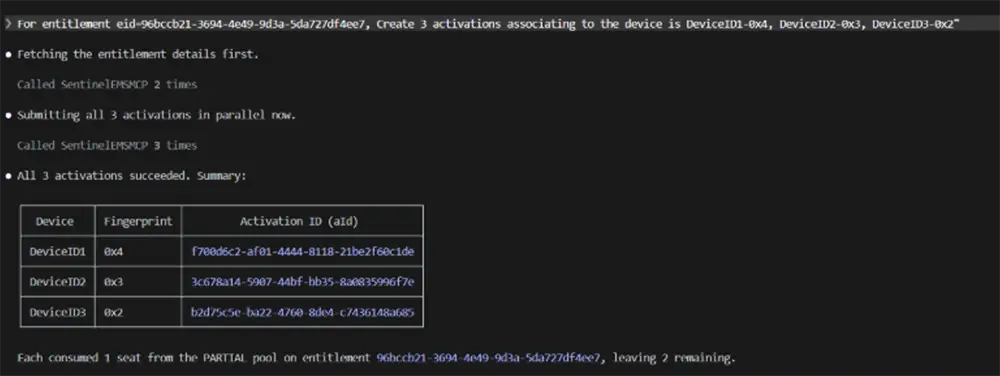
The real impact goes beyond lower activation costs. Fleet activation has long been a major point of friction that made large rollouts hard to support and even harder to renew. An agentic workflow takes that pain away by running activation across the entire fleet automatically, with less coordination, fewer delays, and minimal downtime.
A Workflow to Resolve Licensing Support Cases
Licensing-related issues are often one of the largest customer support case categories. There are clear case types that are most common and most repetitive for your support team. A customer can't find their entitlement. They need a license rehosted. They need an emergency extension. They're locked out of the portal. These cases are well-defined and the resolution paths are known, and yet they consume a disproportionate amount of your support team's time.
An AI-assisted licensing support workflow can read the case notes, identify the issue as licensing-related, look up the right entitlement, regenerate entitlement certificates, activate on behalf of a customer, help locate a locking code, process a rehost, generate emergency or temporary licenses, check SaaS provisioning status, and handle routine portal access issues.
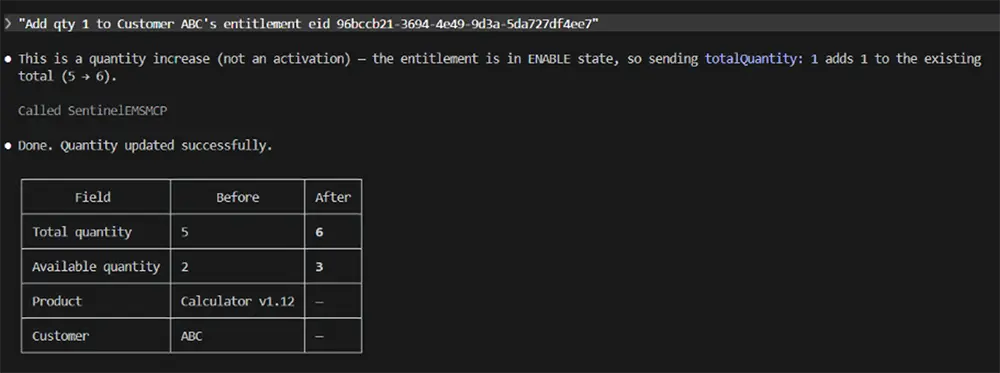
The workflow can also apply guardrails. For example, a rehost request can be checked against rehost history to flag possible misuse. A temporary license can follow predefined limits. Cases that involve commercial judgment, unusual usage patterns, or customer sensitivity can be escalated for human review.
The business impact is lower support cost without lowering support quality. Customers get faster answers to routine licensing issues. Support teams spend more time on complex, relationship-sensitive cases. The business can grow without every new customer adding the same level of ticket volume and analyst pressure.
What This Means for You
Every workflow described in this article already exists in your business. Today, most of them run through people rather than agents. That reflects how entitlement operations have worked for years, but in the age of AI super-efficiency, the operational cost is becoming harder to ignore.
MCP support from Sentinel removes the technical barrier to automating these workflows. Companies that act early will reduce delays, respond faster, and free their teams from repetitive entitlement tasks. The even greater advantage will come from how they use that recovered capacity. Instead of processing routine requests, people can focus on complex customer needs, resolve exceptions that require judgment, identify revenue and expansion opportunities, and turn what they learn into better products and commercial decisions.
Thales Sentinel is the market-leading monetization, licensing, entitlement and protection platform, trusted by thousands of customers across 100 countries and 30 industries.
Talk to us about preparing your monetization operations for AI-assisted workflows.