 Haider Iqbal | Director of Product Marketing
More About This Author >
Haider Iqbal | Director of Product Marketing
More About This Author >
Haider Iqbal | Director of Product Marketing
More About This Author >
Haider Iqbal | Director of Product Marketing
More About This Author >
Digital trust has never mattered more, and has never been harder to earn. As AI reshapes how organizations interact with customers and partners, the technology businesses are betting on to drive efficiency is the same technology their customers don't trust.
93% of IT leaders are already using, deploying, or planning AI initiatives. Yet, only 23% of consumers trust companies to use AI responsibly with their data. That gap isn't a communications problem. It's a revenue problem.
The Thales Digital Trust Index 2026, one of the most comprehensive global studies of digital trust to date, surveying more than 15,000 consumers, business partners, and IT decision makers, makes the stakes clear. Trust is won or lost at sign-up, login, authentication, and data handling. Get those moments right, and you build relationships that convert and retain. Get them wrong, and users simply move on.
This blog explores what the 2026 DTI reveals about:
- The importance of first impressions and seamless onboarding
- The disparity between AI adoption and consumer trust
- How trust is unevenly distributed between highly and less regulated sectors
- How partner access friction fuels risk and delays
- The mismatch between passkey intent and adoption
Digital Trust Lives and Dies by the First Interaction
First impressions count. Consumers’ first digital interactions are where trust begins. Sign-up, login, and account settings determine whether an organization feels safe, competent, and worth continuing with. For businesses, nailing the first interaction sets the tone for the entire relationship.
And yet, too many organizations may be wasting that opportunity. 68% of consumers reported experiencing website issues, including slow speed, downtime, or long sign-up processes, in the past year that forced them to abandon the website or switch to another. When access feels too long or intrusive, 33% switch to a competitor or give up entirely, while another 36% delay engagement or seek alternative channels.
If organizations take one thing away from these findings, let it be this: bungle the initial interaction, and you’re actively pushing potential customers towards your competitors. Getting that interaction right, however, is the simplest way to stand out from the crowd.
Explore key findings from the Digital Trust Index
AI adoption is accelerating, but consumer trust is lagging. Explore insights from the 2026 Digital Trust Index on authentication, onboarding, and closing the trust gap.
Consumers Don’t Trust Organizations with AI – But Partners Do
AI is fast becoming ubiquitous in corporate environments. Businesses are starry-eyed over potential efficiency benefits, cost savings, and productivity gains. In fact, 93% of IT leaders say they are already using, deploying, or planning AI initiatives, but consumers don’t share their optimism.
77% of consumers say they would not trust a company more if it used generative AI, and 37% even said they would trust an organization less. Even worse, only 23% say they trust companies to use AI responsibly with their data, and 77% remain concerned about AI agents acting on their behalf online.
Partners – third party users of external partner systems, such as vendors and distributors, contractors and freelancers, and consultants and auditors – however, have a much more positive view of AI.
In stark contrast to consumers, partners believe AI can actually improve trust, particularly when positioned as an enabler of stronger security and access controls. 70% of partner users say that they would trust an external partner more if it used generative AI to handle data and access management, and the same proportion (70%) says they would trust a partner more if it used agentic AI for the same purpose.
The takeaway isn’t to simply communicate better about AI, but to deploy it differently depending on the audience. Partner-facing AI has a receptive runway; consumer-facing AI needs to earn its place through transparency, visible controls, and a staged rollout that builds confidence before it asks for trust.
Banking Remains the Most Trusted Sector – But Overall, Trust Falls
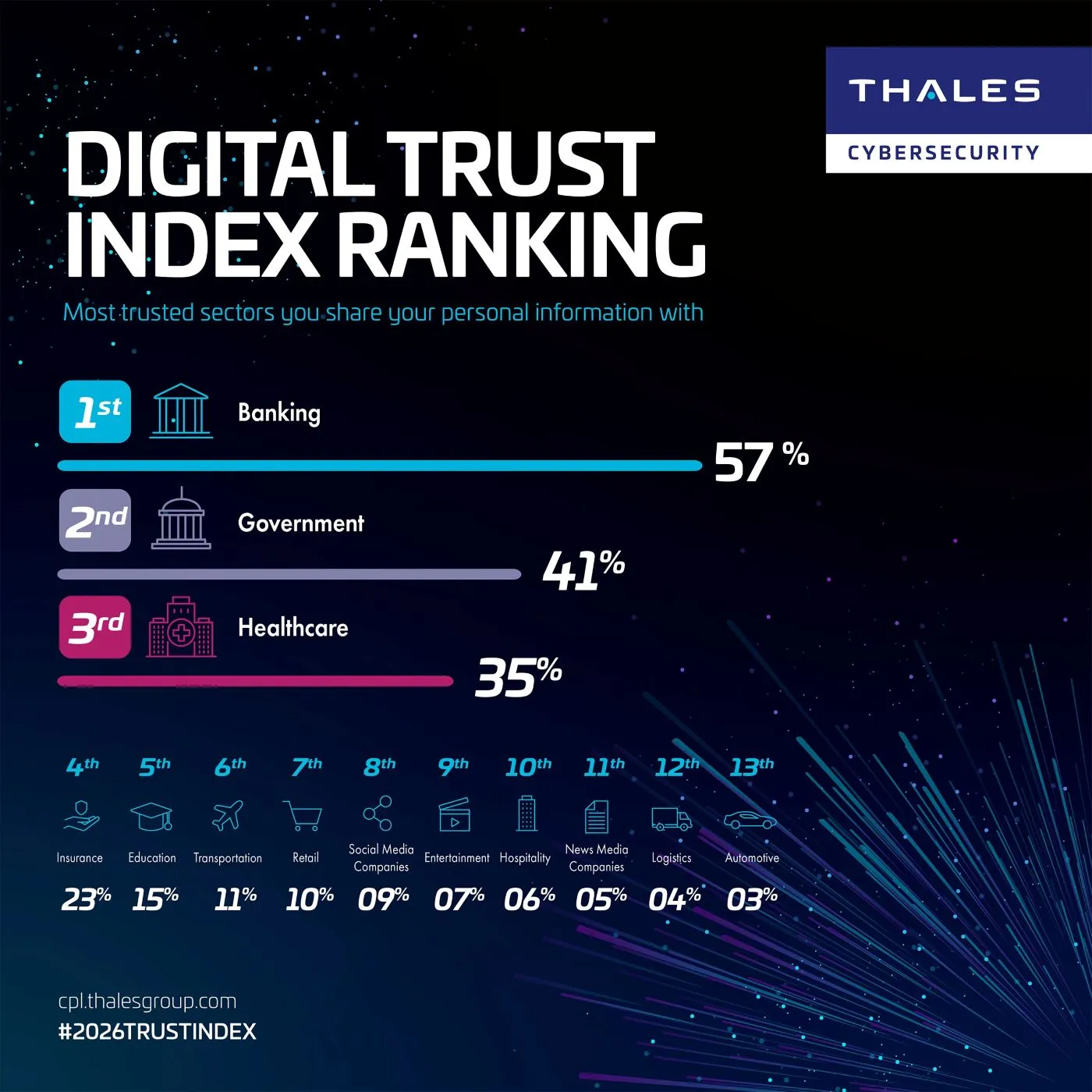
The banking industry holds a unique position within the digital trust sphere. 57% of respondents said they are most comfortable sharing personal information with banks (up from 44% in 2025), making it the only sector in which more than two in five consumers express top-level comfort sharing personal information.
Trust in government (40%) and healthcare (35%) companies is generally better than other sectors, although both have softened year-on-year. Most sectors outside the top three – banking, government, and healthcare - sit in abysmally low double or even single digit trust percentages.
The reason behind this mismatch is twofold. On one hand, in highly regulated sectors, security and resilience expectations are clearer and protections are more visible. On the other hand, the disconnect between what organizations believe they deliver and what users actually experience is driving abandonment, time-consuming workarounds, and increased risk.
Partner Access Friction Fuels Delays and Risks
Organizations have an opportunity and a responsibility to make partner access smooth and reliable. When they don’t, frustrations and even risks can proliferate.
92% of partner users reported experiencing issues when trying to access an external partner organization’s system in the last 12 months. Even when they don’t experience issues, a lack of information can be just as damaging: only 22% receive status updates on access requests very frequently.
Much in the same way as consumers, partner users often give up when faced with too much friction. 89% of partners have abandoned or delayed a work task with an external partner in the past 12 months due to a website issue.
In addition, friction can result in more than just productivity setbacks. It can force partners to use risky workarounds. 66% say they have shared or borrowed credentials, causing a gradual accumulation of security debt that increases the likelihood of breaches and compliance failures.
Strong Authentication Is a Trust Signal – Not Just a Security Control
Visible authentication builds consumer trust. 69% of consumers say MFA would make them trust a company more; 68% say the same about passkeys. These aren't niche preferences but the highest-scoring trust signals in the entire study.
IT and security leaders recognize the opportunity, with 87% saying offering passkeys is important, yet only 49% of organizations actually offer them. This gap represents both a risk and a competitive opening. Consumers are actively rewarding the organizations that meet them with recognizable, user-friendly security. The ones that don't are leaving trust (and revenue) on the table.
Trust is Your Greatest Differentiator
The central tension of the 2026 Digital Trust Index is also its central opportunity. AI is arriving faster than consumer trust can adapt, but that gap is closeable.
Transparent deployment, visible controls, and a staged rollout that starts where trust already exists can turn AI from a liability into a differentiator. The same logic applies across the board - friction is reducible, authentication is modernizable, and the gap between what organizations believe they deliver and what users actually experience is measurable, which means it's fixable.
Trust today is shaped as much by design decisions as by security controls, and the organizations that get both right will convert more customers, build longer-lasting relationships, and compete more effectively in an increasingly AI-driven economy.
For more insights into the digital trust landscape, download the full Thales Digital Trust Index 2026.
69% of consumers say MFA would increase company trust
Struggling to build trust with customers and partners in an AI-driven world? You aren't alone. Download the 2026 Digital Trust Index for the latest insights.