What is a data risk?
A data risk assessment identifies where sensitive data is exposed, who can access it and what the business impact of a breach would be. Traditional assessments are point-in-time projects; CipherTrust DSPM makes the assessment continuous, correlating sensitivity, access, activity and vulnerabilities so the highest-impact risks are prioritized as they emerge.
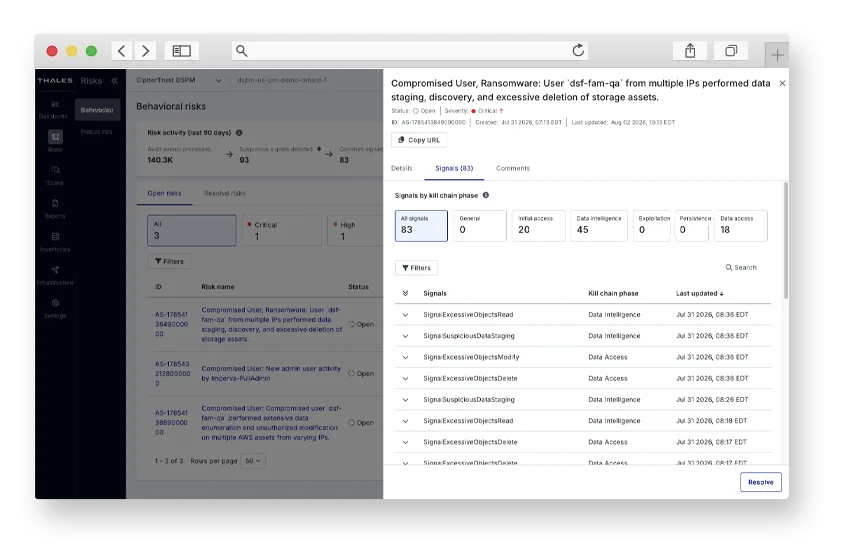
Focus on the Data Risks that Matter Most
Make faster, better-informed decisions about which data risks require attention first.

See Business Impact
Give teams a clearer view of which data issues could affect operations, compliance, reputation, or customer trust. Move beyond technical findings and understand where action can reduce business risk.

Align Priorities
Focus limited resources on the issues that deserve attention first. Reduce time spent sorting through low-value findings and create a clearer path from risk awareness to decision making.

Act with Confidence
Equip teams with the context needed to decide what to address, who should be involved, and which next steps will have the greatest impact. Improve coordination across security, data, compliance, and operations.

Reduce Noise
Turn overwhelming data-risk signals into a more manageable set of business-relevant priorities. Help teams avoid alert fatigue and concentrate on exposures that could create the most disruption.

Target Response
Respond faster by clarifying where data risk exists, why it matters, and what actions should happen next. Support more targeted investigations and reduce delays caused by disconnected tools or incomplete context.

Track Progress
Give leaders and stakeholders a clearer way to understand how data risk is changing over time. Support stronger reporting conversations around risk reduction, remediation focus, and security program effectiveness.
Prioritize Risks that Impact Your Business
CipherTrust DSPM analyzes data risk by correlating key metrics around sensitivity, user and entity interactions, and business context to understand which risks matter most, where remediation should start, and how to reduce exposure before it is exploited.
Risk Analysis and Prioritization Capabilities
Analyze where sensitive data may be exposed, over-permissioned, duplicated, or unmanaged, providing key insight into where the greatest operational, regulatory, or reputational risks exist.
Map users, groups, roles, applications, services, third parties, and AI tools to data. Identify excessive, inherited, or inappropriate access that may expand insider risk, third-party unauthorized access, or breach impact.
Correlate key data interaction details to prioritize risks most likely to impact the organization to focus remediation efforts on what matters most.
Analyze sensitive data that may be used, accessed, copied, or consumed by AI, analytics, and agentic workflows. Identify risky AI data paths and govern sensitive data within policy.
Support investigation and reporting with evidence of data location, access, exposure, activity, and posture. Communicate risk clearly to security, compliance, audit, and executive stakeholders.
Security teams do not need more findings without direction. CipherTrust DSPM gives organizations the ability to analyze sensitive data risk in context, so teams can understand which exposure matters, who is exhibiting risky behavior, where to focus resources, and how well remediation actions are fortifying the data environment.
Why Risk Analysis Matters
Modern data risk requires context, prioritization, and action.
34 %
of organizations have complete knowledge of where their data is stored. (Thales 2026 Data Threat Report)
39 %
of organizations can fully classify their data. (Thales 2026 Data Threat Report)
61 %
of organizations use five or more tools for data discovery, monitoring or classification – fragmented signals, harder prioritization. (Thales 2025 Cloud Security Study)
Security that integrates with your technology ecosystem
With one of the industry’s largest cyber security technology ecosystems, Thales solutions integrate with the most widely used technologies to protect and secure access to your mission-critical applications and data.













Related solutions
Explore adjacent Thales capabilities that strengthen discovery, protection, and control across the data estate.
Prioritize Data Risk and Respond
Learn how CipherTrust DSPM can help your organization analyze exposure, access, activity, and business context to prioritize sensitive data risk and reduce exposure faster.
We think Thales DSPM is a strong option for organizations that need a single platform covering discovery, classification, and native data protection without stitching together multiple vendors. The case is particularly strong for regulated industries and organizations with on-premise or hybrid infrastructure, where cloud-native DSPM tools often fall short. If your security requirements include full encryption key ownership, tokenization, and data masking enforced at the data layer across cloud and on-premise environments, Thales is well worth the investment.”

RESOURCES & FAQS
Related resources


Frequently asked questions about Data Risk Analysis
CipherTrust DSPM analyzes sensitive data risk by correlating data sensitivity, exposure, access, permissions, activity, vulnerabilities, and business context to help teams prioritize remediation.
Security teams often face too many findings without enough time to investigate them all. Risk prioritization helps them focus on data exposures and risks most likely to create business, regulatory, or reputational impact.
Access analysis helps identify excessive, inherited, or inappropriate permissions to sensitive or business critical data. Access analysis helps support least-privilege governance and reduces insider, third-party, and ransomware blast-radius risk.
CipherTrust DSPM shows where sensitive data is exposed, who can access it, and which risks matter the most, while helping teams decide where to apply remediation, protection, access changes, or governance controls.
CipherTrust DSPM helps analyze sensitive data exposure across AI, analytics, and agentic workflows so teams can understand what data AI may access, where risks exists, and how to govern data use responsibly.