 Krishna Ksheerabdhi | VP, Product Marketing
More About This Author >
Krishna Ksheerabdhi | VP, Product Marketing
More About This Author >
Krishna Ksheerabdhi | VP, Product Marketing
More About This Author >
Krishna Ksheerabdhi | VP, Product Marketing
More About This Author >
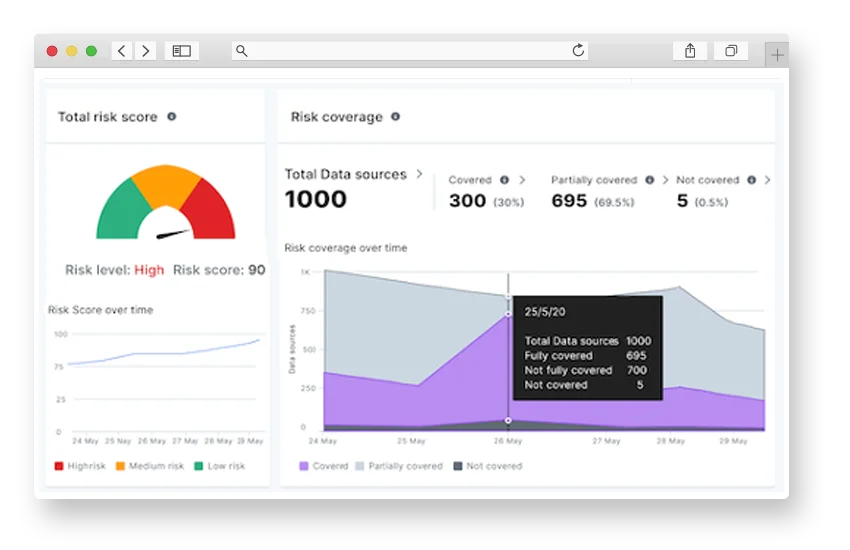
Most Data Security Posture Management (DSPM) programs are built to discover and classify sensitive data, score risk, and report findings. For many organizations, that is also where the program ends.
The result is a well-populated dashboard and an exposure problem that has not moved.
That gap is not primarily a technology problem. It is a program design problem. Buying a DSPM tool that surfaces findings is not the same as building a program that acts on them. Without effective prioritization and remediation workflows, greater visibility simply generates more alerts for an already constrained security team to investigate, while the underlying exposure remains unchanged. The difference shows up in audit outcomes, breach history, and security budgets that grow harder to justify over time.
Discovery and classification are necessary starting points, but a complete DSPM program also analyzes which exposures matter most, applies protection controls that reduce those exposures, and governs those controls consistently across cloud, SaaS, on-premises, and hybrid environments. In this article, effective DSPM therefore means four connected capabilities: discover, analyze, protect, and control. A program that stops at visibility has done only half the job.
Value, measured correctly, means reduced exposure: fewer unknown sensitive data repositories, faster time from risk identification to remediation, stronger encryption and access controls, cleaner audit evidence, and sustained improvement in how sensitive data is protected where it matters most.
At a Glance: Turning DSPM Visibility into Measurable Risk Reduction
- DSPM value comes from reducing exposure—not generating more findings.
- Effective programs connect four capabilities: discover sensitive data, analyze risk, protect the data, and maintain control over time.
- Contextual prioritization helps security teams focus limited resources on exposures with the greatest potential business impact.
- Remediation must extend beyond alerts and access changes to controls such as encryption, tokenization, masking, and least-privilege enforcement.
- Every high-priority finding needs a clear owner and an integrated workflow that moves it from discovery to verified resolution.
- A phased, risk-based deployment can control cost and complexity while allowing the organization to prove value before expanding coverage.
- ROI should be measured against a baseline using exposure reduction, remediation time, protection coverage, audit readiness, operating effort, and defensible cost savings.
- DSPM delivers lasting value when it integrates with the broader security architecture and adapts as cloud, AI, regulatory, sovereignty, and cryptographic requirements evolve.
What Operational Value Does a DSPM Program Provide?
The most common mistake in DSPM evaluation is measuring success by what the program finds rather than what it changes. A program that surfaces hundreds of risks but does not reduce exposure has not delivered value. It has produced a larger backlog for an already constrained security team.
A DSPM program delivers operational value when it reduces sensitive-data exposure rather than merely generating findings. In practice, that means previously unknown sensitive data repositories are inventoried, assigned to accountable owners, and brought under appropriate protection and governance. The highest-priority exposures are remediated faster, excessive access is reduced, protection controls are verified, and audit preparation draws on continuous evidence rather than a last-minute scramble. Most importantly, sensitive data becomes harder to reach, misuse, or expose than it was before the program began.
A successful DSPM program must also make that improvement visible to stakeholders and executives. Rather than reporting the number of repositories scanned, records classified, or findings generated, security leaders should show where the organization’s most significant data risks exist, what business operations or regulated information they affect, and whether those risks are declining over time.
Comparisons against an established baseline can demonstrate changes in exposure, remediation speed, accountable ownership, protection coverage, audit readiness, and operational effort.
Executive reporting should connect those trends to outcomes the business recognizes: reduced likelihood and potential impact of data exposure, stronger regulatory readiness, more efficient use of security resources, and greater confidence in cloud, AI, and data-modernization initiatives. Evidence that a control was applied and the exposure was reduced is more meaningful than evidence that a ticket was closed.
The distinction between findings generated and demonstrable risk reduction is what separates a DSPM deployment from a DSPM program.
What DSPM Capabilities Drive Real Business Value?
The capabilities that follow work as an integrated cycle rather than as standalone features. Together, they move the program from understanding where sensitive data resides to prioritizing risk, applying protection, and sustaining those protections as the environment changes.

The Four Pillars of Modern DSPM
Discover: Build Visibility You Can Trust
Continuous data discovery and classification are key elements in any successful DSPM program.
Data that once resided primarily in a small number of databases within an organization’s internal network is now distributed across cloud services, SaaS applications, AI pipelines, collaboration systems, development environments, structured databases, documents, images, and other unstructured sources. This expansion makes continuous discovery essential: the 2026 Thales Data Threat Report found that only 52% of organizations claim to know what data they have and where it resides.
A DSPM solution should continuously update its inventory and classifications rather than rely on periodic scans or manual inventories.
Security teams need an up-to-date understanding of where regulated, confidential, and business-critical information is before they can decide whether it is adequately protected. Knowing where sensitive data lives is the prerequisite. It is not, by itself, a risk reduction measure.
Analyze: Turn Visibility into Meaningful Priorities
Finding sensitive data is only the beginning. Security teams also need to understand which exposures are most likely to create material business impact. That requires more than assigning severity to an isolated misconfiguration or access issue.
Effective risk analysis combines multiple types of context, including:
- The sensitivity, regulatory classification, and business value of the data
- Who or what can access it, including users, applications, APIs, third parties, and AI systems
- Whether permissions are excessive, stale, or inconsistent with least-privilege policies
- How the data is being accessed, used, shared, copied, or moved
- Whether activity deviates from normal behavior
- Internet exposure, vulnerabilities, misconfigurations, and other reachable attack paths
- Whether encryption, masking, tokenization, and other protection controls are present and properly configured
- The potential operational, financial, regulatory, and reputational consequences of exposure
No single factor tells the complete story. A broadly accessible repository may appear urgent, but its business impact depends on what it contains, who can reach it, how it is being used, whether it is adequately protected, and what would happen if the data were disclosed or disrupted. Conversely, a narrowly accessible data store may represent a critical risk if it contains regulated customer records, supports an essential business service, or is being accessed through unusual user, application, API, or AI activity.
DSPM risk analysis creates business value by combining data sensitivity, access, usage, protection status, and potential impact to identify the exposures that matter most. By correlating these signals, DSPM can reveal combinations of risk that individual alerts may miss and rank findings according to their likely impact on the business. This helps constrained security teams reduce noise, focus investigation and remediation on the most consequential exposures, and direct protection resources where they can deliver the greatest risk reduction.
Protect: Visibility Without Mitigation Leaves Work Unfinished
Identifying where sensitive data is exposed is not the same as remediating the risk. Even correcting excessive permissions or changing an access control list addresses only one part of the problem. The data may remain readable if credentials are compromised, access paths change, or a newly connected user, application, API, or AI system begins interacting with it.
Effective remediation reduces exposure at the data layer. For posture-related risks, organizations should be able to automatically apply protection controls based on the sensitivity of the data and the context of the risk, including:
- Encryption of sensitive data
- Tokenization of regulated or high-risk data when full values are not required
- Data masking for users, applications, APIs, analytics, and AI workflows that do not require clear-text access
- Remediation of excessive, stale, or inappropriate entitlements to enforce least privilege
- Consistent policy enforcement across cloud, SaaS, on-premises, and hybrid environments
Not every risk can or should be resolved automatically. When changes in users, applications, APIs, or AI introduce new access paths or behaviors, security teams also need targeted guidance that explains the affected data, the source and context of the risk, the recommended action, and the teams responsible for resolving it. Guided remediation can help teams tighten entitlements, apply protection directly to the data, or integrate the response into existing identity, cloud, ticketing, and security operations workflows.
The 2026 Thales Data Threat Report found that, on average, less than half (47%) of sensitive cloud data is protected by encryption. This protection gap illustrates why DSPM cannot stop at visibility: the program must connect identified exposure to remediation, verify that controls were applied, and confirm that risk declined as identities, applications, integrations, and AI workloads evolve.
Control: Keep Protection Consistent Over Time
With no centralized governance, protection becomes inconsistent.
Without centralized governance, protection policies and controls become inconsistent across environments. Strong DSPM programs address that fragmentation through centralized policy and key management, privilege oversight, continuous audit evidence, and integration with security operations.
The 2026 Thales Data Threat Report found that 53% of organizations allow cloud providers to control the encryption keys for over half of their applications. This is a structural gap in key ownership that centralized governance is specifically designed to close.
Discovery identifies the problem. Analysis prioritizes it. Protection reduces it. Governance keeps it reduced. A program that treats any of these as optional is still running halfway.
| Capability | Visibility-only DSPM | DSPM with mitigation |
|---|---|---|
| Primary output | Findings and dashboards | Reduced data exposure |
| Operational impact | Larger investigation backlog | Prioritized remediation |
| Remediation | Separate manual processes | Integrated protection workflows |
| Protection controls | Limited | Encryption, tokenization, masking, and access remediation |
| Audit readiness | Evidence of findings | Evidence of findings and verified risk reduction |
| Executive outcome | Better visibility | Measurable security improvement |
Why Don’t More DSPM Features Automatically Deliver More Value?
When evaluating DSPM, buyers should ask a simple question: will this platform help us reduce more risk, or will it only help us find more of it? More connectors, broader data source coverage, and additional risk-scoring dimensions may surface more findings, but capability breadth is not a proxy for program effectiveness. The real measure of value is whether the organization can prioritize those findings, remediate the underlying exposures, and continuously reduce data security risk.
The 2026 Thales Data Threat Report found that organizations already run an average of seven data protection and monitoring tools, with 73% operating five or more. That level of sprawl carries a complexity tax that compounds quietly: more systems to maintain, more alerts to triage, more coordination required before anything gets remediated. Adding a capable DSPM platform to an environment already running at that level does not automatically reduce complexity. Without a clear path from findings to action, it adds to the backlog.
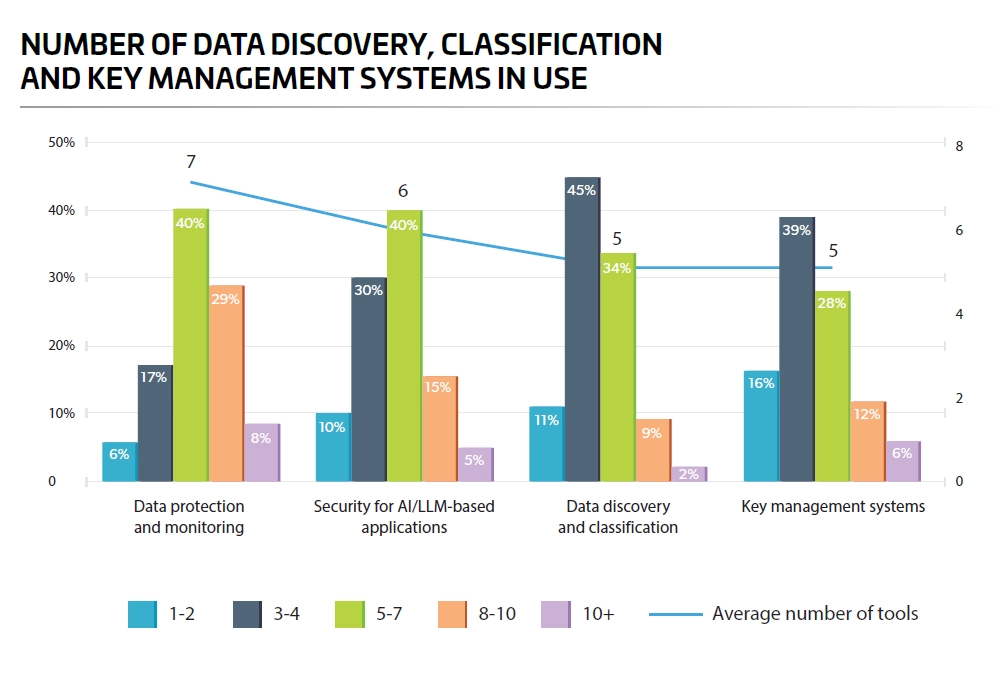
Thales Data Threat Report: Number of Data Discovery, Classification, and Key Management Systems in Use
Many DSPM programs stall when the volume of risk findings exceeds the organization's capacity to act. This gap between insight and remediation turns visibility into noise rather than meaningful risk reduction.
When a platform surfaces hundreds of risks across dozens of environments and the security team has no reliable way to distinguish which exposures require immediate protection from which can wait, the instinct is to deprioritize everything. As a result, the investment becomes hard to justify.
The organizations that avoid this pattern typically share one characteristic: they scope DSPM to what they can operationalize, not to what they can afford to deploy.
That means starting with the environments that carry the most business risk, such as regulated data, customer records, and data feeding AI workloads, and building remediation workflows before expanding coverage. Maturity-based adoption is not a limitation on ambition. It is what separates programs that demonstrably reduce exposure from programs that produce evidence that exposure still exists.
Why Do DSPM Programs Fail to Reduce Data Risk?
DSPM failures are rarely the result of poor detection. More often, they happen when accountability stops at prioritization, leaving remediation without a clear owner.
Discovery surfaces a sensitive dataset in an exposed cloud bucket. The DSPM platform flags it as high priority. Then the question becomes: whose job is it to act? It’s a question of ownership and accountability. If that question does not have a clear answer, the findings age in a queue alongside dozens of others.
DSPM programs fail to reduce data risk when discovery and prioritization are not connected to accountable remediation. The platform may identify a sensitive dataset and rank it as high priority, but the finding will remain unresolved if no team owns the next action. Operationalizing DSPM requires defined responsibilities across security, cloud, application, data, and governance teams, together with integrated workflows and executive commitment to measurable risk reduction.
The platform works. The program does not.
Analyst Research
Omdia Universe Report for Data Security Posture Management
Learn how evolving threats, global regulations, cloud adoption, and AI are shaping DSPM.
DSPM and Risk Prioritization: Where Value Is Won or Lost
Risk prioritization determines where limited security resources can produce the greatest reduction in exposure. Rather than treating all findings equally, organizations can direct encryption, tokenization, masking, access remediation, and governance toward the data whose sensitivity, accessibility, and business role create the greatest potential impact.
A customer records database sitting in an exposed development environment warrants faster action than a low-sensitivity archive with identical access controls, even though both would appear in a visibility-only report.
Prioritization also helps organizations decide where they need to invest in encryption, tokenization, masking, stronger governance, or access controls.
How Can CISOs Avoid Overpaying for DSPM?
The goal is not to deploy DSPM everywhere on day one. It is to reduce risk where it matters most.
Leading organizations begin by focusing DSPM investments where they will have the greatest impact: high-value data stores, mission-critical applications, and the most exposed environments. By proving processes and outcomes first, CISOs can scale coverage over time while avoiding unnecessary costs and operational complexity.
Organizations can avoid overpaying for DSPM by deploying it in phases based on business risk. Start with the environments that contain the most sensitive data or support the most critical business functions. Establish discovery, classification, ownership, and remediation workflows; measure whether exposure declines; and then expand coverage in stages. This approach limits unnecessary scope, reduces operational disruption, and creates evidence for further investment.
DSPM should expand as the organization’s operating model matures. Once teams can consistently assign ownership, remediate priority findings, and verify risk reduction, they can extend coverage, automate additional remediation, and deepen integrations with identity, cloud, governance, and security operations.
When evaluating a solution, CISOs should ask what happens after the platform identifies a risk. Can it encrypt, tokenize, mask, remediate access, and manage policies? Can it integrate those actions into existing workflows, or will it simply add more tickets to the backlog?
The bottom line is to determine whether the organization can achieve risk reduction over time. In the absence of proof, it would be hard to justify further investment in the project even if the platform boasts numerous capabilities.
Data Security Posture Management
Maturity Assessment
How resilient, scalable and future-proof is your organization’s data security posture?
How Should Organizations Measure DSPM Value and ROI Over Time?
Meaningful measurement focuses on changes in security outcomes and operating efficiency—not platform activity alone. A defensible value case starts with recurring work the organization already performs, such as discovering data, reviewing and prioritizing findings, coordinating remediation, assembling audit evidence, and maintaining multiple tools and integrations.
Organizations should establish a baseline before deployment and track progress at regular intervals.
Useful measures include:
- Reduction in unknown sensitive data repositories
- Reduction in exposed or insufficiently protected sensitive data
- Percentage of high-priority findings with an accountable owner
- Time required to validate a finding and identify the correct technical and business owners
- Time from risk identification to verified mitigation
- Reduction in aging remediation backlogs
- Reduction in vulnerable data through encryption, tokenization, masking, access remediation, deletion, retention, or approved exceptions
- Time spent transferring context among DSPM, ticketing, IAM, cloud, data protection, and governance tools
- Preparation time for audits and regulatory inquiries
- Quality, completeness, and timeliness of compliance evidence
- Retired or consolidated tools, reduced platform consumption, avoided contract renewals, and avoided hiring required to expand coverage
These measures should follow the complete workflow. Closing a ticket is not enough; the organization should verify that the control was applied and that exposure was reduced. Financial benefits should also be treated conservatively. A capability becomes a defensible saving only when the organization can remove operating work, retire or renegotiate a contract, reduce consumption, avoid a renewal, or prevent otherwise necessary growth in labor and tooling.
For executive and board reporting, CISOs should translate operational metrics into a concise account of business risk and progress. Reporting should show where the most significant sensitive-data risks exist, whether those risks are declining, how quickly critical exposures are being resolved, whether ownership and protection coverage are improving, and how the program is affecting audit readiness and operating cost. Trend lines and comparisons against the initial baseline are generally more useful than raw counts of findings because they demonstrate whether the program is producing sustained improvement.
A practical value review can be conducted over four to six weeks using actual repositories, workflows, ticket volumes, labor effort, contracts, audit preparation, and growth plans. Security and finance teams can then validate conservative, expected, and upside scenarios before presenting ROI or total cost of ownership to leadership.
According to the 2026 Thales Data Threat Report, only 6% of organizations that failed a compliance audit had no breach history, compared with 30% of organizations that passed all audits. This association does not make audit performance a standalone measure of security effectiveness, but it supports using audit readiness alongside exposure, remediation, and control-verification metrics when assessing the broader program.
Future-Proofing the DSPM Program
A DSPM program should be designed for an environment that will continue to change. Data moves into new clouds, SaaS applications, analytics platforms, and AI workflows. Regulations evolve, identities and access paths multiply, and cryptographic requirements shift. A future-ready program maintains visibility, protection, and control through those changes rather than requiring a new inventory, policy model, or governance process each time the environment evolves.
Maintain Sovereignty as Data Moves
Data sovereignty depends on more than the physical location of a workload. Organizations need to know where sensitive data is stored and processed, which jurisdiction applies, who or what can access it, and who controls the encryption keys. This becomes more difficult as data passes through interconnected cloud services, SaaS applications, backups, analytics environments, and AI pipelines.
According to the 2026 Thales Data Threat Report, 40% of organizations are reducing the amount of data available outside sovereign regions, 54% are refactoring applications to better segment or isolate data, and 53% allow cloud providers to control encryption keys for more than half of their applications.
Together, these findings show why DSPM should continuously detect sovereignty drift and connect data location and classification with access governance, encryption, and customer-controlled key management.
Adapt to Regulatory Change
New regulatory requirements should not trigger another manual inventory and reporting exercise. Continuous discovery, classification, ownership, data lineage, policy enforcement, and audit evidence provide a reusable foundation that organizations can adapt as privacy, industry, and AI regulations change.
A future-ready DSPM program allows security and governance teams to update policies, identify affected data, verify that required controls are applied, and demonstrate compliance without rebuilding the operating model. This turns regulatory change from a periodic scramble into a manageable extension of existing governance processes.
Govern Data Used by AI
AI applications create new paths for sensitive data to be retrieved, combined, copied, and exposed. The 2026 Thales Data Threat Report found that 70% of organizations rank the speed of change within AI ecosystems as a top AI security risk, while 61% report that attackers are targeting their AI applications, with sensitive data as the leading target.
DSPM must therefore extend beyond traditional repositories to understand how data is used for model training, retrieval-augmented generation, inference, copilots, autonomous agents, and APIs. Organizations need to identify sensitive data entering these workflows, understand the permissions assigned to human and machine identities, and apply least privilege. Masking, tokenization, or encryption should protect data when AI systems do not require access to full clear-text values.
Prepare Long-Lived Data for Quantum Risk
DSPM does not make cryptography quantum-safe, but it can help organizations identify which sensitive and long-lived data should be prioritized within a broader cryptographic inventory and post-quantum migration program.
The 2026 Thales Data Threat Report found that 61% of organizations regard “harvest now, decrypt later” as their leading quantum concern, while 59% are prototyping or evaluating post-quantum cryptographic algorithms. By connecting data sensitivity, retention requirements, business value, and current protection controls, DSPM can help determine which data requires earlier remediation and where crypto-agility will matter most.
Future-proofing does not mean predicting every new technology or regulation. It means establishing continuous visibility, adaptable policies, integrated protection, and centralized governance so the program can respond as risks and requirements change.
DSPM in the Broader Data Security Strategy
DSPM should function as the decision layer that connects data discovery and risk analysis to the systems responsible for protection, access governance, workflow orchestration, and evidence. Its strategic value lies not in adding another standalone dashboard, but in helping the broader security architecture act on sensitive-data risk consistently.
In practice, DSPM needs to work alongside encryption, tokenization, data masking, key management, secrets management, IAM, data activity monitoring, DLP, SIEM, SOAR, ticketing, and broader governance processes. Each capability addresses a different part of the problem: DSPM identifies where risk exists and how severe it is, while the surrounding security architecture determines whether anything changes as a result.
This integration is especially important for regulated organizations and those managing hybrid or multicloud environments. As data estates expand, identities and applications multiply, and sensitive information moves across more systems, point-in-time visibility can no longer keep pace.
Effective data security connects discovery and risk analysis with protection controls, access governance, policy enforcement, and evidence that remediation has reduced exposure.
Isolated DSPM, deployed without connections to remediation workflows, protection controls, or governance processes, tends to plateau. Most DSPM investments are defensible at the point of purchase. Fewer are defensible eighteen months later, when the dashboards are populated but the exposure numbers have not moved. The difference is almost always whether the program was built to find risk or to reduce it.
Integrated into a broader platform such as the Thales CipherTrust Data Security Platform, DSPM can help companies identify sensitive data, prioritize the highest risks, apply protection, and maintain centralized control across complex environments.
Frequently asked questions about DSPM
What are the most important DSPM capabilities?
The most important DSPM capabilities are continuous discovery and classification, contextual risk analysis, data protection and access remediation, and centralized governance. Together, these capabilities help organizations discover sensitive data, analyze which exposures matter most, protect the data, and maintain consistent control over time.
Why is discovery alone not enough for DSPM?
Discovery identifies where sensitive data exists and what risks it carries. Without analysis to prioritize those risks, protection controls to reduce exposure, and governance to sustain those controls over time, findings accumulate but exposure does not decrease. Discovery is the starting point, not the outcome. A complete DSPM program connects visibility to cryptographic remediation, access remediation, targeted guidance, and verified resolution.
How does DSPM reduce data risk?
DSPM reduces data risk by identifying sensitive data, evaluating its business and technical context, prioritizing the exposures most likely to cause harm, and applying controls such as encryption, tokenization, masking, access remediation, and policy enforcement. The process is complete only when the organization verifies that the control was applied and the exposure was reduced.
How do encryption, tokenization, and masking fit into DSPM?
These tools secure sensitive data identified as needing protection through the DSPM process. Together, they shorten the time between finding risk and reducing it.
How do CISOs measure DSPM ROI?
CISOs should measure DSPM ROI by comparing a predeployment baseline with changes in data exposure, remediation speed, accountable ownership, protection coverage, audit preparation time, operating effort, and tooling costs. Activity metrics such as repositories scanned or findings generated provide context, but ROI depends on verified risk reduction and defensible savings from reduced labor, lower consumption, consolidated tools, avoided renewals, or avoided hiring.
What influences DSPM pricing?
Key DSPM pricing variables include the number and diversity of data sources, cloud accounts and SaaS applications in scope, structured and unstructured data volume, monitoring frequency, deployment model, and the depth of integration with IAM, encryption, tokenization, masking, SIEM, ticketing, and key management platforms.
Why do some DSPM programs fail to deliver value?
Most projects end at the stage of discovery and reporting. Greater benefit is derived from linking those findings to remediation and protection controls.
How long does it take to see value from DSPM?
Organizations can begin seeing DSPM value once they identify previously unknown sensitive data, assign owners, and remediate priority exposures. Broader value develops over time as protection controls, integrations, governance, and measurement mature. The relevant milestone is not deployment speed alone, but the time required to move from discovery to verified reduction of data exposure.
Resources to Continue Learning



Best DSPM solutions for enterprise data security
Explore how enterprise buyers evaluate modern DSPM solutions and what differentiates platforms that move beyond visibility to risk reduction.