 Damien Bullot | Vice President for Software Monetization at Thales
More About This Author >
Damien Bullot | Vice President for Software Monetization at Thales
More About This Author >
At a glance:
- AI is weakening the link between seats and value. Customers can accomplish more with fewer users, while usage-driven costs rise.
- Vendors are rethinking how they charge. 76% say AI is driving consideration of new pricing models.
- Execution depends on trusted usage data. 95% say it is critical for billing accuracy, yet only 25% have it centralized.
- One model will not fit every product. Seats, usage, credits, outcome-based and hybrid models will increasingly coexist.
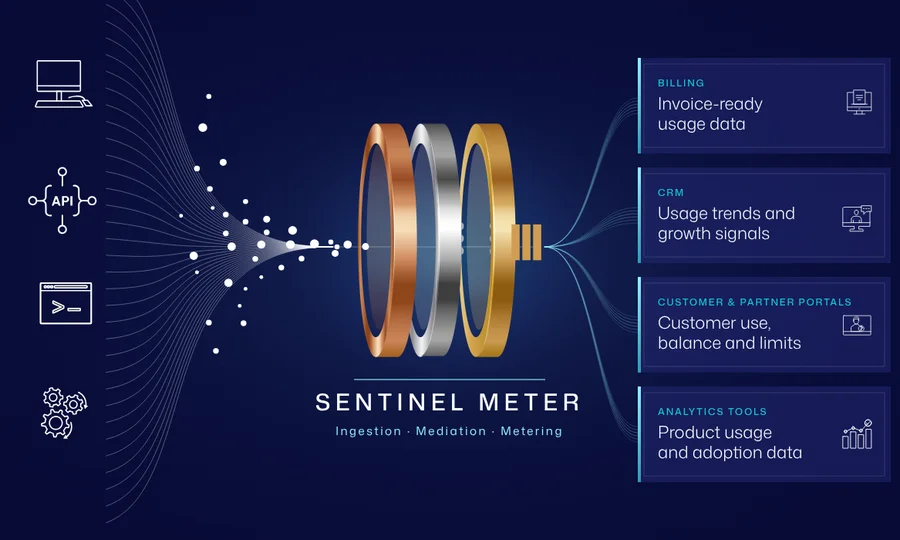
Sentinel Meter and entitlement management close that gap by capturing usage, cleaning it, and metering it against the plan. Then it hands billing-ready records to the systems already in place.
Traditional software business models have long depended on a relatively stable relationship between access and economic value. Vendors typically charged according to the number of people, devices, or installations authorized to use a product. As access expanded, customer value and vendor revenue generally grew with it. Perpetual, named-user, and seat-based subscription models all reflect some version of this logic.
AI changes that relationship.
One person can use an AI feature to complete work that once required several people. A single account can generate thousands of model interactions. An AI agent can keep working with little direct input from a user. The number of licensed users may stay flat even as the customer receives more value and your delivery costs rise sharply.
AI is also changing what customers expect to pay for. As software takes on more of the work, buyers increasingly expect pricing to reflect the value or activity they receive rather than simply the number of people with access.
That creates a basic commercial problem: you may be charging for access while paying for activity. The gap may be small during an early release. As customers adopt the feature and use it more often, it can weaken margins and leave a growing share of product value outside the commercial model.
Vendors can see the problem coming. According to IDC research, more than 60% of vendors have already integrated AI into their offerings, and more than 76% report that AI is driving the consideration of new pricing models.
60 %+
of vendors have already integrated AI into their offerings
76 %+
report AI is driving consideration of new pricing models
Source: IDC research
AI separates software access from cost and customer value
A software license has always represented a defined right. A perpetual license grants access to a product or version. A subscription grants access for a set period. A named-user license connects that access to a person. Capacity and concurrent models place limits on resources or simultaneous use.
The commercial model works as long as that right retains a clear relationship to what the customer receives and what you must provide. AI weakens that relationship in several ways.
- Every AI interaction can add cost. Inference, data processing, and retrieval consume resources with every run. Public cloud AI services charge for tokens, requests, or provisioned capacity, making consumption a variable cost.
- Human users can get more value from the same seat. AI allows a person to accomplish more without adding users or licenses. The customer receives more value from the same number of seats, while vendor revenue may stay flat.
- AI agents can consume without adding human users. AI agents take this a step further. One employee can initiate several agents, each making calls and consuming resources as it completes work. The number of licensed users may remain unchanged even as product activity, customer value, and delivery costs increase.
The Usage Monetization Era
The Business Model for the AI Revolution
Consumption-based pricing is on every software vendor’s radar today.
Find out how to implement the right infrastructure without disrupting your tech stack. Read this new white paper, Usage Monetization Era: The Business Model for the AI Revolution.
The commercial response
Choose a metric that reflects value
The commercial response starts with choosing a metric that reflects how customers receive value and how the product is actually consumed.
That sounds simple, but the choice has consequences. A metric that closely tracks infrastructure cost may be easy for the vendor to measure and difficult for the customer to understand. A metric tied to a business outcome may feel more intuitive to the buyer, but it can be harder to define, attribute, and audit. The strongest model has to work commercially and operationally.
Vendors should evaluate potential metrics against a few practical questions. Can usage be measured accurately across the environments where the product runs? Can the customer understand and predict what drives consumption? Does the metric give the vendor enough control over variable delivery costs? Can the resulting usage be connected cleanly to entitlements, billing, and customer-facing reporting?
Structure pricing around customer needs
The payment structure matters just as much. Pay-as-you-go gives customers flexibility, while commitments and prepaid credits can provide greater budget and revenue predictability. Included allowances can make adoption easier, while overage creates room for revenue to grow with consumption. Each approach changes how risk is divided between the vendor and the customer.
Support different environments and evolving business models
The delivery model of software, and the accessibility by the software vendor during use of the product, also plays an important role. Deployments in disconnected, or at least occasionally offline environments, can require usage to be controlled and limited locally. In Healthcare, Energy, Automation, Government and other regulated or sensitive verticals, this is a key consideration.
Visibility becomes part of the commercial model too. Customers need to know how much they have consumed, what remains in their allowance or balance, and what will happen when they reach a threshold. Vendors need the same visibility to control costs, enforce commercial terms, and recognize when growing usage signals a need for a different plan.
There is also no reason to assume the first model will be the last or the only model in use at the same time. AI products, usage patterns, and customer expectations are still changing. Commercial terms need enough flexibility to support new metrics, allowances, tiers, credits, and overage rules without forcing the business to redesign the product or revenue stack every time pricing evolves.
Seat based + usage based: Most portfolios will require more than one model
Most software portfolios will need a mix of commercial models.
Not all products within a suite create value in the same way. One product or offer may still fit a seat-based model, another may be sold through a perpetual or term license. Usage-based pricing might be reserved for AI or consumption-heavy products. The commercial infrastructure therefore needs to support several models across the portfolio, rather than treating usage-based pricing as a separate, stand-alone motion.
The mix can also happen inside a single offer. A base subscription might include a number of seats with a defined AI allowance, with overage above it. Higher tiers can include more usage or access to premium capabilities. Credits can provide a common commercial unit across several types of activity. A separately licensed AI module may work when the feature has a distinct buyer or use case.
Different customer segments may need different structures as well. Smaller customers may prefer pay-as-you-go flexibility. Larger enterprises may want committed usage, prepaid credits, or fixed allowances that make spend easier to budget.
Outcome-based pricing will fit a narrower set of products. It requires a result that both sides can define, measure, and attribute with enough confidence to support billing.
For many vendors, the result will be several models operating at once across products, customer segments, and offers. That increases the need for a monetization approach that can support different metrics and commercial rules without creating a separate operating process for every model.
Implementation: Making usage-based pricing work in practice
A usage-based model works when the business can reliably follow consumption from the moment it happens to the moment it becomes a billable record.
That is harder than it sounds. Usage may be generated across SaaS products, APIs, devices, customer-hosted software, offline deployments, and third-party services. Those systems do not necessarily produce data in the same format, with the same customer context, or at the same level of quality.
At the other end of the process, finance needs a clean record it can trust. The product needs to know whether the customer is still within their purchased limits. Customers need enough visibility to understand what they are consuming before an unexpected charge appears.
The work between those points is what turns product activity into commercial usage.
1. BRONZE: Capture usage wherever it happens
Everything starts with the raw record of what the customer did.
That might be an API call, an AI inference, a transaction, a device event, a feature invocation, or usage reported by a third-party service. For a vendor with several products and deployment models, those records may originate from dozens of different systems.
The first challenge is therefore coverage. If a billable event never enters the usage process, it cannot be measured, controlled, or billed later.
Ingestion brings those records together from the vendor’s own products and from external sources, across cloud, on-premises, connected, and offline environments. The aim is to capture usage without forcing every product team to redesign its telemetry simply to support a new commercial model.
At this point the data is Bronze. It tells you that activity occurred, but it is still raw.
2. SILVER: Make the usage trustworthy
Raw telemetry is almost never ready to drive usage-based billing.
Two systems may describe the same event differently. Records may be duplicated. A usage event may lack the customer identifier needed to know which plan applies. Some events may be invalid and should never reach billing.
This is where mediation comes in.
Mediation validates the incoming records, removes duplicates, standardizes fields and units, and adds the context needed to understand the event commercially. That includes connecting usage to the correct customer and entitlement.
The data has now moved from raw product activity to Silver: clean, contextualized usage that the business can trust.
This step matters because every decision downstream depends on it. A bad record can become a bad usage total, an incorrect overage, or a billing dispute.
3. GOLD: Measure usage against what the customer bought
Clean data still needs commercial meaning.
Metering takes the Silver usage records and applies the rules of the offer. Depending on the business model, that might mean counting API calls, measuring compute, deducting credits, tracking transactions, or measuring another agreed unit.
The meter then compares that consumption with the customer’s commercial terms. How much have they purchased? What is included? When does the allowance reset? Is there an overage provision? Which entitlement applies?
At this point, the usage becomes Gold: consumption measured according to the customer’s plan and ready to drive business action.
The distinction is important. A product can generate millions of telemetry records without the business knowing what those records mean commercially. Gold data answers that question.
4. Enforce the agreement while usage is happening
Once consumption is measured against the customer’s purchased rights, the vendor can decide what should happen when a threshold is reached.
That decision depends on the agreement. The customer might receive a warning as they approach their limit. Usage might be capped once the allowance is exhausted. Or the product may continue operating while the additional consumption becomes billable overage.
This connects the commercial model back to the product at runtime.
Without that connection, a vendor may know that a customer exceeded its commitment only after the billing period closes. By then, the cost has already been incurred, and the customer see the overage for the first time, getting an unpleasant surprise.
Runtime enforcement gives both sides a chance to act earlier.
5. Send billing-ready usage data into the systems you already use
Once usage has been captured, cleaned, measured, and associated with the correct commercial terms, it can move into the systems that run the business.
The billing platform receives clean, itemized usage records and can apply rating and invoicing logic. The vendor does not need to rebuild the billing system simply to support a new source of consumption data.
Once that flow is in place, the next question is architectural: how do you add these capabilities without forcing finance to replace the billing systems and revenue processes that already work?
Add usage models without rebuilding billing
For many vendors, the biggest obstacle is not choosing a usage-based model. It is finding a practical way to run it across products, deployment environments, and existing financial systems.
Usage may come from your own applications, third-party services, APIs, connected devices, on-premises software, or offline deployments. That data has to be captured, cleaned, connected to the right customer and entitlement, and measured against the commercial terms before it is ready for billing.
This is where Sentinel Meter enters the picture.
Sentinel Meter collects records from your products and third-party sources across cloud services and on-premises deployments, without requiring product telemetry re-engineering.
The data is then validated, reconciled, deduplicated, standardized, and enriched with customer and entitlement context. Metering applies the customer’s commercial rules and can trigger the right action when a threshold is reached: warn, cap, or allow and bill.
If your billing system was not built for usage-based models, you do not have to replace it. Sentinel handles the usage processing upstream, then sends clean, metered records into your existing billing environment.
Once that usage record exists, it can support more than the invoice. Product teams can see which capabilities customers actually use. Sales and Customer Success can see expansion signals or emerging renewal risk. Customers can see their own consumption before the billing period closes.
Pricing an AI feature still requires customer research, cost analysis, and commercial judgment. Execution depends on whether the business can capture the usage, apply the purchased rights, and produce records the rest of the organization can trust.
Contact us to learn how Sentinel can help you introduce usage-based and hybrid pricing models across your software portfolio, while working with your existing billing systems.