Proudly Partnering With...
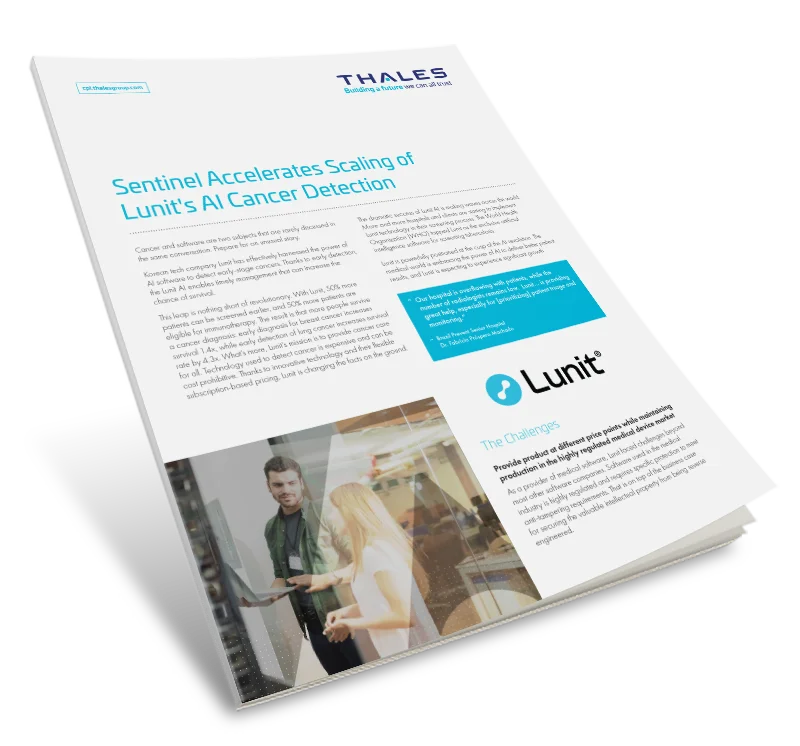

Lunit, an AI company based in Korea, builds medical imaging software that helps detect cancer earlier to increase survival rates. Since medical diagnostics technology can be cost prohibitive, Lunit pairs its AI with flexible, subscription-based pricing to help more medical providers adopt the technology without paying for capabilities they don’t need. Due to their successful subscription model, Lunit has grown globally, with hospitals and other medical institutions incorporating its software into their screening workflows.
As the infrastructure for scaling their software business, Lunit chose the Sentinel Software Monetization platform for its licensing, protection, and entitlement management capabilities. This case study examines Lunit’s software licensing needs and challenges before implementing Thales Sentinel, and consequent results after.
Lunit required a software licensing and monetization platform with strong security that was easy for teams to operate. Before choosing Sentinel, they faced the following challenges:
Lunit made an early decision to implement a software monetization platform from the start—before scaling issues forced a reactive fix. The company selected Thales Software Monetization’s Sentinel Platform to scale its business with the platform’s licensing, entitlement management, delivery, and protection capabilities.
Sentinel’s licensing and entitlement provisioning addressed demands created by varied deployment models (device-embedded use cases and multiple cloud environments). It also enabled Lunit to control product functionality and feature access through distributed software licenses, supporting multiple packages without constant re-engineering of the core application.
Lunit’s leadership also emphasizes that professional license management allows their engineers to stay focused on core technology rather than developing a homegrown licensing system. This way, the business maintains continuous protection and entitlement control, code-free.
Lunit deployed Sentinel's Licensing Delivery Kit (Sentinel LDK) to meet their needs as follows:
a. Security and compliance. Sentinel supports strong encryption and hacking prevention that both help meet regulatory needs. For Lunit, tamper-resistant software is critical for both compliance and responsible clinical use.
b. Business agility. Sentinel helps Lunit introduce new products and package features quickly without major additional engineering. That makes it easier to offer bundles aligned to medical diagnostic needs, and budget constraints.
c. Secure, free trials. Lunit uses Sentinel to offer customers an accessible free trial while maintaining highly secure, tamper-proof licensing—important when prospects need hands-on experience, but the software still must be protected.
d. Future proof for automation at scale. After Lunit went public, sales growth put pressure on systems and operations. They therefore plan to automate licensing and provisioning and connect licenses to CRM/ERP systems using Sentinel Connect. As partner ecosystems expand globally, Lunit also plans a partner portal to automate partner-issued licenses, streamline processes, and reduce manual errors—making adoption easier for end customers and partners worldwide.
e. Usage insights across direct and partner channels. Sentinel also enables Lunit to monitor and analyze usage data whether the software is distributed directly or via partners, helping Lunit manage and optimize the business as it scales.