Proudly Partnering With...


Software licensing and protection is a combination of technologies that ensures software is used legitimately and software IP and code is protected. The result of robust protection and licensing is that you can maintain the integrity and profitability of software products, even in the age of AI assisted vulnerability detection.
Software protection and licensing is about pairing security measures with business rules.
Together, these form a software protection and licensing system: a combination of technology and process that ensures software is used legitimately, protects IP, and gives businesses flexibility to adapt pricing and packaging strategies.
Get the practical guide to software licensing the first time with comprehensive strategies that consider people, processes, and technology.
Software vendors have long faced threats to their revenue. Piracy, unauthorized copying, and license overuse cost companies billions of dollars every year. Those risks haven't gone away.
What's changed is what else that same binary is now exposed to. AI-assisted tools can analyze shipped software and expose exploitable vulnerabilities, not just bypass license checks. For vendors shipping software on-premises, in embedded devices, or via downloads, the binary sitting in the field now needs to defend against both commercial abuse and security exploitation.
The stakes are high. Without robust software protection and licensing, companies risk not only revenue leakage and IP loss, but also the exposure of vulnerabilities that attackers can weaponize for ransomware, data theft, and infrastructure compromise.
When protection and licensing flexibility work together, the business outcome is the ability to monetize software more systematically. Thales' Sentinel Platform brings both aspects into a single monetization ecosystem—providing engineers with protection utilities and business teams with entitlement management so that companies can protect their existing revenue and unlock their next stages of growth.
Software license in cybersecurity plays three key roles:
For business leaders, this makes licensing a strategic layer of cybersecurity—as critical as firewalls or identity management systems.
A complete software licensing system bridges two domains: engineering and business. On the engineering side, developers protect the software and build in license checks. On the business side, product and operations teams decide what each customer can access based on what they purchased, and manage those permissions over time. The license key connects these two domains. It is the enforcement artifact that software uses to enforce access rights.
Developers use tools to protect the code and integrate license checks. These include:
Protection layers like control flow obfuscation, anti-debugging, anti-tampering, and binary encryption also defend against AI-assisted reverse engineering. These mechanisms systematically breaking the workflows automated tools and traditional hackers rely on to recover application logic and locate vulnerabilities.
Product and operations teams manage entitlements and customer activations. They rely on:
To bring these two perspectives together—engineering protection and business entitlement management—you need a unifying enforcement mechanism. That mechanism is the license key.
While the system defines how software is packaged, distributed, and updated, it is the license key that makes those decisions real inside the product.
Every protection check and every entitlement rule ultimately points back to the presence and validity of a key. This is why the design of license keys, and the way they are delivered, becomes the practical foundation for all licensing strategies. A license key is the enforcement artifact that software uses to enforce access rights.
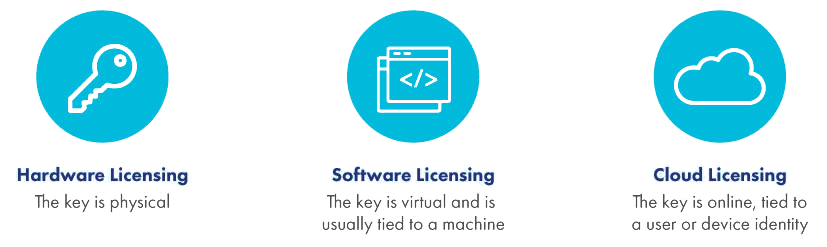
The way keys are delivered and managed creates three main licensing models: hardware-based, software-based, and cloud-based licensing.
The Logical Flow
Across all three models, the license key is what the software checks to enforce rules like trial periods, seat counts, or feature access. The differences lie in where the key lives (USB, local machine, or cloud) and the trade-offs between security, convenience, and flexibility.
Definition
A license key stored on a physical USB device (dongle). The software checks the dongle at runtime; if it’s present and valid, the program runs. The dongle itself holds license data and often cryptographic functions, making it the root of trust.
Advantages
Limitations
Definition
A license key stored virtually on a specific computer or device. The software checks entitlements stored on the local key whenever it runs. The key is bound to that device, making the machine itself the enforcement anchor.
Advantages
Limitations
Definition
A license key stored in the cloud. The user logs in (user-based licensing) or a device presents a digital identity string (device-based licensing). The software checks entitlements against the cloud license server, which grants or denies access.
Advantages
Limitations
Successful software protection and licensing requires careful attention to strategic factors that extend beyond immediate technical implementation.
Building exceptional software is only the beginning. The real test comes when you need to shield your innovations from attack while delivering frictionless access to legitimate users.
Thales Sentinel addresses both sides of that challenge through a complete platform built around two complementary layers.
Sentinel Envelope is the protection layer. It hardens your application against reverse engineering, tampering, and runtime inspection — without touching your source code. Through control flow obfuscation, anti-debugging, anti-tampering, and binary encryption, Envelope systematically breaks the workflows that attackers and AI-assisted tools rely on to recover application logic and locate vulnerabilities. Whether your software runs on-premises, in embedded devices, or via customer-controlled environments, Envelope ensures that even if an attacker accesses the binary, they cannot easily analyze what's inside it. The broader Sentinel platform is the monetization and licensing layer. It gives engineering and business teams the tools to define, enforce, and manage exactly how software is accessed and used. Hardware, software, and cloud-based licensing models support everything from individual seat licenses to usage-based and subscription pricing. Entitlement management ensures customers get access to precisely what they purchased — and that those rights can be updated, expanded, or revoked as the relationship evolves.
Together, these layers form a complete software monetization ecosystem: Envelope protects the binary, and the platform controls who uses it, how, and on what terms.
With over 30 years of experience, Thales has powered the revenue growth of some of the world's most successful software-driven businesses across healthcare, industrial automation, networking, and AI. Contact a specialist today for a personalized assessment of how Sentinel can help you protect your software, your customers, and your business.
Contact a specialist today for a personalized assessment of how Sentinel can help you protect your software, your customers, and your business.